Your Human Design chart contains two distinctly different aspects: your soul purpose and your life purpose. Your soul’s purpose relates to growth and expansion. Our souls manifest on Earth to experience whatever they need to experience to add growth to the Universe.
Your life purpose is the story of who you are in this incarnation—this life. This story is encoded in your energy blueprint and genetic and epigenetic lineage. At the moment of your birth, your soul purpose integrates with your life purpose to create the once-in-a-lifetime event that is you!
In our lives, we often experience a struggle or challenges between the aspects of our soul purpose and our life purpose. These inner struggles are often “pre-scripted” into the story of life. Many people find that when they understand their Human Design, they gain a deeper understanding of their inner struggles. This awareness helps them gain new levels of self-mastery to fulfill their potential in a richer, more meaningful way.
The Human Design chart, also called a BodyGraph, is a visual representation of the sum of human possibilities and energies. The entire archetype of humanity is contained within the structural framework of this chart. All the possibilities for the expression of being human appear here. The BodyGraph shows us the different ways we love, lead, follow, learn, know, grow, and so much more!
Your unique chart says all these things about you and illustrates your best strategy for practical things like making money, having great relationships, being healthy, and staying creatively fulfilled. It helps you understand how you work and how to best make your life work for you.
Following is a sample BodyGraph chart. Your chart may look different depending on the tool used to generate the chart and your unique expression represented within the chart. If you haven’t downloaded your chart yet, I encourage you to do that now here.
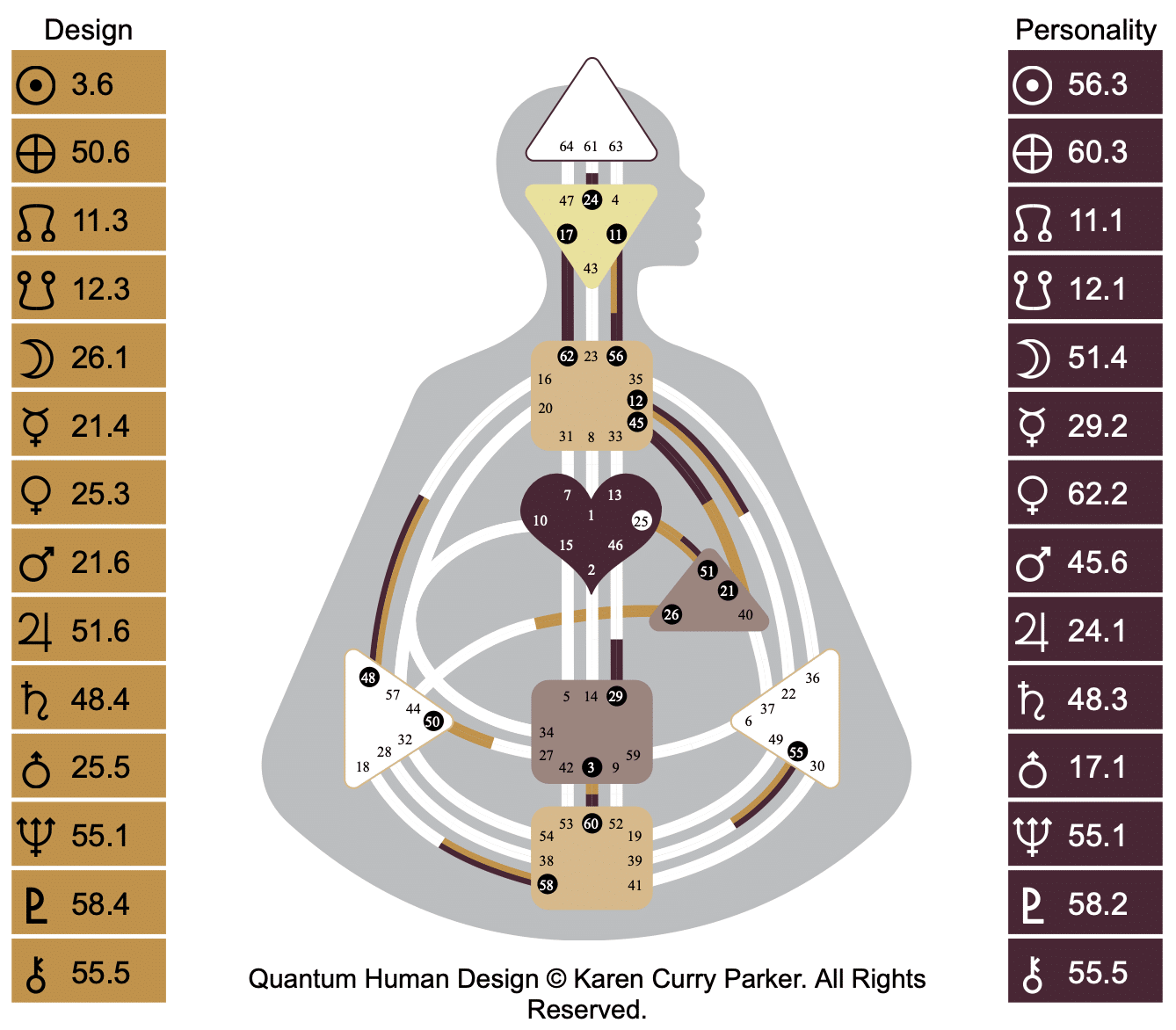
Each chart, calculated using your birthday, birth time, and birthplace, is essentially a map of how you process energy. It reveals your strengths and potential weaknesses, in addition to your gifts and talents. Most importantly, the chart tells the story of who you are, why you are here, and how you can live a life that’s true to you.
The story of your chart is the synthesis of everything found within it. In the following chapters, you will learn how all the different parts of your chart work together to give you a richer understanding of your place and purpose. Each chart story is unique, rich, complex, and involves a lot of data. The Human Design system combines astrology, the Chinese I’Ching, the Hindu Chakra system, the Judaic Kabbalah Tree of Life, and quantum physics.
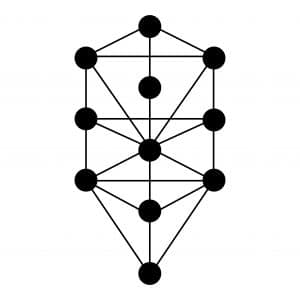
If you study your chart closely, you might find some visual evidence of Human Design’s influences. For example, the Channels that connect the Centers (the geometric shapes on the chart) are derived from the Judaic Kabbalah Tree of Life.
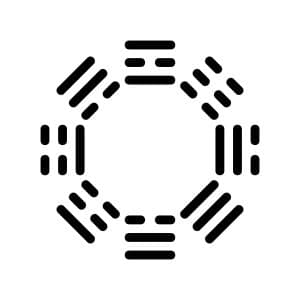
You might notice that sixty-four numbers appear on the Human Design chart. These numbers, called Gates, correlate with the sixty-four hexagrams from the Chinese I’Ching.
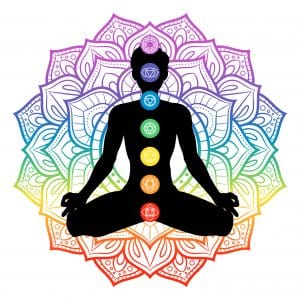
In addition, there are nine geometric shapes, known as Centers, on different parts of the body. These are similar to the seven energy centers of the Hindu Chakra system.
Although you can see pieces of these ancient wisdom teachings within the chart, Human Design is something fairly new and unique. It’s a brand-new tool created to help people in a brand-new way. (For more information on this, please refer to my book Understanding Human Design.)
Assembling all this information is key to understanding Human Design as well as each individual chart. At its root, Human Design is a tool that teaches us about the power and possibility of evolution in humanity. Knowledge can be found on personal, relationship, and collective levels. Human Design’s real beauty lies in unifying all its unique esoteric components.
The actual chart itself is also a synthesis of several parts, which combine to provide an overview of each individual. To see a chart’s big picture and make learning about Human Design easier, we must begin by taking the chart apart, piece by piece.
Breaking Down Your Human Design Chart
Let’s break down the chart into its individual components so that you can begin to understand how these different pieces fit together. This chapter aims to give you a broad overview of the parts of your Human Design chart so that you know where to find the information you’ll need for the rest of the book. The following chapters go into much greater detail, so think of this as an overview of the chart. You’ll dive in deeper as you work through the workbook.
Some of the individual chart pieces have energies that are similar but are actually different on a subtle level. Please understand that we are taking pieces of the chart out of context as you learn about each part. While every piece is important, the full expression of each one depends on what other elements are present in your unique chart.
Understanding yourself and the intricate subtleties of your chart is a beautiful and worthwhile process—and one that you could spend countless hours exploring, truly. To give you a short introduction to the essential parts of your chart, I’m only going to cover some essential aspects of the Human Design Chart.
This will give you a solid basic understanding of your chart—enough to give you a good sense of what the parts of your chart refer to and help to discover where you want to learn more!
The Five Energy Types
When you look at the chart story/overview, you will note that your Type is the first thing listed. The Human Design system consists of five energy Types, and each Type has a specific Strategy for making powerful decisions. Each Type plays a different role when interacting with others and the world.
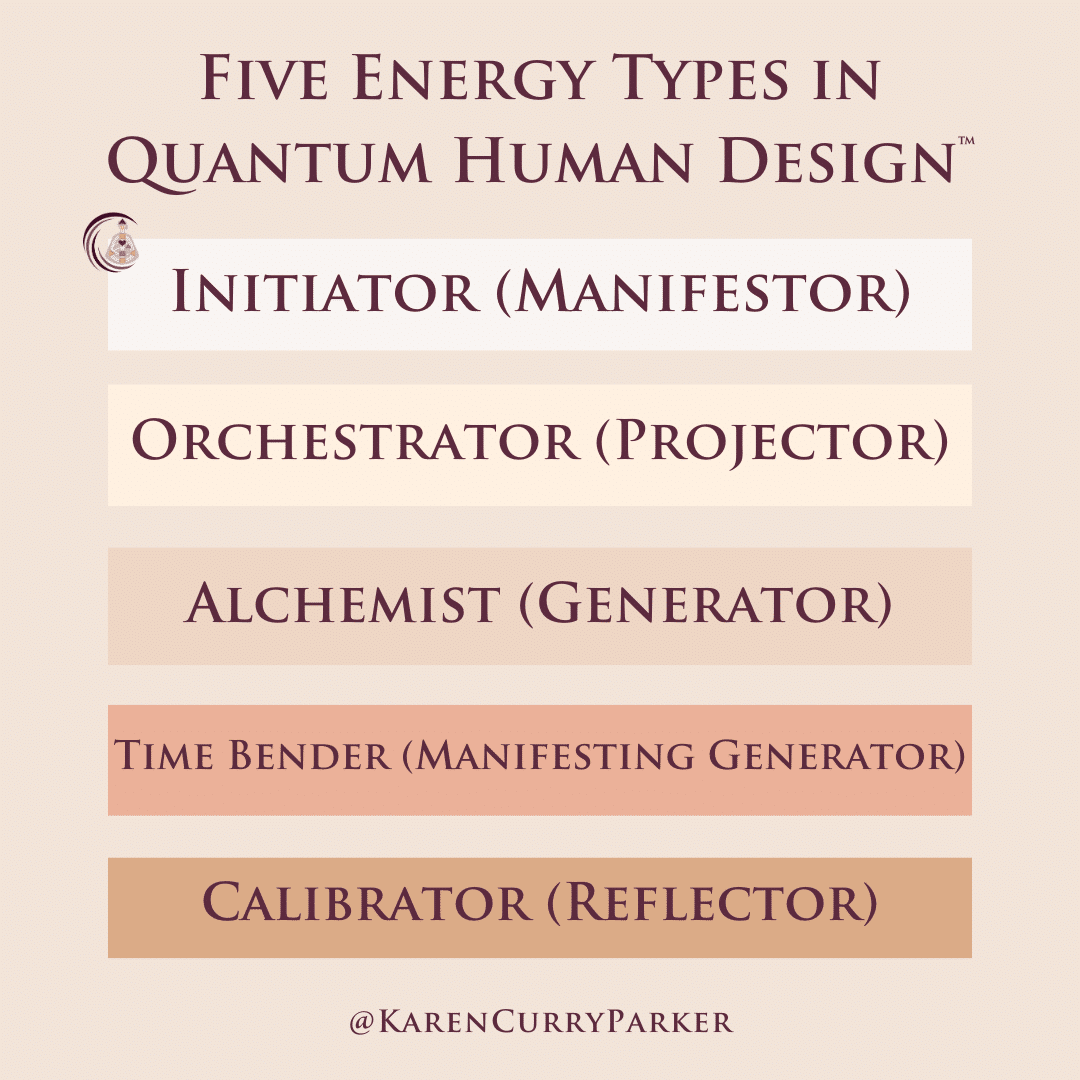
The easiest way to begin benefiting from these Human Design concepts is to figure out your Type and follow the Strategy for that specific Type. Each of the five personality Types has a unique Strategy for making decisions. Knowing your specific Type can help you develop confidence and trust in your capacity to make reliable decisions for yourself.
Here are the five Types:
- Initiator/Manifestor
- Alchemist/Generator
- Time Bender/Manifesting Generator
- Orchestrator/Projector
- Calibrator/Reflector
Strategies
Every Type has a unique way of making personal decisions and taking action in the world. This is known as a Strategy. Your Strategy stems from your specific Type and is perhaps the most important bit of knowledge given to you by your Human Design chart. I say this because your Strategy provides you with key information about how to best operate in the world, including how to make the right choices for yourself and recognize when you are on the right path in life.
Following your Strategy increases your chances of fulfilling your life purpose and experiencing events and circumstances that help you accomplish this on your path. Not following the Strategy for your Type can create further roadblocks and slow your progress toward fulfilling your life’s goals.
Given the importance of Strategy, you can be sure we will cover it in more detail in future posts. But for now, I want you to remember this: by following your Strategy, you will more naturally align with your life purpose; minimize resistance in your life; make strong, healthy decisions that will help you feel good; imbue your life with meaning, and bring more joy to your everyday adventures.
The Twelve Profiles
Twelve different personality Profiles, which are illustrated below, can be found within the Human Design system. Notice that the Profile names below have interchangeable names, which are commonly used in Human Design.
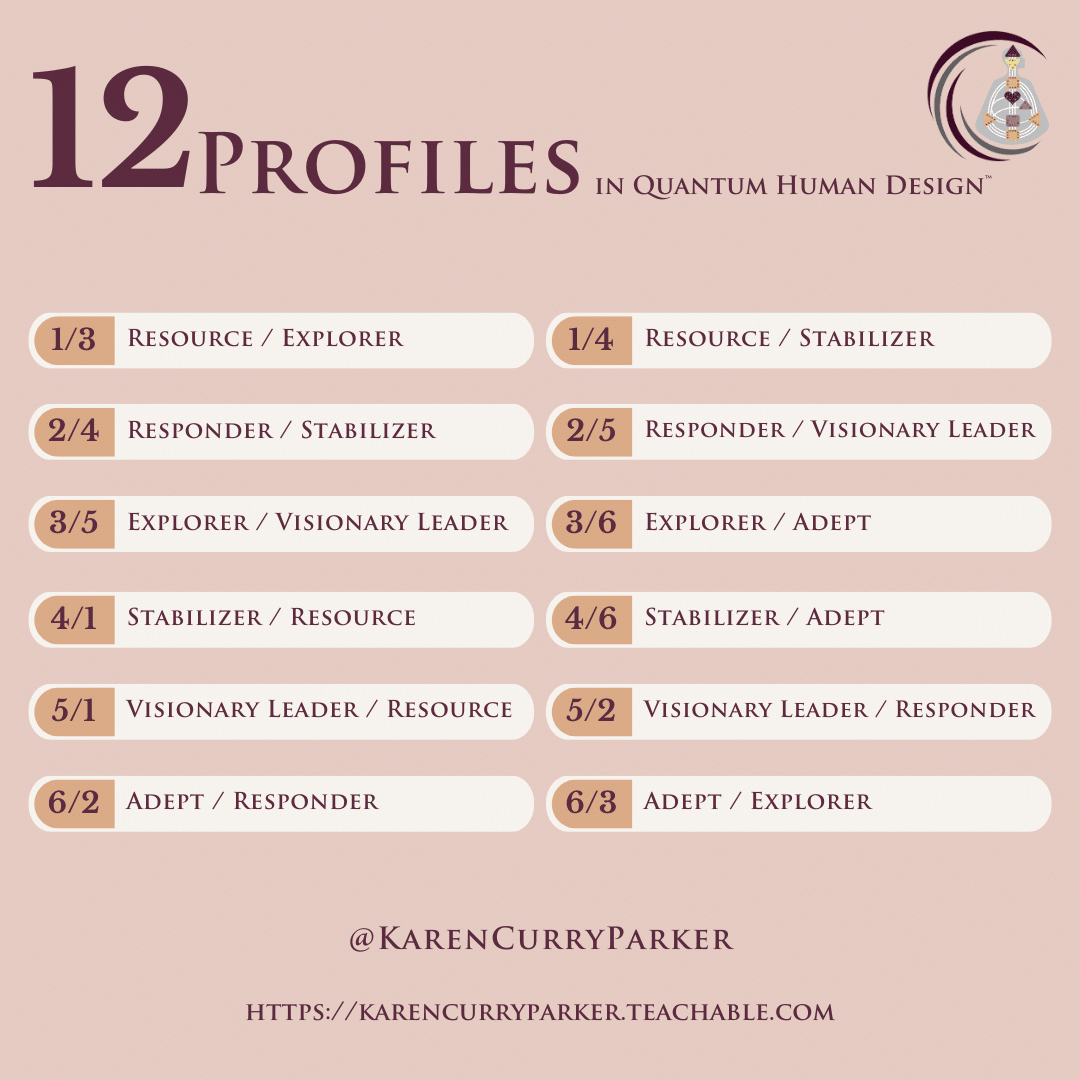
Everyone comes into the world with a specific Profile and purpose. The twelve Profiles describe the major life themes you will encounter, and they illustrate another way your personality interacts with the world. Knowing your Profile can help you recognize some of these major life themes as you move toward fulfilling your life purpose.
Each number found in a Profile has a specific meaning. The first number in your Profile is the element of your personality that you are consciously aware of. The second number in the Profile may be unconscious and more hidden from you.
Your Profile can be thought of as an explanation of your conscious and unconscious archetype and the themes associated with that archetype. Some people are aware of their unconscious Profile, but because it is unconscious, they do not have much control over its expression.
The Six Profile Lines
Following are some basic definitions for each of the six Profile lines.
Line 1: The Resource/The Investigator
The Investigator needs information and feels safe when they have sufficient data. (The internet was created for Line 1 Profiles.)
Line 2: The Responder/The Hermit
Line 2 Profiles need alone time to integrate experiences and reset their energy. The Hermit needs space to feel good and grounded. There is a certain magic to having a Line 2 in your Profile. Once you have taken time away, it’s almost as if other people energetically perceive that you are ready to be invited out to do things and be a part of the community again. Your friends and family always seem to find you when you hide and will call you back out into life.
Line 3: The Explorer/The Experiential Learner
The Experiential Learner must experiment with their ideas and be allowed to make mistakes without judgment. There’s no getting it wrong for the Line 3 Profiles, only figuring out what works based on their understanding of what doesn’t work.
Line 4: The Stabilizer/The Opportunist
The Opportunist builds a foundation of friendships and needs to network and share. Line 4 Profiles need people to accept them for who they are; they need to know what’s next and be prepared to feel safe. (Line 4 Profiles don’t handle being in limbo well.)
Line 5: The Visionary Leader/The Teacher
The Teacher is here to teach whatever they’ve experienced in life. They are considered karmic mirrors and are often subject to the projections of others. Through relationships with Line 5 Profiles, others discover what they need to heal the most within themselves. Line 5 Profiles need to trust that you will see the truth about them to feel safe, and they sometimes hide their truth very deep when you first get to know them.
Line 6: The Adept/The Role Model
The Role Model literally models for others what they are here to share and give the world. Line 6 Profiles need to “walk their talk.” They travel through three distinct life phases: The first phase (birth until age thirty) is a youthful phase of experimentation and experiential learning. The second phase (ages thirty to fifty) is a long cycle of healing, growth, and studying. The final phase (over fifty) is a cycle of living what they’ve learned. Line 6 Profiles need to feel that what they are participating in is worth their effort to find meaning and energy in life.
The twelve Profiles are various combinations of two of each of these lines: Each Profile is a combination of a conscious line followed by an unconscious line. Both your profile lines are essential parts of who you are and how you experience the world.
The Nine Energy Centers
The first thing you’ll notice when you study your chart is that it contains nine geometric shapes. These shapes are called the Centers. Each Center carries and manages a certain frequency of energy and relates to specific themes in our lives.
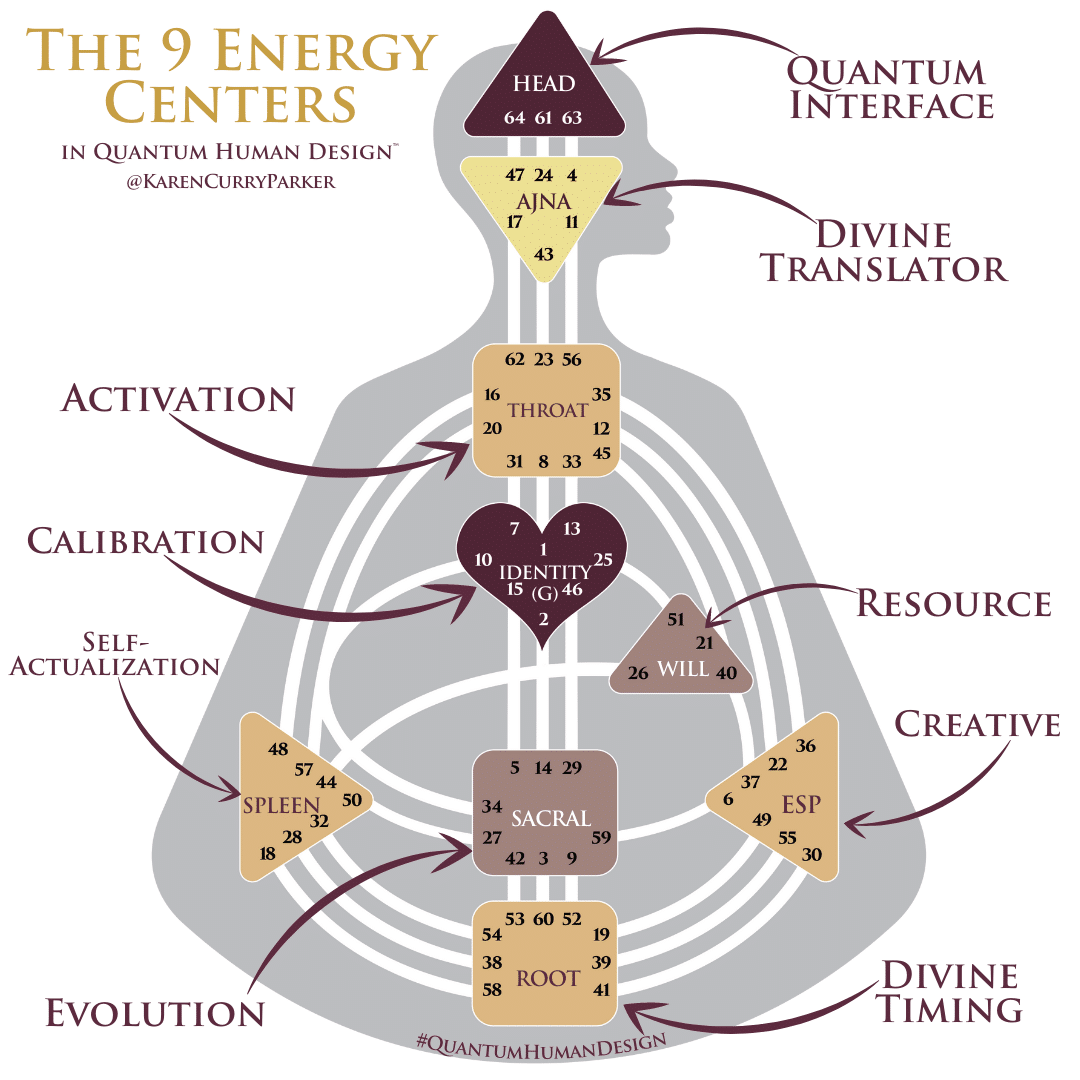
As you can see, these are the nine Centers:
- Quantum Interface/Head
- Divine Translator/Ajna
- Activation/Throat
- Calibration/Identity (G)
- Resource/Will
- Self-Actualization/Spleen
- Evolution/Sacral
- Creative/ESP (Emotional Solar Plexus)
- Divine Timing/Root
If a Center is colored, it is a defined Center. A defined Center has a consistent way of operating and is part of who you are—it’s the energy you radiate out into the world, consistent and truthful all the time. It operates the same way both energetically and thematically. It could be raining, Mercury could be in retrograde, Mars could disappear from the solar system, and your personality aspects would stay the same.
If a Center is white, it is undefined or open. Open Centers are where we take in energy and information from the world around us and from other people. Undefined areas represent the inconsistent aspects of your personality. It’s in these open Centers that we have the potential to experience great wisdom but also pain and confusion. Not only do we absorb energies in our open Centers, but we also amplify them. Because we feel these energies so profoundly and intensely, it’s easy to get overwhelmed.
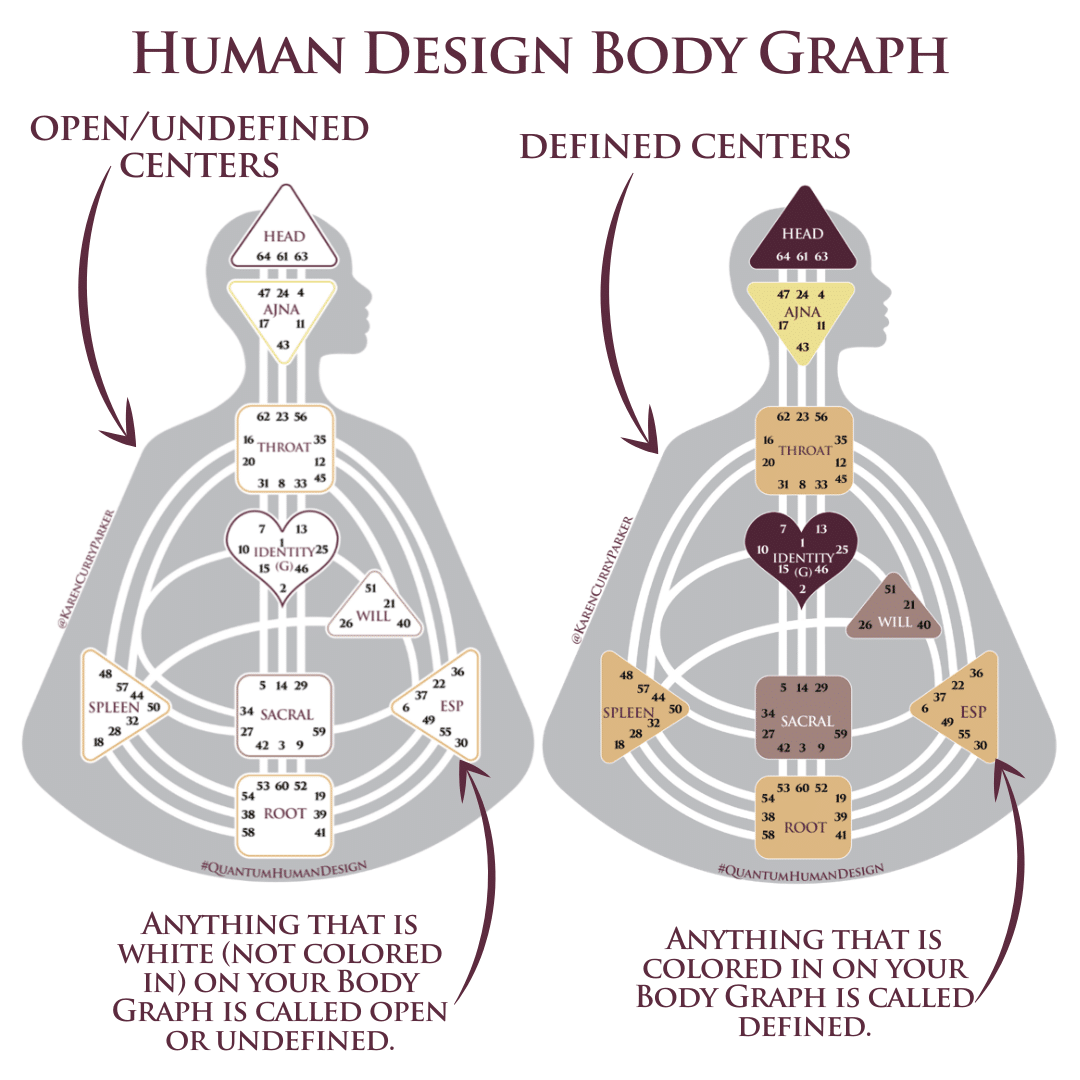
For example, suppose you have an undefined emotional solar plexus (the triangle on the lower right side of the BodyGraph). In that case, you absorb other people’s emotions and feel them more intensely than the person who actually generated those feelings. Emotionally undefined individuals are empathic. This empathy can become a great source of wisdom with awareness. (Any Center where you are undefined is potentially a great source of wisdom.)
Let me give you another example. I have an undefined emotional solar plexus. I hate going to movies because I bawl my eyes out every time. When I watched the movie Spirit: Stallion of the Cimarron (an animated movie about a horse), I cried so hard that my then nine-year-old daughter moved to another seat in the theater because she was so embarrassed. Honestly, it wasn’t even that sad a movie. What I now understand is that my open emotional system was absorbing all the emotional energy in the theater and amplifying it. I was crying tears for everyone in the audience.
While not helpful when watching a movie, my undefined solar plexus is a critical part of my life. In my coaching practice, this aspect of being emotionally undefined is a great asset for understanding my clients’ feelings. When I am assessing their emotional status, I know what they are feeling because I’m feeling it too!
When I worked as a nurse, my undefined solar plexus was overwhelming and exhausting because I didn’t understand my Human Design. I burned out very quickly, soaking up all that emotional intensity. Now, I use my emotional solar plexus as a screen, allowing all my environment’s emotional information to pass through me. I don’t hold on to it, and I don’t become overwhelmed by it and burn out.
Emotionally undefined children are sometimes labeled as “dramatic.” Yet, what they are simply doing is absorbing all the emotional energy from those around them and acting it out. I often see emotionally undefined children labeled as “disturbed” when they are, in fact, acting out the emotional health of their family or even the emotional drama present in their parent’s marriage.
The beauty in the defined and undefined Centers lies in the fact that individually we are all puzzle pieces—parts of a greater whole. We become completely defined when we are together. We each bring pieces that energetically unify us all and offer us the opportunity to express all the human experience. You might sense this when you go to a restaurant or a coffee shop. The customer’s and staff’s designs blend together to create a collective aura.
Your definition comes from the position of the Gates and the planets at the moment of your birth. Wherever you have open energy in your chart, you take it in from the collective aura of others. Your energy and your definition (colored-in parts of your chart) interact with other people’s energy and definition. You experience other people’s energies wherever you have openness (white) in your Human Design chart.
The Numbers and Planets on the Human Design Chart
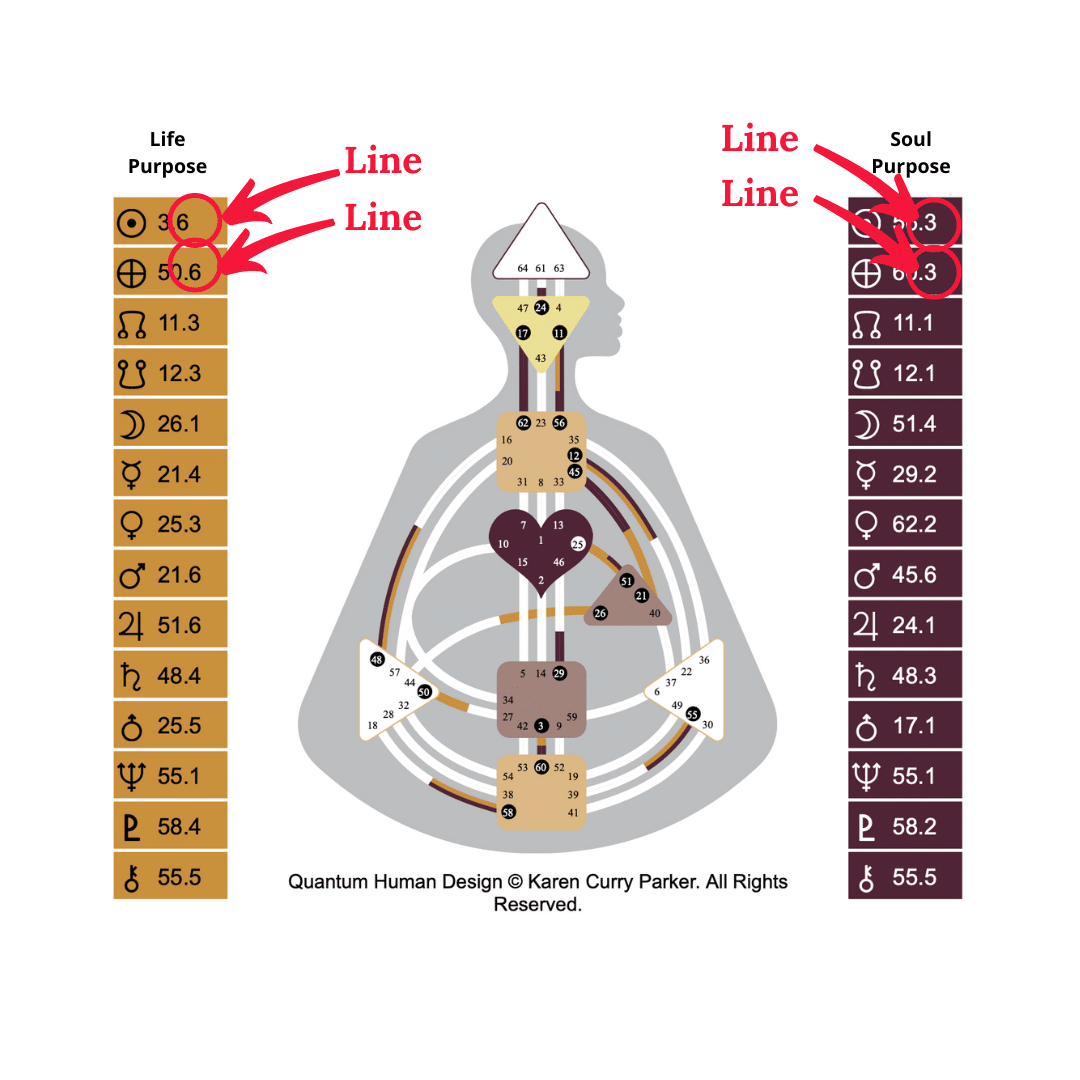
On the chart’s left side, or flanking either side (depending on your Human Design chart), you will find a series of red and black numbers in addition to planetary symbols.
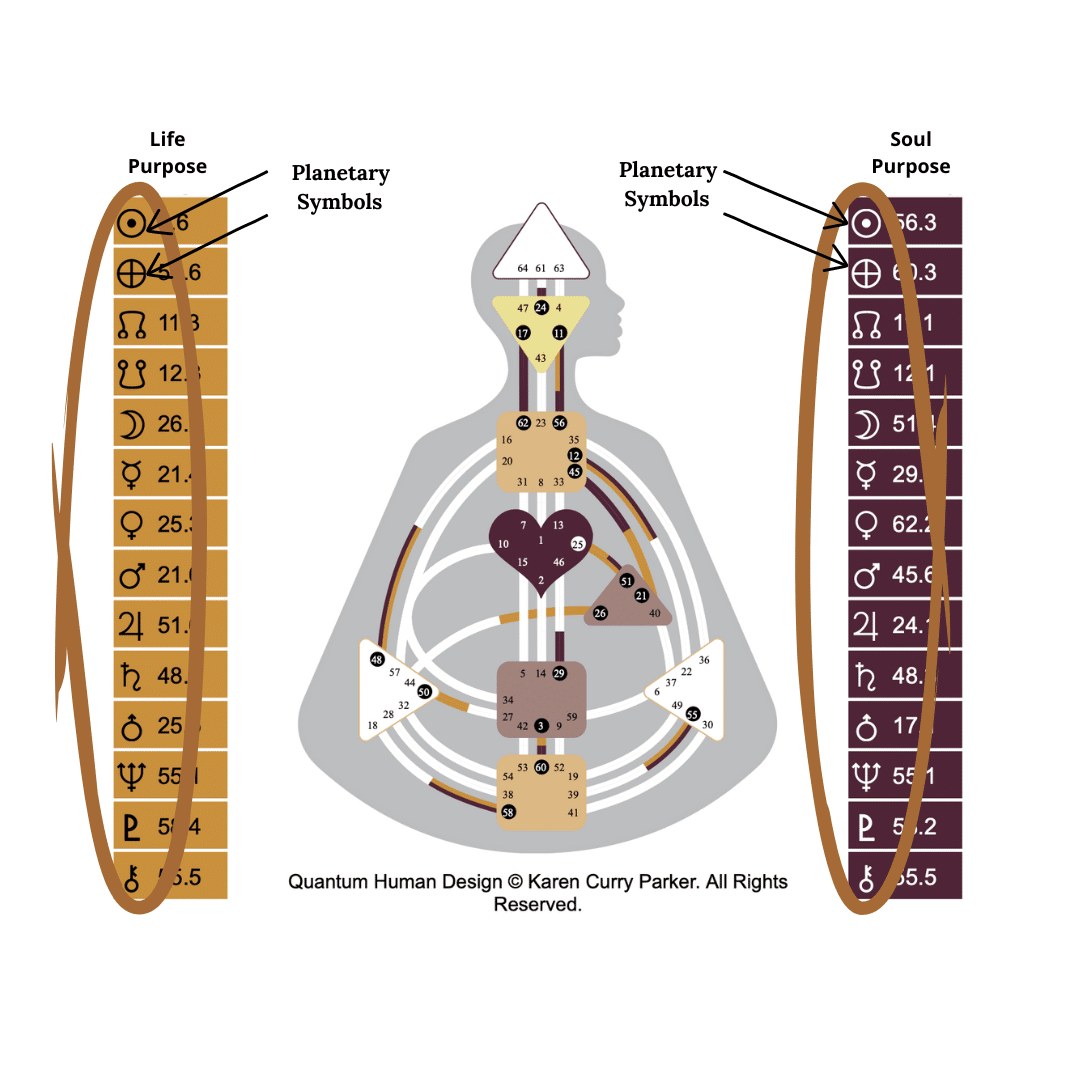
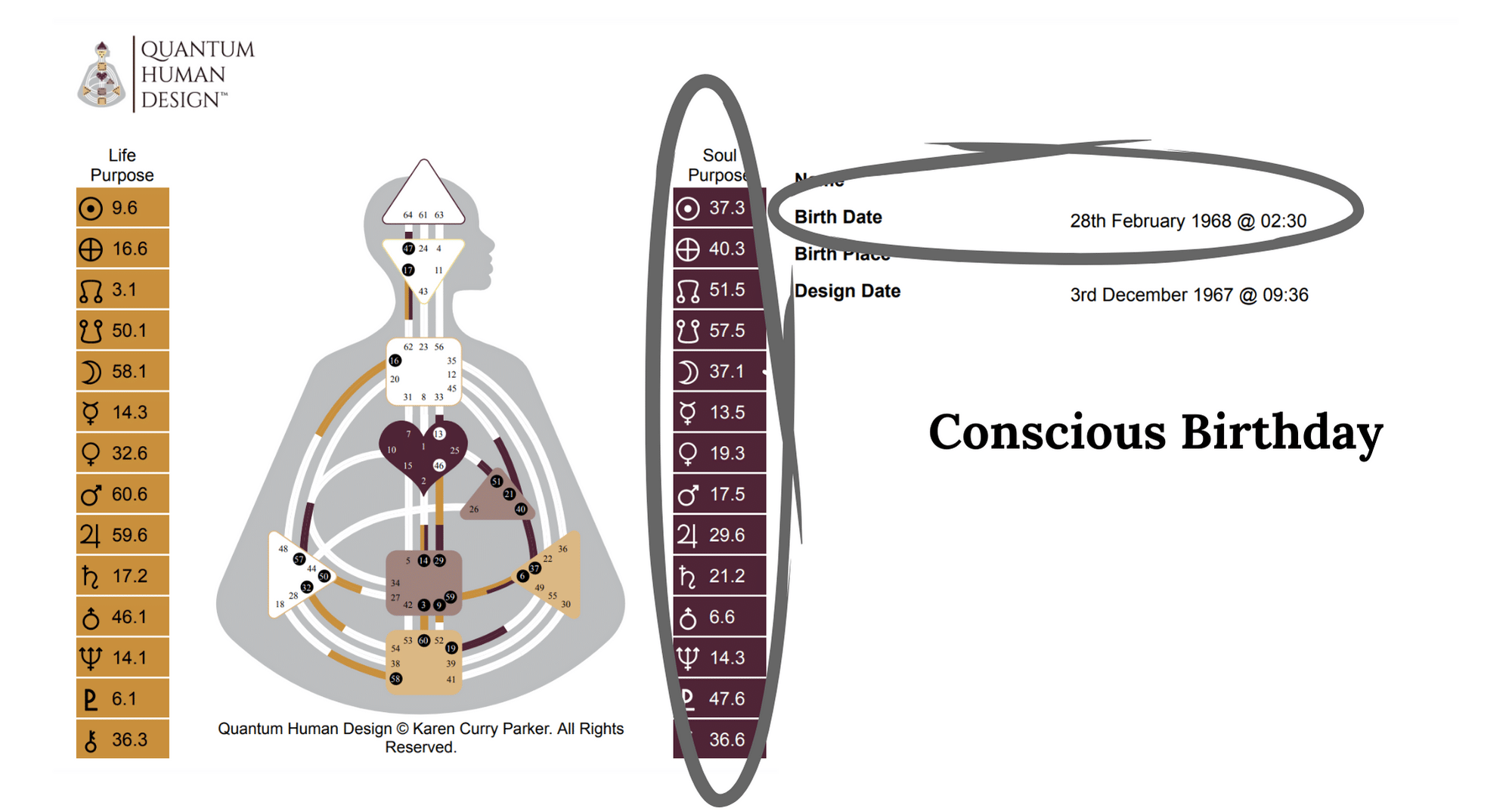
You might also notice that two birthdates are located on your chart. (Note: On some charts, your birthday might be set in the European day/month/year format.)
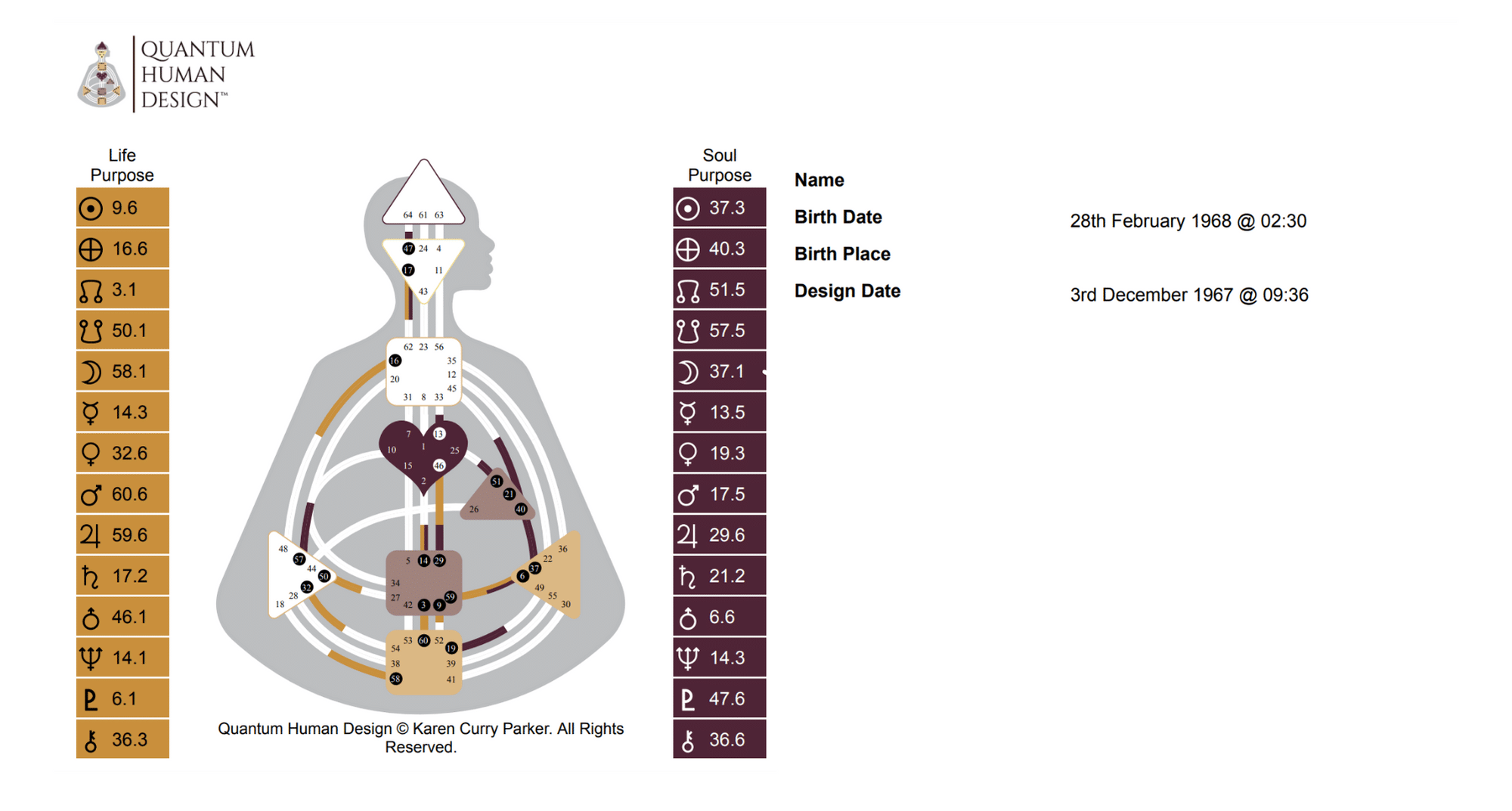
The maroon-colored column is generated from your birth date is your actual, conscious birthday. It is also referred to as your conscious design and contains information about your soul’s purpose in life. Your chart’s black elements are aspects of your personality that you are consciously aware of and, to a certain degree, can control.
The tan-colored column birthdate is approximately 88 astrological degrees from the moment of your birth, or roughly three months before your birth—when your mother may have noticed your movement in the womb. This is your unconscious birthday, the parts of your chart about your life purpose and what you’re here to learn. They are the design of your unconscious personality, the aspects of your personality that are consistently part of you but might not always be apparent.
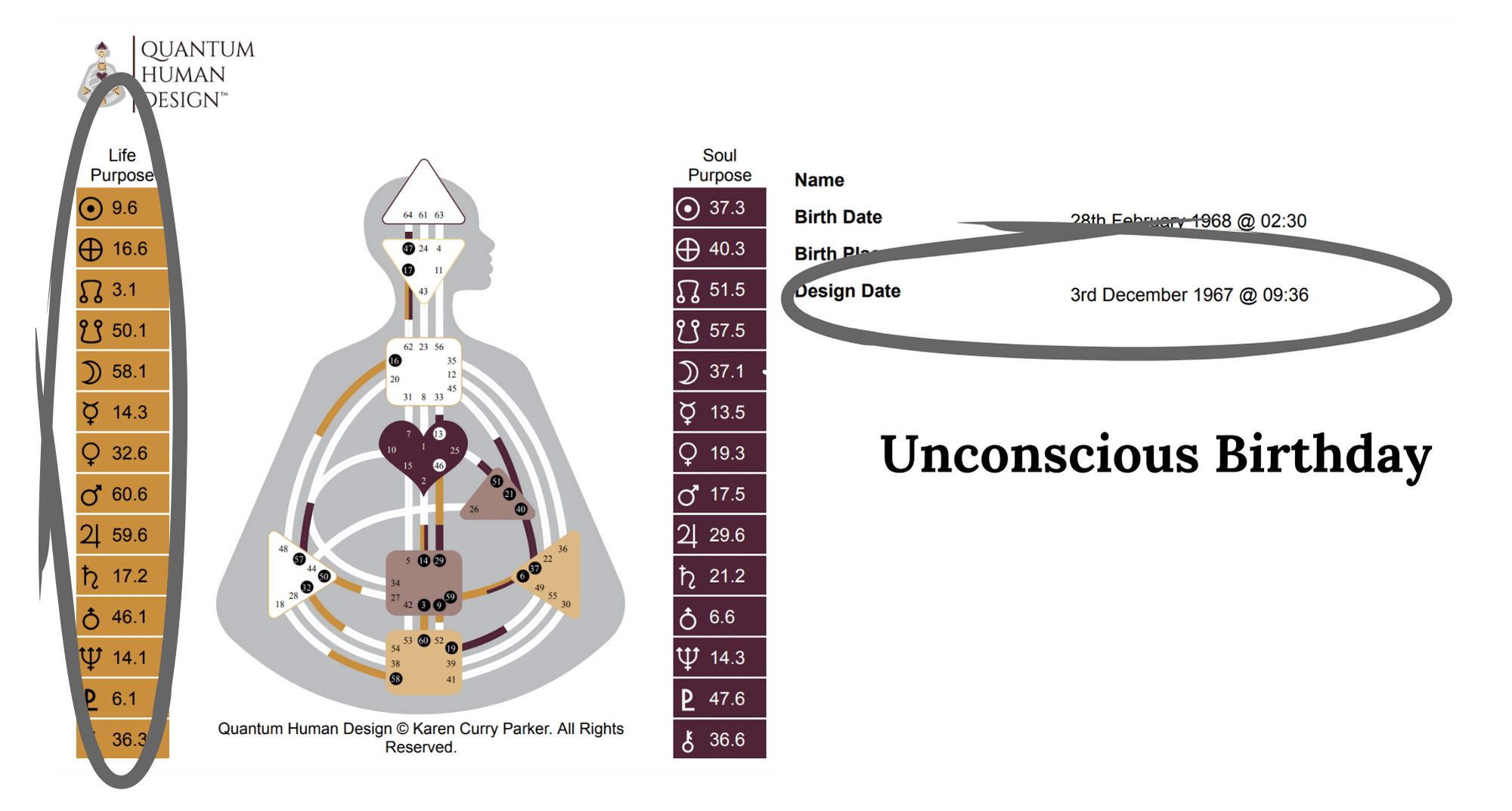
Your family and loved ones usually know the unconscious elements of who you are sooner than you will. Usually, with age, you become more aware of your unconscious personality, and you learn to fulfill your life purpose in a more mature way.
You’ll also find planetary symbols along with those tan and maroon columns. These symbols indicate the astrological position of the energies found in your Human Design chart at the moment of your birth. Your birth chart—the numbers alongside your Body Graph—is fixed throughout your life.
The Gates
You may notice that your Human Design chart is covered with lines; some are Tan or Maroon, some are checkered Tan/Maroon, and some are white. Lines that connect two Centers and are a combination of white, Tan, Maroon, or checkered are known as Channels (see Figure 16). There are thirty-two Channels in the Human Design BodyGraph, and each Channel has two Gates. Each active Gate in your chart adds a different theme or “flavor” to your personality.
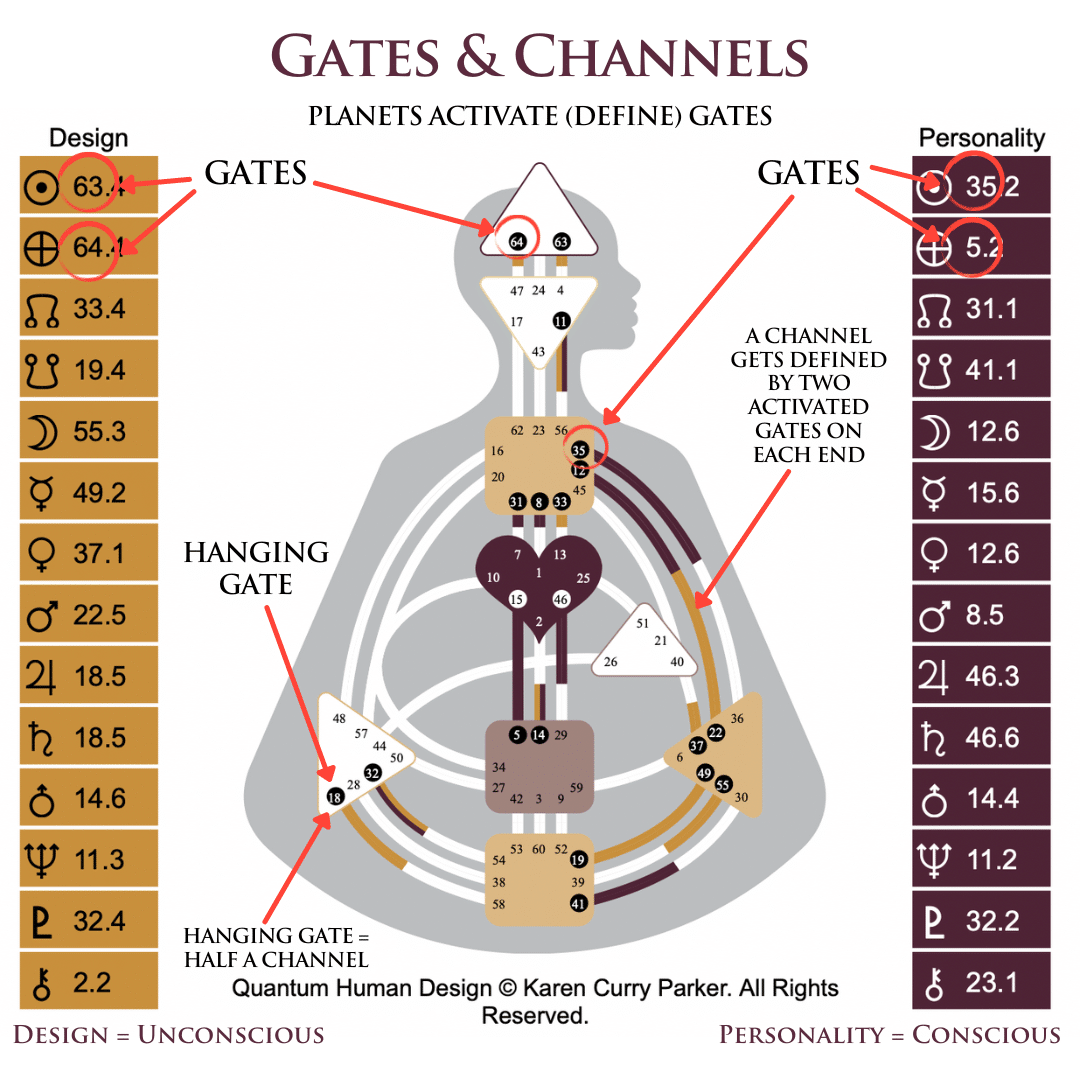
Maroon Gates are derived from the Maroon column of numbers on your BodyGraph. These Gates, of which you are consciously aware, provide you with information about your Soul’s purpose. So, for example, if you have Gate 11 (whose theme centers around being a vessel of ideas) and this Gate is coming out of the Ajna Center toward the throat and is maroon, then you would be consciously aware that you have a lot of ideas.
Tan Gates are derived from the Tan column of numbers on your BodyGraph. They provide you with information about your Life purpose. For example, if you have Gate 13, the Gate of the Witness, and it’s Tan (unconscious), then you may not be aware that your energy field communicates to others that they are safe to share their secrets with you. You likely have no idea why people are always unexpectedly coming up to you and telling you their deepest, darkest secrets.
If you have Tan and Maroon Gates, it means that those energies are part of both your Soul and Life purpose and are often a strong theme in your life. You express these personality aspects both in your conscious and unconscious definition.
A white line to a Gate represents an open Gate. You will always draw in the energy of that open Gate from the world around you, and its expression through you will vary depending on your environment.
When you look at the numbers on the left side of the BodyGraph, you will see that each Gate’s number has a smaller number next to it. For each Gate, there are six different lines, with each line being a further expression of your uniqueness. The lines of the Gates do not show up on the BodyGraph, but their meaning can be revealed during a Human Design analysis. (Refer to the I’Ching to gain more insight into each Gate.)
Frequently Asked Questions About Reading a Human Design Chart
What is a Human Design chart?
A Human Design chart, also called a BodyGraph, is a visual map of your unique energy blueprint. It combines astrology, the I’Ching, the chakra system, the Kabbalah Tree of Life, and quantum physics to reveal your soul purpose, life purpose, strengths, and decision-making strategy.
What do the two columns of numbers in the Human Design chart represent?
The two columns—often shown in maroon and tan or red and black —represent your conscious and unconscious design. The conscious column (soul purpose) reflects traits you’re aware of, while the unconscious column (life purpose) reveals qualities that others may see in you before you recognize them yourself.
What are the Centers in the Human Design chart?
The chart contains nine Centers, shown as geometric shapes. Defined Centers (colored in) represent consistent energy you radiate, while undefined Centers (white) show where you absorb and amplify energy from others. Together, they reveal how you process energy and interact with the world.
What are Gates and Channels in Human Design?
Gates are the 64 numbers on the chart, each correlating with an archetype from the I’Ching. Channels connect two Centers and are made up of paired Gates. Activated Gates and Channels highlight specific themes and gifts in your design, shaping your personality and life purpose.
How do I know my Human Design Type?
Your Type is the first piece of information revealed on your chart. There are five Types—Manifestor, Generator, Manifesting Generator, Projector, and Reflector—each with a specific strategy for making decisions and engaging with life.
What is the importance of Strategy in Human Design?
Strategy is your built-in decision-making guide. By following your Strategy—whether that’s waiting to respond, informing, waiting for an invitation, or allowing a lunar cycle—you align with your natural flow, reduce resistance, and experience greater clarity and fulfillment.
What are Profiles in Human Design?
Profiles describe your life themes and are made up of two numbers (such as 3/5 or 4/6). One number reflects your conscious personality, while the other reflects unconscious traits. Together, they illustrate your archetypal role and the patterns you’re here to live out in this lifetime.
What role do planetary symbols play in the Human Design chart?
The planetary symbols alongside your chart show where celestial influences activated specific Gates at your birth (and about three months before). Each planet adds its own “flavor” to your design, shaping both conscious and unconscious aspects of your personality.
How can Human Design help me in daily life?
Your chart offers guidance on practical areas such as career, relationships, health, and creativity. By following your Type and Strategy, you make better decisions, conserve your energy, and align with opportunities that are correct for you.
Do I need a specialist to interpret my Human Design chart?
While you can begin exploring your chart on your own, Human Design is a complex system with many layers. Working with a certified Human Design or Quantum Human Design specialist can provide clarity, context, and personalized guidance to help you fully integrate your chart into daily life. Find a Specialist here https://quantumhumandesign.com/find-a-quantum-human-design-specialist/
Conclusion
Each part of the Human Design chart provides key insight into your personality. Understanding these parts and the roles they play in your story will aid you in assembling a bigger picture of who you truly are. While we must “take the chart apart” to discuss its key pieces, the chart’s real beauty is in the synthesis of all the parts. The true story of who you are is only revealed when all the pieces come together as a whole.
Are you feeling ready to learn even more? Check out these courses:
QHD Basics – Introduction to Quantum Human Design
Want more content? Why not follow us on YouTube