What Is A Center In Human Design?
In Human Design a center is an energy hub within your body, each governing specific aspects like emotions, thoughts, instincts, and identity. These centers influence your personality traits, behavior patterns, and how a person interacts with the world.
There are nine centers, each affecting a different part of your energy and self-expression. I’ll summarize each of these here, then give you a more complete description and application of them to your life below:
Human Design Center Names
-
Head Center
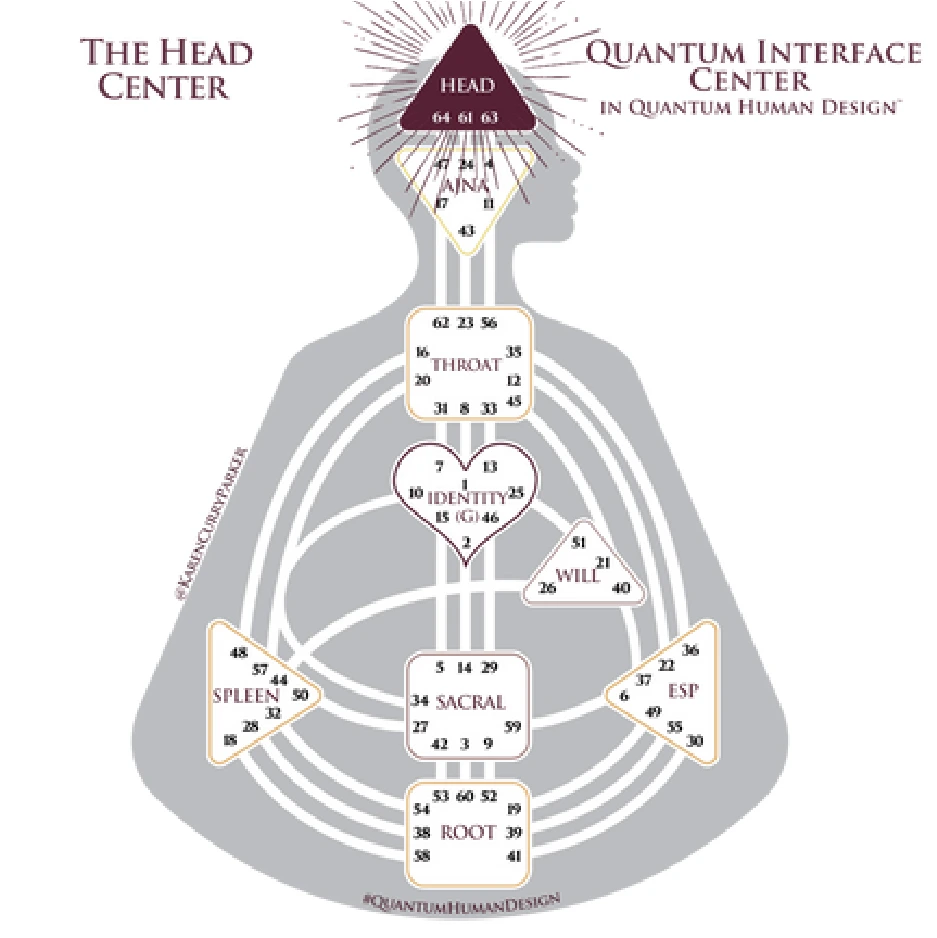
Your Head Center is linked to inspiration, questions, and mental pressure. It drives your curiosity and desire to seek knowledge. Whether your Head Center is defined or open influences how you process ideas and inspiration.
-
Ajna Center
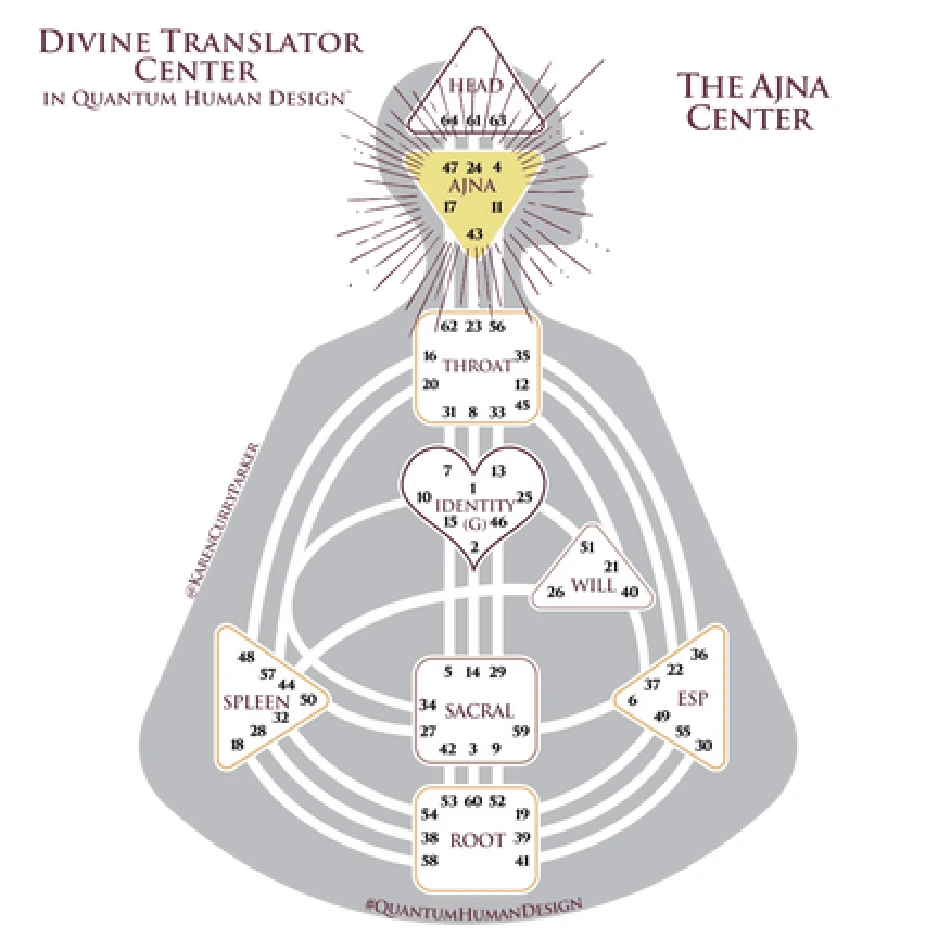
Your Ajna Center is associated with mental awareness, thinking, and analyzing. It represents how you form opinions and beliefs. A defined Ajna suggests a consistent way of thinking, while an open one can indicate flexibility in your beliefs.
-
Throat Center
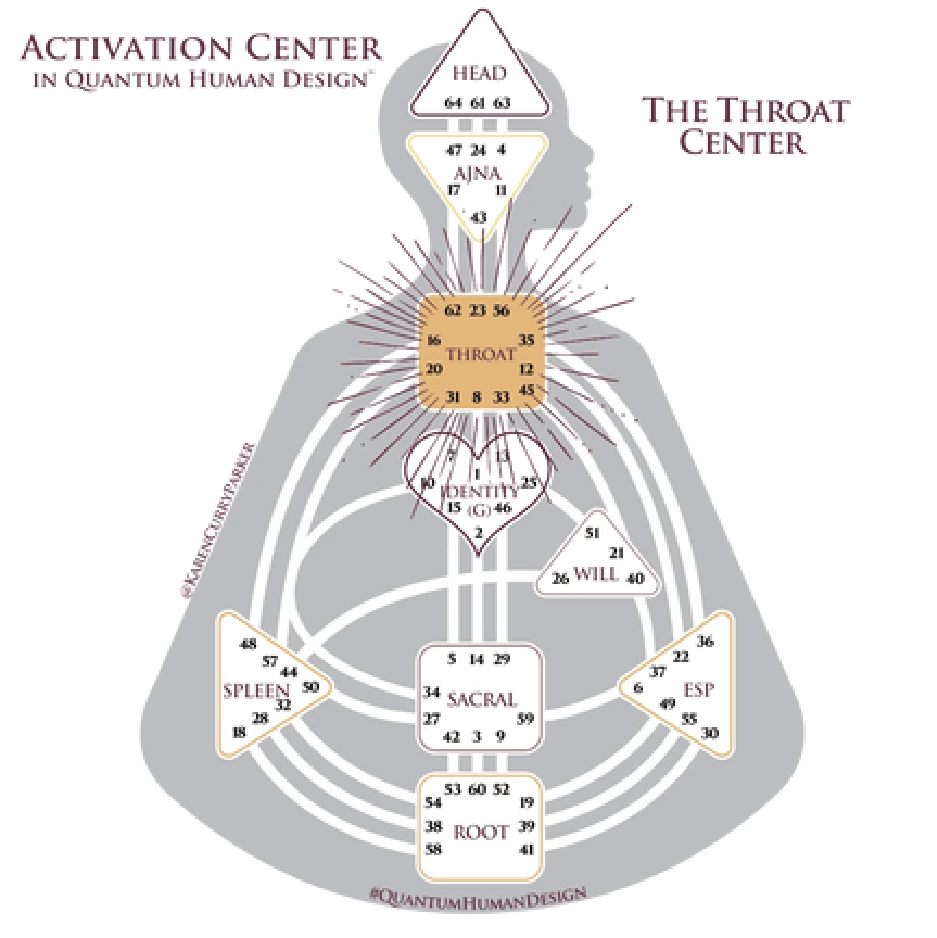
Your Throat Center governs communication and expression. It’s where you manifest thoughts and ideas into the physical world, whether through speaking or acting. If you have a defined Throat Center, you may communicate more consistently, while an open Throat allows you to be highly adaptive.
-
G Center (Identity Center)
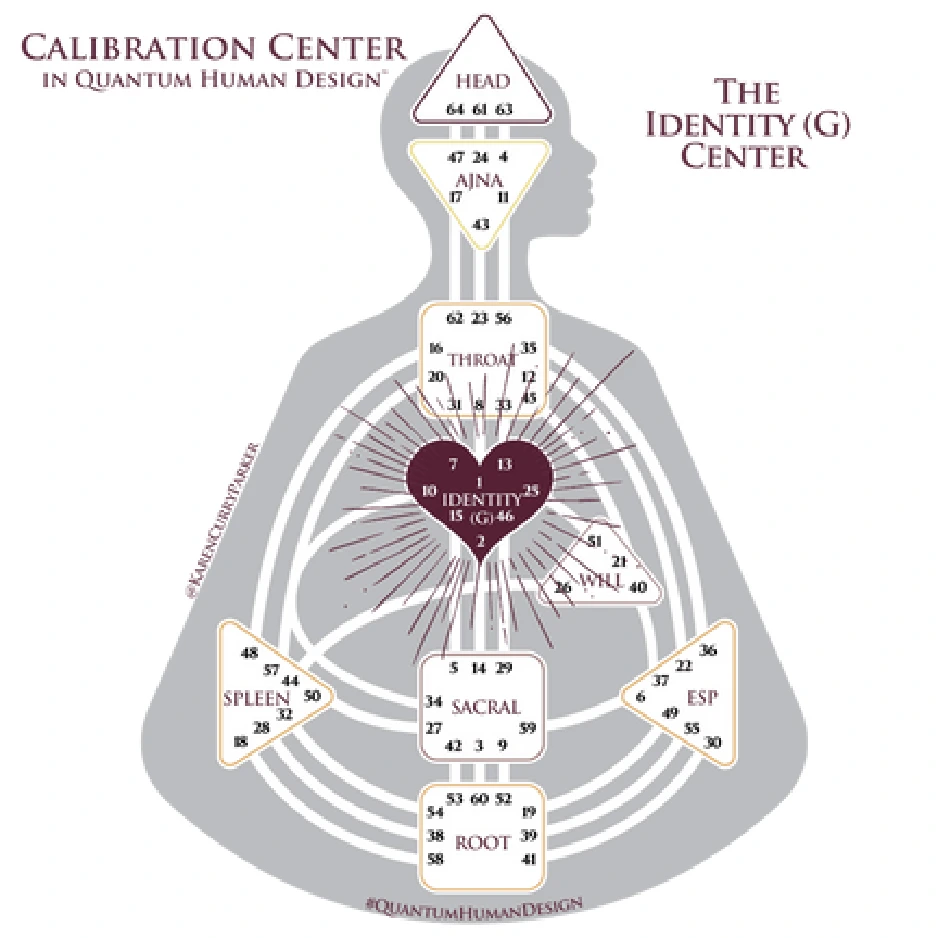
Your G Center is linked to love, identity, and life direction. It’s at the core of your self-purpose, guiding your sense of place in the world. A defined G Center indicates a stable sense of identity, while an open G Center suggests more fluidity and adaptability in how you view yourself.
-
Will Center
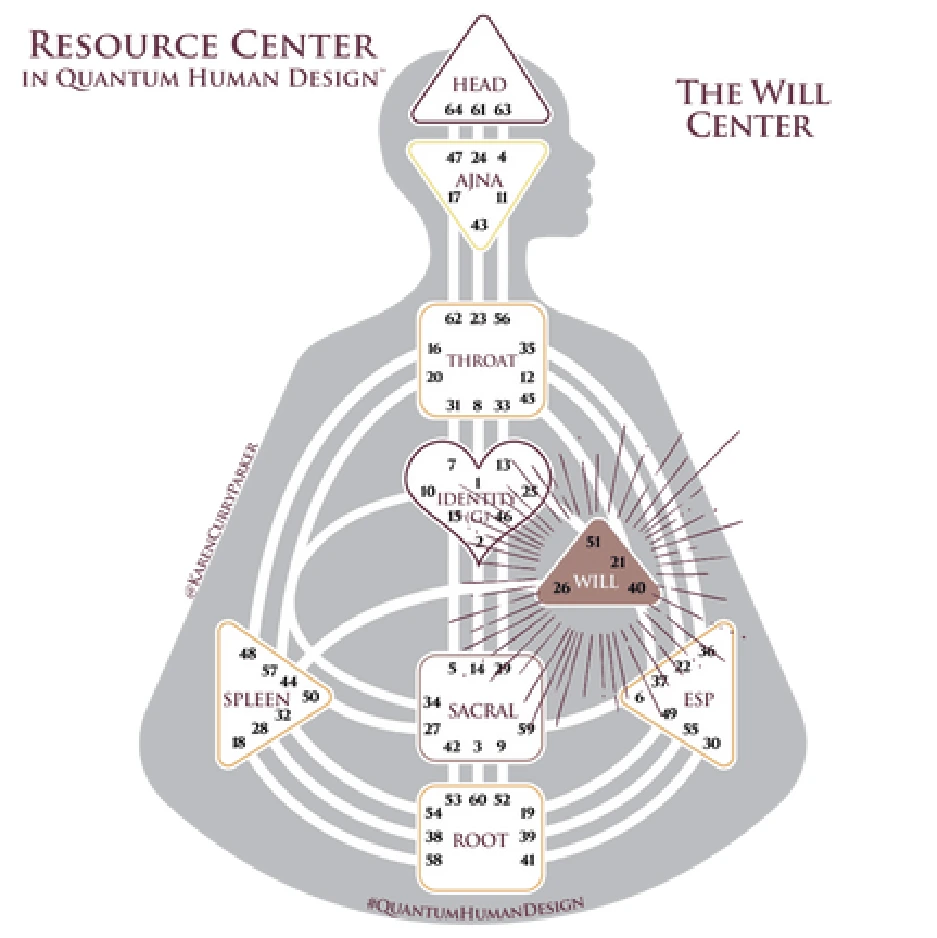
Your Heart or Will Center connects to ego, willpower, and self-worth, dealing with self-esteem and the drive to prove yourself. A defined Will Center provides a consistent source of motivation, while an open Will Center may experience a more variable sense of self-worth.
-
Sacral Center
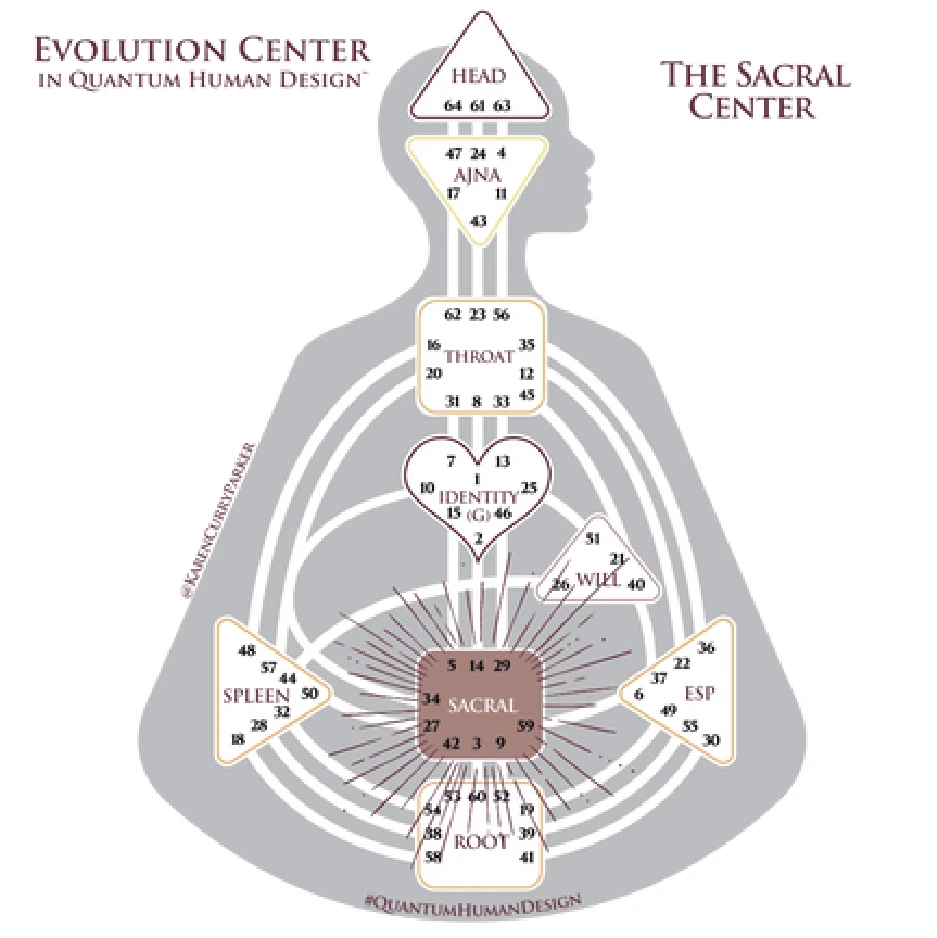
Known as the source of life force energy, your Sacral Center is associated with sexuality, productivity, and generative power. Only Generators and Manifesting Generators have a defined Sacral, giving them sustainable energy. With an undefined Sacral Center, you may experience energy more in waves.
-
Solar Plexus (Emotional) Center
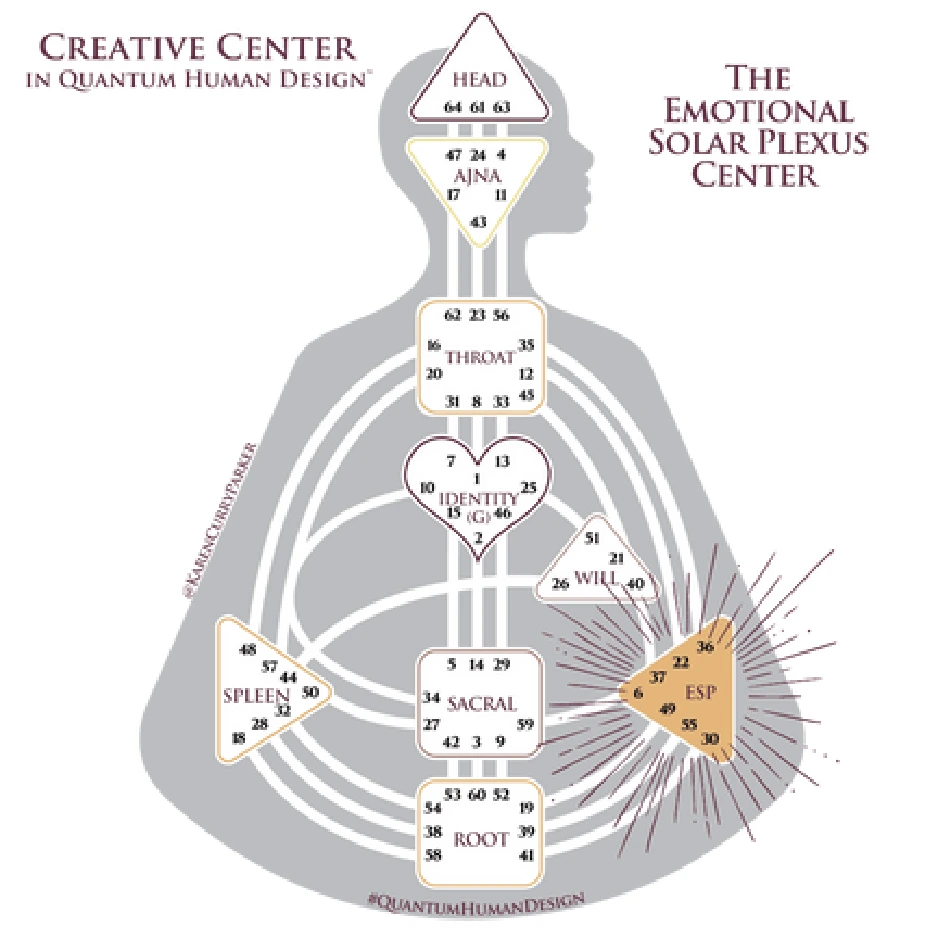
Your Solar Plexus, or Emotional Center, is linked to emotions, moods, and the experience of feelings, shaping your emotional landscape and sensitivity. If defined, this center gives you a consistent emotional wave, while an open Solar Plexus makes you more influenced by the emotions of others.
-
Spleen Center
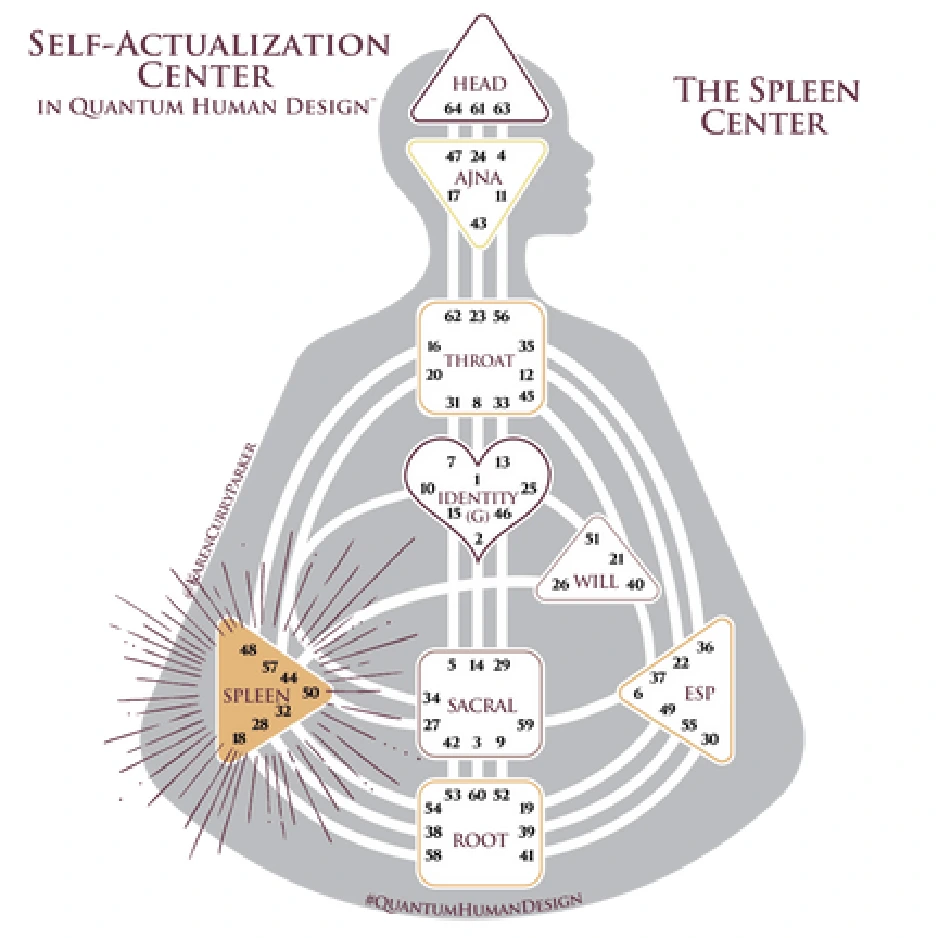
Your Spleen Center is connected to intuition, instincts, and health. It’s your center for survival and spontaneous intuition. A defined Spleen gives a strong sense of immediate knowing, while an open Spleen Center may have more inconsistent intuitive guidance.
-
Root Center
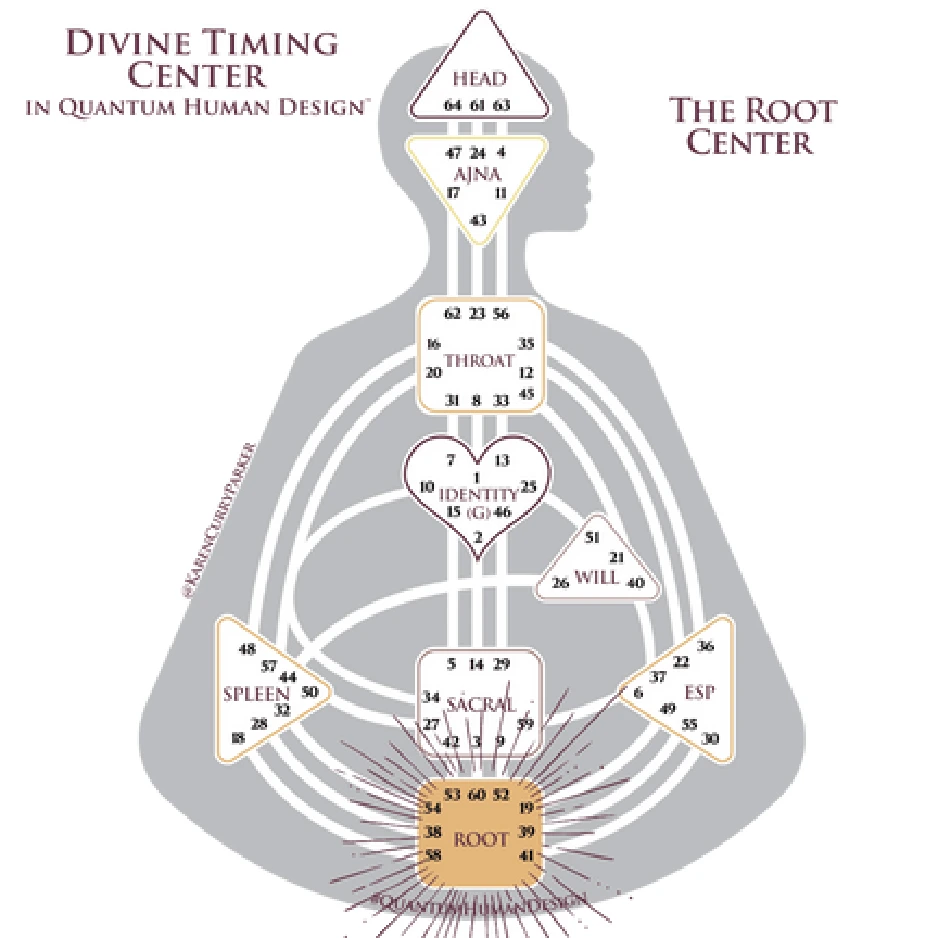
Your Root Center represents adrenaline, stress, and drive. It pushes you to take action and adapt to pressure. Defined Root Centers lead to a consistent relationship with stress, while open Root Centers can create a more fluctuating sense of pressure.
Each of these centers, whether defined (colored in) or undefined (white), influences your energy dynamics, shaping how you express yourself and interact with the world.
The way that your centers are defined, or open, are the building blocks of your type and authority. The configuration of the Centers in the chart tells you about how your energy works in the world, what you’re here to learn from others, and what you’re here to give to the world
The Not-Self Mind and Defined vs. Undefined Centers
In Human Design there is a concept known as the Not-Self mind. Your Not-Self is manifested when you attempt to suppress yourself to fit into social conditioning. This Not-Self sacrifices their own desires, and ideas, in order to fit into the culture around them.
When a center is open it can be a receptor of social conditioning. The open center absorbs this information and can lead you to make decisions from a place of conditioning instead of your true self. Open centers are not a weakness in your design and we can not, and should not, avoid conditioning. When you become aware of how your centers operate, in the Not-Self, you know what to look for when making decisions.
What Is The Difference Between Open And Undefined Centers?
Any center on your chart that is not filled in is unpredictable. A center that is not filled in is considered to be open. The difference between open and undefined centers is that open centers do not have any defined energy while an undefined gate does contain small amounts of energy.
Defined vs. Undefined Centers
When a center is filled in it is defined. These defined centers are full of the energy that makes you who you are and the energy is always there. An undefined center has small amounts of energy that you can draw on with great flexibility.
Your Defined Human Design Centers
Defined centers have fixed and consistent energy. This energy will always be there for you and radiates out to impact others. Defined centers have their own issues, but in general, they are much easier to deal with than the sometimes traumatic experiences of open centers. To live out the beauty and the deep impact of your defined centers, you have to live your Human Design strategy. It will empower you to always know what to do.
Your Undefined Or Open Human Design Centers
Open centers are white, undefined, and mutable. The energy here is inconsistent and depends on your environment and mood. Understanding your open centers will empower you to work with your energy instead of being victimized by the energy you take in.
Note: In Human Design, the terms “open” and “undefined” are both used to describe centers that aren’t consistently active, but they have slightly different meanings:
- Undefined Center: An undefined center is white (not colored in) on your chart, meaning it’s open to external influences. However, it might still have one or more “gates” (specific points on the chart) that are defined within that center. This gives you some sporadic access to the center’s energy when these gates are activated by external transits or interactions with others.
- Open Center: An open center is completely undefined and has no active gates within it. This means you have no consistent or internal source of the energy that center governs, making you even more open to the energy and influence of others in that area. Open centers tend to absorb and amplify the energy around them more acutely, leading to deep flexibility but also potential for conditioning.
In summary, an undefined center may experience some intermittent consistency through specific gates, while a fully open center has no internal consistency at all, creating a high level of sensitivity and adaptability to external energies.
How Do I Find My Human Design Centers?
Looking at a Human Design chart, you will see your Body Graph. The Body Graph contains shapes that represent each of the nine centers. If you do not have your chart yet, go to our free Human Design Chart Generator.
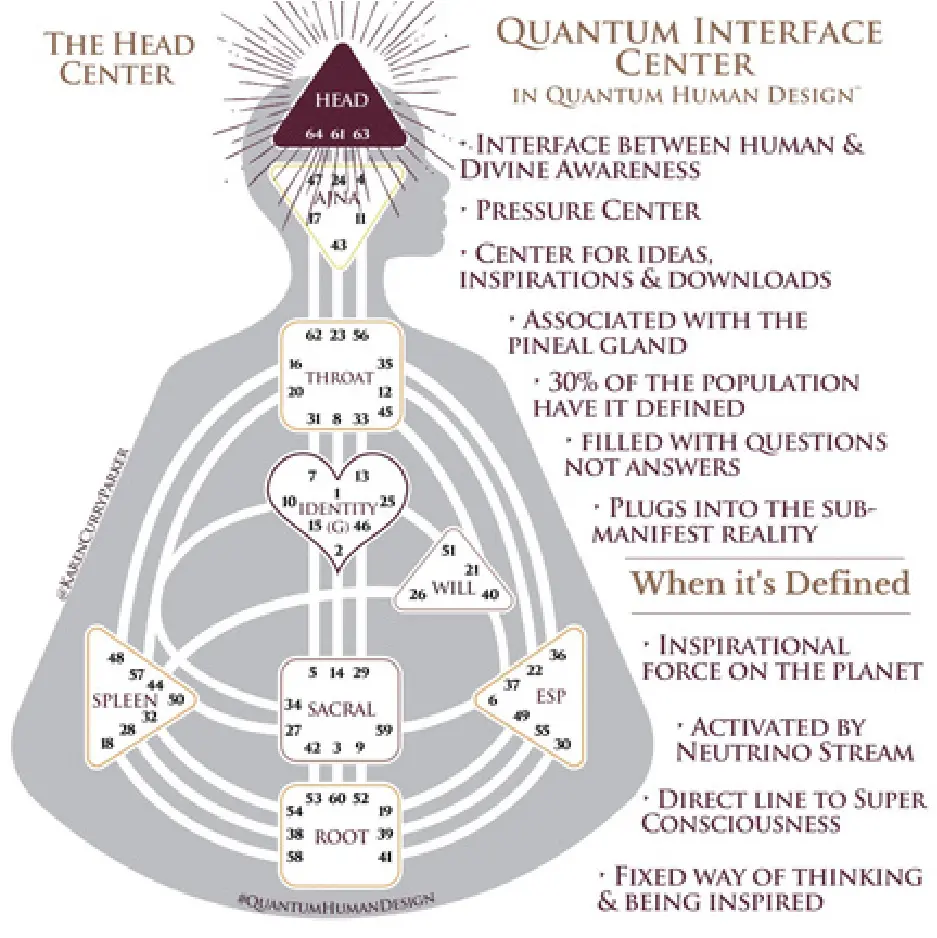
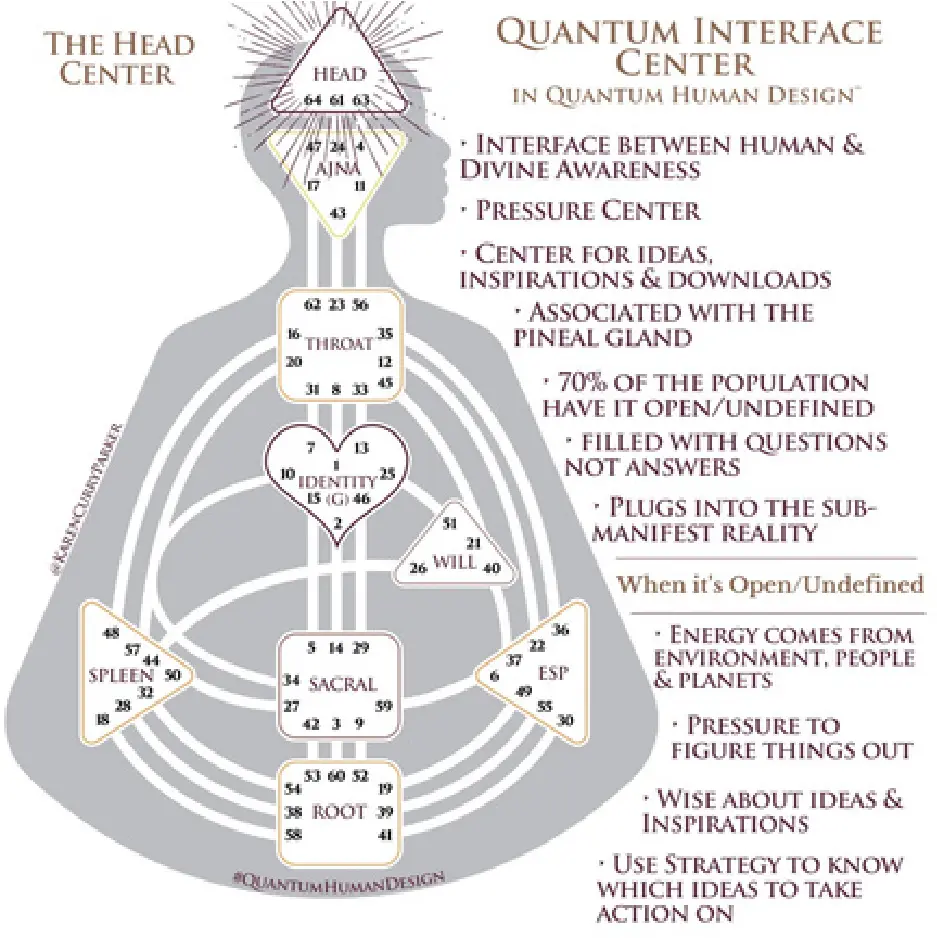
The Head Center/ Crown Center (Quantum Interface)
The Head Center (sometimes called the Crown Center) is associated with the pineal gland in the brain. It is the center for inspiration, and it is always under pressure to answer questions. It is not motorized, but it is a pressure center.
The Open/Undefined Head Center
Someone with an open Head Center does not have a consistent way to receive inspiration, so when they come across inspiration they will take it in and amplify it.
It is very easy when you have an open Head Center to feel inspired all the time. Not only do you feel inspired, but you also feel pressure to act on this inspiration. This can make it look as if you don’t know what you’re doing or you are leaping all over the place trying all kinds of different things.
People may even say that you just need to be decisive, pick one thing and stick to it. Those who understand their open Head Center can have a very deep understanding of who and what is truly inspiring. They can be wise about which inspirations to take action on and which to simply observe.
Not only will someone with an open Head Center have the ability to take in the inspiration of the world and amplify it, but they will also take in all the questions of the world and amplify those, too. This can sometimes make it difficult to make decisions.
For example, let’s say you are going out to eat. Earlier, you had a strong craving for a grilled cheese sandwich. But now that you are at the restaurant, your head is flooded with all kinds of inspiration, especially from the people sitting next to you, and instead of ordering a grilled cheese sandwich, you order a shrimp cocktail. The shrimp arrives, and you spend the rest of the meal wondering why you ordered that. You may be flooded with inspirational energy, but the only thing you really need to do to make good decisions is to follow your strategy for your type.
The Defined Head Center
A defined Head Center is colored in yellow. The energy in the defined Head Center is always “on,” people with defined Head Centers are inspirational forces on the planet. They are always radiating inspiration out into the world. They may not always be aware of it, because it is energetic, but it’s happening.
Defined Head Centers have a consistent source of inspiration. They are always asking questions and may feel that something is wrong if they don’t have an answer. Inspiration is a reflective process. If you have a defined Head Center, it is important to process the questions you are receiving, but don’t rely on the answers to make decisions about your life.
Often, people with defined Head Centers don’t realize that they are questioning things. You may even find that they seem to have permanent quizzical looks on their faces. It is simply a part of their consistent energy.
The Ajna Center (Divine Translator)
Based in the anterior and posterior pituitary in the brain, the Ajna is an awareness center. Its function is to research and conceptualize.
The Open/Undefined Ajna Center
Someone with an open Ajna Center can see many sides to an issue. They are fair, judicious, empathetic, and open-minded. An open Ajna can be very intellectual. An open Ajna doesn’t have a fixed way of thinking, so they are able to process and understand information in a myriad of ways. People with an open Ajna who are able to relax can become great mind readers.
Because the open Ajna is designed to take in information and ideas and see all the different layers and levels of understanding, it can be a challenge for an open Ajna to “lock on to” a fixed idea or belief.
With great effort, people with open Ajnas can hold a fixed idea, but it doesn’t come easily or naturally. If you have an open Ajna, you may have been told that you need to just make up your mind about something and stick to it. Remember that you are here to be wise about ideas and beliefs, but not necessarily adopt them. The beliefs that you hold on to will be the ones you came to through using your Human Design strategy and authority.
The Defined Ajna Center
The defined Ajna Center is colored in green. The defined Ajna is designed to hold information. It is trustworthy and reliable, but it is fixed in how it works. It is important to note again that the mind is a great resource, but it is a terrible place to make decisions. Remember that no decisions should come from the mind.
The Throat Center (Activation)
The Throat Center represents the thyroid and the parathyroid. On the body graph, the Throat Center is the square underneath the Ajna and the Head Centers. The Throat Center is the center for communication, as well as manifestation into action.
The Open/Undefined Throat Center
How your Throat is defined will control how you speak. People with undefined, or open, Throats always feel under pressure to speak. When they are in a group or in school this can be very difficult. The open Throat often blurts out comments or answers—sometimes uncontrollably, unaware of where the comment came from (this is even worse if your mind is also undefined).
There is, however, deep wisdom in the open Throat. Many great singers (like Celine Dion) and well-known speakers (like Bill Clinton) have open Throat Centers. Someone with an open Throat can speak in various ways depending on who they are with. The open Throat can be very good at speaking foreign languages and impersonating others’ speech.
In order for the open Throat and the thyroid to remain healthy, it is important to speak according to your strategy. Open Throats can experiment with not talking. Try going to a party or gathering and don’t say a thing unless you’re given something to respond to or you are invited into a conversation. If you are silent, your aura does the talking! Just wait and see. People won’t be able to stop themselves from talking to you!
The Defined Throat Center
The defined Throat is colored in brown. The defined Throat Center is designed to speak, but how it speaks is controlled by what it is connected to. Understanding where the Throat is connected is vital to understanding how you relate to others. For example, if your Throat is connected to your Ajna, you can speak your mind. If your Throat is connected to your Emotional Solar Plexus, you are able to talk about your feelings effectively.
For the defined Throat to be heard, it is vital that they enter into communication according to their strategy: Manifestors (Initiators*) and Manifesting Generators (Time Benders*) can just talk, Generators (Alchemists*) need to respond, and Projectors (Orchestrators*) need to wait to be invited to speak. Reflectors (Calibrators*) will never have a defined Throat Center.
Effective communication is vital for personal and global well-being. Experiment with living your strategy and see how it improves the quality of your relationships.
The Identity Or G Center (Calibration)
The Identity Center is one of the most important centers in the Human Design system. It is the center for love and direction, the place where the soul is seated. The liver is represented by this center. The Identity Center, sometimes called the “G-Center” or the “Magnetic Monopole,” is the diamond in the middle of your Human Design chart.
The Open/Undefined Identity Center
Individuals with an open Identity Center understand other people’s sense of self and direction. They will take in another person’s identity and amplify it, giving them insight into another person’s perspective. Many therapists, teachers, and intuitives have open Identity Centers.
Because this is the center for direction, being in the right place at the right time is the most important thing for individuals with an open Identity Center. Those with an open Identity Center report they experience a “click” on a cellular level when they are in the right place. It is almost as if they feel a deep sigh of relief when they are in the right town, the right restaurant, and the right office. Being in the right place allows these individuals to receive the right opportunities.
Conversely, if a person with an open Identity Center is in the wrong place, they will also feel it on a deep, deep level. When they are in the wrong place, they may get all the wrong opportunities—or none at all.
The Defined Identity Center
When you have a defined Identity Center, you are here to give love. Your sense of self is probably pretty solid. While you know who you are and where you are going, you might not always know how you are going to get there.
Individuals who have a full channel connecting their Identity Center to the Throat Center can be very vulnerable to criticism, as their creative expression comes straight from their identity.
The Heart, Will, Or Ego Center (Resource)
The Heart, Will or Ego Center is the small triangle located to the right of the diamond in the middle of the chart. It is the center for the heart, the stomach, the gallbladder, and the thymus. It is also one of the four motors.
The Open/Undefined Will / Heart Center
7 out of every 8 people have an open will center. All those failed attempts to go on a diet, quit smoking, or stay organized were not your fault. Open Will centers do not have consistent access to willpower. When you have an open Will Center, it is crucial that you use your strategy to make agreements and promises. If you don’t, you will be using energy you don’t have and run the risk of entering into the wrong situations and feeling obligated to make yourself follow through. And you might miss the right opportunity because you will be busy forcing yourself to do something you don’t want to do.
The Will Center is also all about value and the material plane. It is very common to have a tendency to undervalue yourself. Those with open Will Centers might undercharge for their business services or even give their services away, even when no one asks them to. The open Will Center can help you become very wise about what is truly valuable in life. You may, with time and experience, become very wise about what you are worth, both in the business arena and in your personal life. You may also become wise about knowing when it is time to work and when it is time to rest.
The Defined Will / Heart Center
A defined Will Center will always be red on your chart. When you have a defined Will Center, you have consistent access to willpower. If you have a defined Will Center and you decide that you would like to start running every morning, it will be pretty easy for you to get into a regular routine and make yourself run every day, even if you don’t feel like it. You might pause your routine for a few days to rest, but you’ll pick it back up in a few days and stick with it consistently.
When you have a defined Will Center, it is very important for your self-esteem to make promises and keep them, even if you don’t want to. Take your promises seriously if you have a defined Will Center, as it takes time and energy to follow through, and you always deliver on your word.
The Emotional Solar Plexus Center (Creative)
On the body graph, the Emotional Solar Plexus is the large triangle on the far right of the chart. The kidneys and pancreas are associated with the Emotional Solar Plexus. It is a motor center and this emotional energy fluctuates in waves.
The Open / Undefined Emotional Solar Plexus
About half of us have an open Emotional Solar Plexus. Emotionally open individuals are here to learn about emotional energy and become wise about feelings. When you are emotionally open, you are truly empathetic and can take in other people’s emotional energy and amplify it.
This can be a great gift because it allows you to deeply understand other people. This understanding does come with a caution because the open Emotional Solar Plexus will take in emotional energy and amplify it, this can be a very painful center to have open when you do not understand how it works.
It is easy to think that the emotions you are experiencing are your own, and if someone else’s energy is negative, it can be painful when it flows into your awareness. Consequently, it is common for open-emotional people to develop coping strategies that involve being nice, pleasing, avoiding conflict, and having a secret life.
It is not that emotionally open people are weak or lack character. It is truly more painful for these people to enter into highly charged emotional situations. It is crucial to become conscious of emotional energy when you are emotionally open so that you can allow that frequency of energy to flow through you without you feeling responsible for it or as if you need to fix it. Be an emotional screen, not a sponge.
The Defined Emotional Solar Plexus
The defined Emotional Solar Plexus will be brown. If you are part of the 50% of the population that has a defined Emotional Solar Plexus, you carry emotional energy at all times.
The channels connecting your Emotional Solar Plexus to other centers will determine the kind of emotional waves that you experience. Some of you have only small undulations in your emotional frequency. Others may experience high emotional highs and low emotional lows, with plateaus in between. The wavelike nature of emotional energy, it is easy to mistake the melancholy of the low end of the wave for depression.
If you are emotionally defined, depression can become a big problem if you are looking for a reason why you are feeling down. We have a lot of judgment against negative emotions in our culture. But not all negative emotions are destructive. Melancholy or the low end of an emotional wave is also a very important creative energy.
Regardless of your Human Design type, if you have a defined Emotional Solar Plexus you have emotional authority. Your emotional waves are a crucial piece of your process because when the emotion passes you can make a clear decision. Waiting for the right emotional state before taking action will keep you from leaping into emotional decisions and regretting them later.
The Sacral Center (Evolution)
The Sacral Center is one of the most important centers in the Human Design system, and it is the most important of the four motors. The Sacral is the square located toward the bottom of the chart. It is the energy center for workforce and lifeforce energy, and it is associated with the reproductive organs—the ovaries and the testes.
The Open / Undefined Sacral Center
An undefined Sacral Center has an unlimited capacity to experience lifeforce and workforce energy. The undefined Sacral Center is here to become wise about work and sexuality. When you have an open Sacral Center, you have the ability to take in and amplify workforce and lifeforce energies for short periods of time.
This means that in short bursts, people with undefined Sacral Centers can work as hard as, or even harder than, Generators and Manifesting Generators. Because of this, a lot of people with open Sacrals think they can do more than anyone else. And for short periods of time, this is actually true.
But remember the key word in understanding the energy of the Sacral is sustainability. And a person with an open Sacral Center cannot maintain a high level of energy for a prolonged period of time without really burning themselves out.
What that means is that if you have an open Sacral Center, you are not here to work a Monday through Friday, nine-to-five job. And for most people with open Sacral Centers, hearing that they are not designed to work in the traditional sense is a great relief! That doesn’t mean that if you have an open Sacral that you can’t work or that you don’t need to work. But you will probably do best finding a way to work that has some level of flexibility built into it.
Collectively, we have a lot of beliefs about the value and importance of work. A non-Sacral being does not have the energy for sustainable labor. Because of this, many non-Sacral beings get a lot of judgment from others about being lazy or incapable. But non-Sacral beings have their own wisdom and energy to add to the planet. They just work differently.
Non-Sacral beings may also be judged as lazy because of their need for naps and significant alone time—but these needs are vital for their physical health. As a non-Sacral person, you need alone time to discharge the excess Sacral energy from your system. You also need to nap to recharge yourself and revitalize your body. Both alone time and adequate sleep are crucial for you to stay healthy.
The Defined Sacral Center
If you have a defined Sacral Center, it will be red. This red square is what makes you a Generator. The most important function of the Sacral Center is work. When you have a defined Sacral motor, you are designed to work. The challenge is, of course, finding the right work that you love.
The energy of the Sacral Center is counterintuitive to how most of us have been raised in this culture. Generally speaking, we have been raised to believe that we have to go out and “make things happen.” We have been taught to “manifest our destiny.” But, as many of you may have already experienced, if you have a defined Sacral and you go out and try to make things happen, you usually just feel frustrated because nothing turns out the way you had planned.
If you have a defined Sacral motor you are designed to wait for things to show up. This can be very difficult because that Sacral energy hums and buzzes and is just longing to do something. Sacral beings are very busy people. They are designed to be “doing.” The Sacral Center is all about waiting and responding to whatever shows up in your outer reality. Think about this. If you have a defined Sacral Center, how many times have miraculous and unexpected things happened to you out of the blue? Sacral energy works best if you learn to wait for the right thing to show up and then respond to it.
The Spleen Center (Self-Actualization)
The Spleen is the large triangle located on the left side of the Human Design chart. The Spleen is the center for intuition, time, the lymph nodes, and the immune system.
The Open /Undefined Spleen Center
An open Spleen means that you likely have a sensitive immune system. It may seem like you get sick easily, but what that really means is that you are very sensitive to the subtle changes in your body, and you notice when you start to feel a little “off.” You may be very sensitive to medications and need lower doses, or you may even do better with homoeopathic remedies. Also, be aware that your tolerance for alcohol or recreational drugs may be lower, and you may experience the effects at much lower rates of consumption.
When you have an open Spleen, it means that you don’t have consistent access to “feel-good” energy. People with open Spleens like to be around people with defined Spleens. It makes them feel nurtured and strong.
Remember that an open center is unlimited in how it can experience the energy of a particular center. If you have an open Spleen you can experience unlimited intuition. It just won’t always be the same. Someone with an open Spleen may experience “gut feelings” one day, have “inner knowingness” on another day, and hear a guiding voice or have a prophetic dream on a different day. Because an open Spleen doesn’t have consistent access to intuitive energy, many people with an open Spleen think they don’t have very much intuitive insight. How an open Spleen receives their intuition will vary depending on who they are around, but they will probably be deeply intuitive.
The Spleen is also the center for time, it is common for people with open Spleens to struggle with the concept of time. Many are chronically late, while others who have had bad experiences in the past with being late are compulsively early. It can be difficult for people with open Spleens to rush. Because our open centers are where we carry our deepest conditioning, if you have an open Spleen, you have the potential to be hyper-aware of time, particularly if you have had bad experiences with losing track of time.
The Defined Spleen Center
The defined Spleen Center will be brown on your chart. When you have a defined Spleen, you are designed to be in the moment. Your decisions will be in the moment. Your sense of timing will be “right now.” A defined Spleen will speed you up and give you a sense of time and consistent intuitive insights in the moment.
Defined Spleens have very powerful immune systems. Because the immune system is so strong, it is easy for a person with a defined Spleen to “miss” the first symptoms of illness. If you have a defined Spleen, you might not notice that you are sick until you are very, very sick. It is also common for people with defined Spleens to keep working through an illness. It is important to remember to check in with your body periodically if you have a defined Spleen.
The intuition of the defined Spleen speaks once and then never again. That gut feeling that you should or shouldn’t be doing something is your Spleen speaking to you. Because the Spleen is survival based, it can also communicate to you with fear. Some of those fears include a fear of inadequacy, a fear of responsibility, a fear of imperfection, a fear that life is meaningless, and a fear that your dreams will never be realized. It is very easy to become paralyzed by these fears. The wonderful thing about Spleen-based fears is that no matter how frightening they feel, they can be best conquered by just pushing through them.
The challenge of the defined Spleen is to figure out whether your intuition is giving you an important message about survival or whether you are simply experiencing the energy of the Spleen, and you need to push forward with understanding and insight. This is where living your strategy is so important. If you are experiencing the fears of the Spleen, use the strategy of your type to decide whether you should do something or not.
The Root Center (Divine Timing)
The Root Center is the square located at the very bottom of the body graph. This is the center for adrenaline. It is also considered one of two pressure centers in the system (the other one being the Head Center). The Root Center energy operates in pulses.
The Open / Undefined Root Center
If the square at the bottom of your chart is white, then you have an open Root Center. It takes in adrenaline energy from others and amplifies it. Someone with an open Root Center might enjoy the rush of being in front of a crowd or other adrenaline-charged experiences, such as skydiving or bungee jumping. On a more simple level, people with open Root Centers may opt for safer adrenaline fixes, such as caffeine or chocolate.
Because the open Root Center is a pressure center, individuals with an open root can sometimes feel that they are under pressure to be free. In other words, people who process energy this way have a hard time relaxing or playing unless all their work is done. It seems reasonable to get your work done before you can go out to play, but people with an open Root Center will feel such pressure to get things done that they don’t ever allow themselves time to recharge their batteries. Eventually, they can become so drained that they are ineffective at work.
Sometimes, the energy taken in the open Root Center might be too much for a person, and they may suffer from anxiety. Individuals can have different levels of sensitivity in their open centers.
The truth of the open Root Center is that the work is never done. If you give an individual with an open Root Center a job to do, they will do it very quickly in order to get out from under the pressure of having to get it done. Of course, while they may be efficient, they can be moving so quickly that they make mistakes or skip steps—especially if they are a Manifesting Generator. That is why it is crucial to realize that the open Root Center is just an energy center and you do not have to be a victim to that energy.
The Defined Root Center
If you have a defined Root Center, the square at the base of your chart will be brown. This means that you have a fixed way of processing adrenaline energy, and it will operate cyclically, depending on which of the lines you have colored in around your Root Center.
You will get things done when the adrenaline pulse is there; when you don’t have that adrenaline pulse, things won’t necessarily get done. You have a natural cycle for your adrenaline energy. If you have a defined Root Center then you are somewhat immune to adrenaline pressure. That doesn’t mean that you don’t experience stress. However, your stress may come from other factors or through other open centers that you may have in your body graph. Simply put, when you have a defined Root Center, things get done when they get done.
Whether defined or open, your centers contain great power. Begin to consider how you can utilize the ever-present energy of your defined centers. Can you channel that energy to help yourself balance the vulnerability of your open centers? Remember there is no suffering in our design, only opportunities to grow.
Note: The names in brackets above are the Quantum Human Design (QHD) names for these Types. QHD helps us to reframe the ‘Not Self’ or conditioned self in Human Design to explore the potential of the deconditioned self and to live more in alignment with our inner truth.
If you want to learn more about how to read your Human Design Chart, you might like this post helping you in Reading Your Human Design Chart
If this article has inspired you to want to learn about Human Design, click here to visit our School
Want more content? Why not follow us on YouTube