The Left Angle Cross of the Plane in Human Design represents a unique life theme centered on navigating emotional experiences and establishing a stable identity through rhythmic patterns. This cross combines the energies of Gate 36 (Crisis), Gate 6 (Friction), Gate 10 (Love of Self), and Gate 15 (Extremes). Unlike Right Angle Crosses that focus on personal destiny, the Left Angle Cross of the Plane carries a transpersonal karma, meaning individuals with this cross are designed to interact with and impact others through their journey of emotional mastery and self-empowerment.
People with this Left Angle Cross of the Plane serve as experiential guides, helping others navigate the relationship between emotional desire, friction, personal empowerment, and finding sustainable rhythms in life. Their presence creates opportunities for others to understand how crisis and emotional intensity can lead to deeper self-love and acceptance when balanced with appropriate rhythms and boundaries.
The 4 Gates in The Left Angle Cross of the Plane
Gate 36 (Crisis)
Gate 36 carries the emotional impulse of desire and longing for new experiences. This gate is always seeking the next adventure or emotional exploration. When this energy waits for emotional clarity, it creates profound experiences, but without waiting, it can leap into chaos and crisis. Gate 36 is plagued by boredom and has a natural tendency to pursue novelty, making it a powerful initiator of emotional experiences.
Gate 6 (Friction)
Gate 6 connects the Sacral Center to the Emotional Solar Plexus, creating a penetrating energy that can break into people’s auras. This is emotional and energetic friction rather than seductive charm. Gate 6 brings intensity to interactions and relationships, creating natural points of contact and connection that aren’t always comfortable but are often transformative.
Gate 10 (Love of Self)
Gate 10 stands as one of the most significant gates in Human Design, rooted in the Identity Center and associated with empowerment. The energy here is about living out personal magnificence by example, empowering others through demonstrating self-love and individual responsibility. In its highest expression, Gate 10 embodies empowered action and self-acceptance. In its shadow, it can manifest as blame and victimhood.
Gate 15 (Extremes)
Gate 15 brings the energy of extremes, particularly in rhythm. People with this gate constantly seek their rhythm, though it changes frequently. When they find a consistent rhythm, it tends to be different and extreme compared to conventional patterns. This energy helps establish unique patterns that work for the individual, even if they seem unconventional to others.
The Core Theme of the Left Angle Cross of the Plane – Emotional Navigation and Empowered Rhythm
The Left Angle Cross of the Plane encapsulates a journey of navigating emotional desires and crises while establishing empowered self-love through finding appropriate rhythms. This cross holds the capacity to experience the full spectrum of emotional intensity, from crisis to friction to empowerment, all while seeking sustainable patterns that honor individual needs.
The cross carries a left-angle theme, meaning it focuses on transpersonal karma and collective impact. Individuals with this cross aren’t primarily here for personal destiny work (like Right Angle Crosses) but rather to interact with others in ways that demonstrate how to navigate emotional intensity with self-love and appropriate boundaries. Their experiences become teaching moments for their community, showing others how to move through crisis toward empowerment.
The “Plane” in this cross’s name refers to the level, stable surface that emerges when emotional extremes are balanced with empowered self-love and appropriate rhythm. Like an airplane that must navigate turbulence to reach smooth flying, people with this cross demonstrate how to move through emotional chaos to find their own stable pattern.
Detailed Analysis of The Two Variations of The Left Angle Cross of the Plane
Thematic Core: From Crisis to Empowerment
Both variations of this cross share the fundamental theme of navigating emotional experiences toward self-empowerment through establishing appropriate rhythms. Each configuration emphasizes different aspects of this journey.
Left Angle Cross of The Plane 1 (36/6 | 10/15)
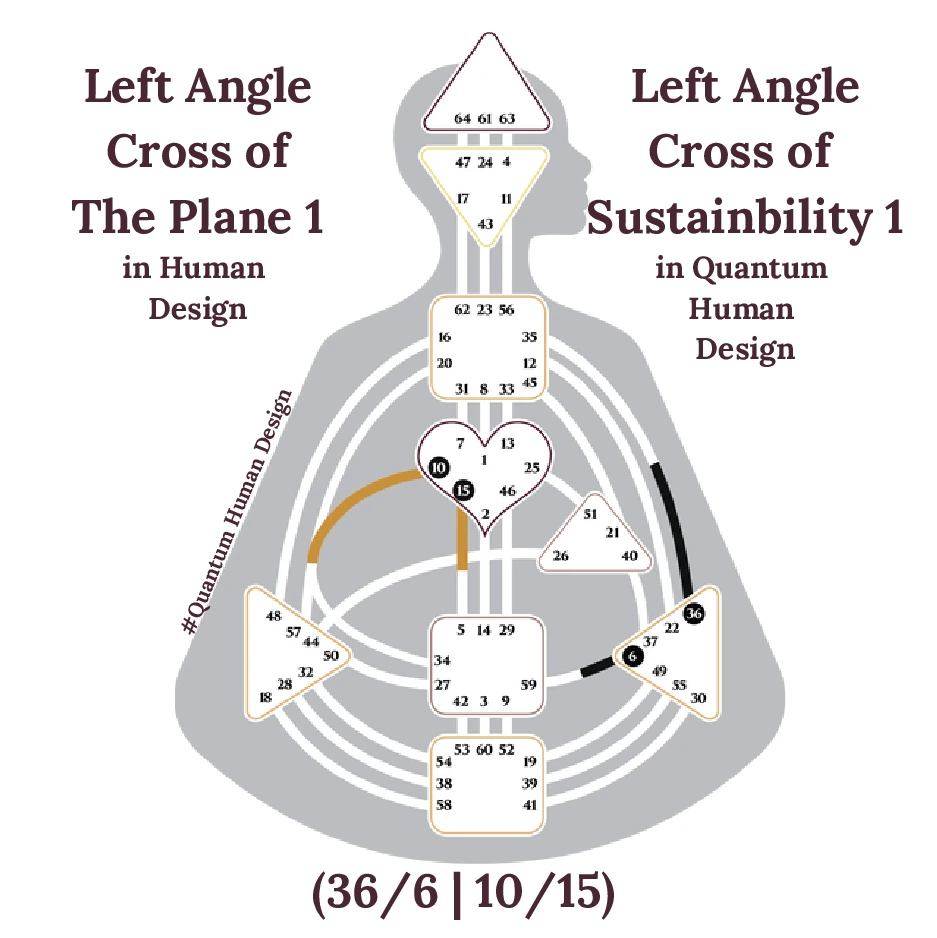
Primary Energy Flow: Crisis → Friction → Love of Self → Extremes
This variation begins with the emotional impulse for experience (Gate 36), making it the most emotionally driven configuration. The journey begins with desire, progressing through friction to self-empowerment and rhythmic stability.
Characteristic Traits
- Leads with emotional intensity and desire for experience
- Naturally creates friction in interactions as a teaching tool
- Develops self-empowerment through emotional experiences
- Establishes unique rhythms through trial and error
Professional Expression
- Excels in roles requiring emotional intelligence and crisis management
- Natural ability for transformational coaching and counseling
- Effective at helping others navigate change and uncertainty
- Strong at creating systems that honor individual rhythms
Relationship Dynamics
- Forms connections through shared emotional experiences
- Creates transformative friction that deepens bonds
- Models self-love and empowerment for partners
- Establishes relationship rhythms that may seem unconventional
Challenge Areas
- May create an unnecessary crisis when bored
- Can overwhelm others with emotional intensity
- Needs to distinguish between healthy and destructive friction
- Must learn that not everyone wants extreme rhythms
Life Purpose
This variation is designed to guide others through emotional intensity toward self-empowerment by demonstrating how crisis and friction, when properly navigated, lead to stronger self-love and more authentic life rhythms. They are the “storm navigators” who show others that turbulence can lead to clarity.
Left Angle Cross of The Plane 2 (6/36 | 15/10)
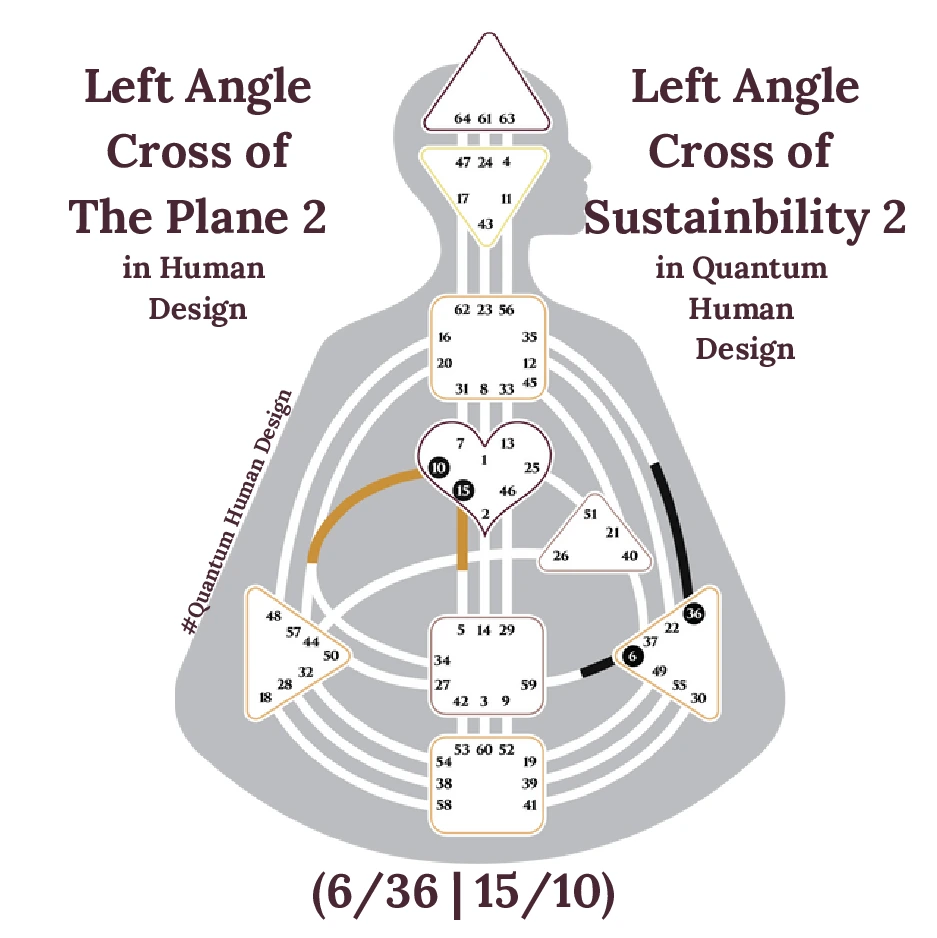
Primary Energy Flow: Friction → Crisis → Extremes → Love of Self
Leading with friction (Gate 6), this variation emphasizes the penetrating, connecting energy that initiates emotional experiences, ultimately building toward empowered self-love through establishing appropriate rhythms first.
Characteristic Traits
- Leads with energetic presence and natural magnetism
- Creates emotional experiences through authentic connection
- Establishes unique patterns before deepening into self-love
- Develops empowerment through rhythmic consistency
Professional Expression
- Excels in roles requiring authentic presence and influence
- Natural talent for facilitation and group dynamics
- Effective at establishing new organizational rhythms
- Strong at building cultures that honor individual empowerment
Relationship Dynamics
- Forms connections through energetic presence and authenticity
- Builds relationships through navigating challenges together
- Develops deeper self-love through partnership
- Maintains connections through established rhythms
Challenge Areas
- May create friction without conscious awareness
- Needs to develop emotional awareness gradually
- Can struggle with appearing too intense initially
- Must learn to balance rhythm with empowerment
Life Purpose
This variation is designed to demonstrate how authentic presence and the willingness to create friction lead to meaningful experiences that, when grounded in appropriate rhythms, develop genuine self-empowerment. They are the “rhythm setters” who demonstrate to others that sustainable empowerment begins with establishing patterns.
Focus and External Expression of Each Variation
Each variation expresses itself differently in the world:
36/6 | 10/15: The Emotional Navigator – Guides others through crisis and friction toward self-empowerment and sustainable rhythms
6/36 | 15/10: The Rhythm Keeper – Demonstrates how authentic presence and established patterns create space for emotional experiences that build self-love
While both variations of the Left Angle Cross of the Plane have the potential to guide others through emotional intensity toward empowerment, each configuration offers a unique pathway. The order of gates influences how the individual initiates experiences, navigates challenges, relates to others, and ultimately serves their transpersonal purpose.
Application of the Left Angle Cross of the Plane to Your Professional Life
Your Left Angle Cross of the Plane brings distinctive abilities that make you particularly valuable in professional roles requiring emotional intelligence, crisis management, and the creation of sustainable systems. Your Gate 36 allows you to understand and navigate emotional intensity, while Gate 6 brings the penetrating presence needed for authentic impact. Gate 10 ensures you model self-empowerment, and Gate 15 helps you establish rhythms that honor individual differences.
Your Natural Professional Gifts
In the workplace, your Cross of the Plane creates a unique signature that makes you especially effective at:
- Navigating organizational crises with emotional intelligence
- Creating authentic connections that transform workplace culture
- Modeling empowered leadership through personal responsibility
- Establishing systems that honor individual rhythms and needs
Ideal Professional Roles
Your cross naturally excels in positions that involve:
- Crisis management and organizational transformation
- Human resources and people development
- Coaching and counseling services
- Creating flexible work systems and policies
- Change management consulting
- Therapeutic professions
- Cultural development and diversity initiatives
- Any role requiring emotional intelligence and authentic presence
Real-World Applications
Consider this scenario: An organization faces a significant crisis that has triggered emotional responses throughout the team. While others focus on quick fixes or avoiding the discomfort, your Gate 36 helps you understand the emotional undercurrents. Your Gate 6 enables you to form authentic connections with individuals affected by the situation. Your Gate 10 models empowered responses rather than a victim mentality, and your Gate 15 helps establish new rhythms that prevent future crises.
Leadership Through Your Design
As a leader with the Left Angle Cross of the Plane, you have a distinctive approach:
- You don’t shy away from emotional intensity or organizational friction
- Your teams learn to navigate crises through your example
- You create cultures where self-empowerment is modeled and valued
- You establish rhythms that honor individual needs while serving collective goals
A Day in Your Professional Life
Here’s how your cross might express itself during a typical workday:
Morning Strategy: While your team reviews objectives, your Gate 6 creates an authentic presence that helps people feel genuinely seen. You naturally sense where friction exists and where it might be productive versus destructive.
Midday Crisis Response: When unexpected challenges arise, your Gate 36 helps you stay present with the emotional reality rather than bypassing it. You guide others through the intensity rather than around it.
Afternoon Pattern Building: As you work on systems and processes, your Gate 15 helps you create structures that allow for individual variation. Your Gate 10 ensures these systems support empowerment rather than dependency.
Building Your Career Path
When making career choices, look for environments that:
- Value emotional intelligence and authentic presence
- See crisis as an opportunity for transformation
- Support individual empowerment and personal responsibility
- Allow for flexible rhythms and unconventional approaches
- Appreciate depth over superficial harmony
The Left Angle Cross of the Plane in Your Intimate Relationships
As a carrier of the Left Angle Cross of the Plane, you bring a profound dynamic to intimate relationships. Through your Gate 36, you naturally seek deep emotional experiences and aren’t satisfied with surface-level connections. This intensity can be both magnetic and challenging for partners who may not understand your need for emotional depth and occasional crisis as a path to growth.

Your Gate 6 creates a penetrating presence that means partners can’t hide from themselves when they’re with you. This isn’t comfortable energy, but it’s transformative. Your Gate 10 models the self-love and empowerment you hope to see reflected back, while Gate 15 establishes relationship rhythms that may seem extreme or unconventional to others but work perfectly for you.
Making Relationship Choices Through Your Left Angle Cross of the Plane
Understanding Your Attraction Patterns
With your Left Angle Cross of the Plane, you’ll notice distinct patterns in who you’re drawn to and who is drawn to you. Your Gate 36 often attracts people seeking emotional intensity and transformation, while your Gate 6 draws those who need someone willing to create productive friction in their lives.
Recognizing Healthy vs. Unhealthy Attractions
Your cross makes you particularly magnetic to people seeking emotional guidance and transformation, but this can manifest in two distinct ways:
Healthy Attractions Look Like:
- Partners who can handle emotional intensity without becoming overwhelmed
- People who value self-empowerment and personal responsibility
- Relationships where both partners navigate a crisis together
- Connections that honor each person’s unique rhythm
Unhealthy Attractions Might Include:
- People addicted to drama and chaos without growth
- Partners who depend on you to manage their emotions
- Relationships where friction becomes destructive rather than transformative
- Connections where your need for intensity creates constant instability
Creating Balanced Partnerships
Your ideal partnerships often include:
Mutual Emotional Capacity
Look for partners who:
- Can navigate emotional depth without losing themselves
- Value authentic friction as a growth opportunity
- Demonstrate their own self-empowerment
- Have established their own sustainable rhythms
Shared Growth Orientation
Seek connections where:
- Both partners see crisis as an opportunity for transformation
- Emotional intensity leads to deeper intimacy
- Self-love is practiced and modeled by both people
- Individual rhythms are honored within the relationship
Questions to Ask Yourself When Dating
When meeting potential partners, consider:
- “Can this person handle my emotional intensity without making me feel like I’m too much?”
- “Do they take personal responsibility for their experiences or play victim?”
- “Can they navigate friction without shutting down or becoming aggressive?”
- “Do they honor their own rhythms or constantly abandon themselves to please others?”
Building Sustainable Connections
The most sustainable relationships for your cross often develop through:
- Shared experiences of navigating challenges together
- Mutual commitment to personal empowerment
- Honoring each partner’s unique emotional needs
- Establishing relationship rhythms that work for both people
Remember, your Left Angle Cross of the Plane doesn’t mean you need constant crisis in your relationships. You’re most powerful in partnerships where both people can handle emotional depth when it arises, create productive friction that deepens connection, maintain self-love through challenges, and establish rhythms that honor both individuals. Your transpersonal purpose means the relationship itself becomes a teaching for others about navigating intensity with empowerment.
Parenting Through Your Design
Your Left Angle Cross of the Plane brings both unique gifts and challenges to your parenting journey. Your children benefit from your natural ability to:
- Navigate emotional intensity without shame or avoidance
- Create transformative friction when needed for growth
- Model self-empowerment and personal responsibility
- Honor each child’s unique rhythm rather than forcing conformity
Navigating Your Child’s Emotional Development
Whether it’s a toddler experiencing big feelings or a teenager navigating identity formation, your Gate 36 helps you stay present with emotional intensity rather than trying to bypass or fix it. For instance, when your child experiences disappointment or loss, you naturally provide space for the full emotional experience while demonstrating that these moments lead to growth.
Your Gate 6 creates an authentic presence that helps children feel genuinely seen, even when what you’re seeing isn’t comfortable. You might find yourself saying things like, “I see you’re really angry right now, and that’s okay. Let’s figure out what that anger is trying to tell you.”
Your Gate 10 models self-love and empowerment, teaching your children that they are responsible for their responses to life, even when they can’t control what happens to them. Your Gate 15 helps you honor each child’s unique rhythm rather than forcing everyone into the same pattern.
Creating Family Dynamics
Your presence naturally helps create a family environment where:
- Emotions are honored rather than suppressed
- Conflict is seen as an opportunity for deeper connection
- Personal responsibility is modeled and taught
- Each person’s unique needs and rhythms are respected
For example, during family challenges or transitions, you might find yourself naturally:
- Staying present with uncomfortable emotions
- Creating friction that helps family members grow
- Demonstrating empowered responses to difficulties
- Establishing rhythms that work for your unique family
The Balance of Intensity and Stability
One of your unique challenges as a parent with this cross is finding the balance between honoring emotional intensity and providing stable rhythms. Your Gate 36 might sometimes create or welcome crisis for growth opportunities, which can be confusing for children who need more predictability.
You might notice this playing out when:
- Your child needs routine, but you’re drawn to spontaneity
- They require emotional stabilit,y but you value intensity
- They want conventional rhythm,s but you model extremes
- They need you to be steady when your nature is transformative
Building Long-Term Resilience
Through your parenting style, you’re teaching your children invaluable life skills:
- How to navigate emotional intensity without being overwhelmed
- The value of authentic presence over superficial harmony
- The importance of personal empowerment and responsibility
- How to honor their unique rhythm rather than conforming to others’ expectations
A Personal Experience
Consider this scenario: Your child faces significant peer conflict at school. While other parents might try to fix the situation or minimize the emotional impact, your Left Angle Cross of the Plane guides you differently:
- Your Gate 36 helps you stay present with their emotional pain
- Gate 6 creates space for authentic dialogue about the conflict
- Gate 10 guides them toward empowered responses rather than victimhood
- Gate 15 helps them establish boundaries that honor their needs
As the situation unfolds, you might create opportunities for them to:
- Fully experience and express their emotions
- Understand how friction can deepen genuine friendships
- Take personal responsibility for their part in the conflict
- Establish rhythms and boundaries that prevent future similar situations
Your role isn’t to shield them from all friction or intensity, but to guide them in navigating these experiences with self-love and empowerment. Through your example, they learn that emotional depth and occasional crisis are natural parts of life that, when navigated consciously, lead to greater self-knowledge and more authentic relationships.
Frequently Asked Questions About the Left Angle Cross of the Plane
What makes the Left Angle Cross of the Plane different from other incarnation crosses?
The Left Angle Cross of the Plane is unique because it carries a transpersonal karma, meaning individuals with this cross are designed to impact others through their personal journey of navigating emotional intensity toward self-empowerment. Unlike Right Angle Crosses, focused on personal destiny, people with the Left Angle Cross of the Plane serve as living examples of how to move through crisis and friction while maintaining self-love and establishing appropriate rhythms.
How do I know which variation of the Left Angle Cross of the Plane I have?
Right Angle Crosses represent personal destiny, with your purpose centered on your individual journey and self-discovery. Left Angle Crosses, like the Left Angle Cross of the Plane, represent transpersonal or interpersonal karma - your purpose is fulfilled through interactions with others. You're here to impact, teach, and transform others through your experiences. Right Angle Crosses are about 64% of the population, while Left Angle Crosses make up about 34%
Does the Left Angle Cross of the Plane work differently for different Human Design Types?
Yes, your Type (Generator, Projector, Manifestor, or Reflector) determines HOW you live out your cross's purpose, while the cross itself represents WHAT that purpose is. For example, a Generator with the Left Angle Cross of the Plane navigates emotional intensity through responding, whereas a Projector with the same cross does so by waiting for invitations and recognition. Your Strategy and Authority always come first in decision-making.
How does my profile interact with the Left Angle Cross of the Plane?
Left Angle Crosses only appear with profiles 5/1, 5/2, 6/2, and 6/3. Your profile influences how you embody your cross's energy. A 5/1 with the Left Angle Cross of the Plane may project solutions to emotional crises, seeking stable foundations. In contrast, a 6/3 might model emotional mastery through three life phases - experimentation, withdrawal, and authentic leadership.
Can my Left Angle Cross of the Plane change over time?
No, your Incarnation Cross is fixed at birth and doesn't change. However, how you EXPRESS it evolves as you mature, decondition, and align with your Strategy and Authority. Many people don't fully embody their cross until later in life. It's not something that automatically emerges - you awaken IN it rather than TO it as you become more differentiated.
How do I live in alignment with the Left Angle Cross of the Plane?
Living in alignment means following your Type's Strategy and Authority first, which naturally allows your cross to emerge. For the Left Angle Cross of the Plane specifically, this means: honoring your emotional intensity without creating unnecessary drama, allowing productive friction without forcing it, maintaining self-love through challenges, and establishing rhythms that celebrate your unique needs. Your cross isn't something you "do" - it's what naturally happens when you're living as yourself.
What if I don't resonate with the description of my Left Angle Cross of the Plane?
This can happen for several reasons: you may still be heavily conditioned by your environment, you haven't yet begun living according to your Strategy and Authority, you're in an early life phase (particularly if you're a 6/2 or 6/3 profile under age 30), or you're looking for your cross to be a "doing" rather than a natural "being." Your Incarnation Cross emerges through living your design correctly, not through trying to act it out.
At what age does the Left Angle Cross of the Plane become more prominent?
While your cross is active from birth, most people don't fully embody their Incarnation Cross until their Saturn Return (around age 28-30) or later. If you have a 6th line profile (6/2 or 6/3), you may not fully express your cross until after age 50 when you complete the three phases of the 6th line process. The cross unfolds naturally as you decondition and mature into your authentic self.
How does the Left Angle Cross of the Plane affect career choices?
Individuals with the Left Angle Cross of the Plane tend to excel in careers that require emotional intelligence, crisis management, and the ability to create systems that honor individual differences. They thrive in roles such as coaching, counseling, human resources, organizational transformation, and any field where navigating emotional intensity and modeling empowerment is valuable. Their unique ability to stay present with friction and crisis while maintaining self-love makes them particularly effective in helping professions and leadership roles during times of change.
Can people with the Left Angle Cross of the Plane have stable relationships?
Absolutely. While individuals with the Left Angle Cross of the Plane bring emotional intensity and may create friction in relationships, this doesn't prevent stable partnerships. In fact, their relationships often become deeply transformative and authentic. The key is finding partners who can handle emotional depth, value authentic friction as a growth opportunity, maintain their own empowerment, and honor individual rhythms. When these elements are present, relationships with people who have the Left Angle Cross of the Plane can be profoundly stable and growth-oriented.
Is the emotional intensity of the Left Angle Cross of the Plane exhausting?
The emotional intensity can be challenging, particularly if the individual hasn't learned to honor their unique rhythms (Gate 15) or maintain self-love (Gate 10) through the experiences. However, when properly understood and navigated, this intensity becomes their gift rather than their burden. The key is recognizing that not every moment requires crisis (Gate 36) and that friction (Gate 6) should be productive rather than destructive. As people with this cross mature in their understanding, they learn to channel their intensity in ways that serve both themselves and others.
How do the two variations of the Left Angle Cross of the Plane differ?
The primary difference lies in the energy flow. Variation 1 (36/6 | 10/15) leads with emotional desire and crisis, moving through friction toward empowerment and rhythm. These individuals tend to initiate experiences through emotional intensity. Variation 2 (6/36 | 15/10) leads with friction and authentic presence, establishing rhythms before deepening into emotional experiences that build self-love. These individuals tend to create space through their presence first, then navigate the emotional intensity that emerges.
What does it mean that the Left Angle Cross of the Plane has a transpersonal karma?
Transpersonal karma means that individuals with the Left Angle Cross of the Plane are here not just for their own personal growth but to impact others through their experiences. Their journey of navigating emotional intensity, creating productive friction, developing self-empowerment, and establishing authentic rhythms serves as a valuable teaching for their community. They demonstrate through lived experience how to move through crisis toward empowerment, and others learn from witnessing and interacting with them.
How can someone with the Left Angle Cross of the Plane avoid creating unnecessary drama?
The key is distinguishing between productive intensity that leads to growth and destructive drama that simply creates chaos. This requires developing awareness around Gate 36 (Crisis) to differentiate between authentic desires for new experiences and boredom-driven escapism. It also requires understanding Gate 6 (Friction) to know when penetrating energy serves transformation versus when it's just being disruptive. Grounding in Gate 10 (Love of Self) helps maintain empowerment rather than victimhood, while Gate 15 (Extremes) supports finding sustainable rhythms rather than constantly seeking crisis.
Can the Left Angle Cross of the Plane be compatible with other crosses?
Yes, compatibility in Human Design is complex and depends on many factors beyond just incarnation crosses. The Left Angle Cross of the Plane can be highly compatible with crosses that value emotional depth, authentic presence, and personal empowerment. Right Angle Crosses, focused on personal mastery, often appreciate the transpersonal teaching the Left Angle Cross of the Plane provides. Left Angle Crosses oriented toward a relationship or community can create beautiful partnerships. The key is finding individuals who honor emotional intensity and are committed to their own empowerment rather than depending on others to manage their experiences.
Your Journey: Emotional Mastery Through Empowered Rhythm
Your Left Angle Cross of the Plane carries a profound transpersonal purpose in the human story. Through the interaction of your four gates – the experiential intensity of Gate 36, the penetrating presence of Gate 6, the empowerment of Gate 10, and the rhythmic uniqueness of Gate 15 – you’re designed to be a living demonstration of emotional mastery through self-love and appropriate boundaries.
While you naturally experience and even seek emotional intensity, your true gift isn’t just in navigating crisis but in showing others how friction and intensity, when met with self-empowerment and sustainable rhythms, become pathways to deeper authenticity and self-love. Your presence reminds others that avoiding emotional depth or friction doesn’t create peace; true stability comes from learning to navigate intensity while maintaining self-love and honoring individual needs.
Whether in your professional life, intimate relationships, or parenting journey, you serve as a living bridge between emotional intensity and empowered stability. Your experiences demonstrate that sustainable empowerment comes not from avoiding crisis but from developing the self-love and appropriate rhythms that allow you to move through intensity without losing yourself. By understanding and embracing your design, you become not just someone who experiences deeply, but a guide showing others how to navigate emotional turbulence toward greater self-love and authentic expression.
This isn’t always an easy path – it requires discernment about when friction is productive versus destructive, wisdom in establishing appropriate boundaries, and deep commitment to maintaining self-love even during crisis. Yet as you align with your cross’s energy, you demonstrate that true empowerment isn’t about avoiding intensity but about developing the internal stability and appropriate rhythms that allow you to experience the full range of human emotion while remaining centered in self-love.
Remember that your transpersonal karma means your role isn’t to rescue others from their emotional experiences or to create a crisis for its own sake. Instead, you’re here to demonstrate through your lived experience that emotional intensity, when navigated with self-love and appropriate rhythms, becomes the fertile ground for authentic empowerment. Through your unique combination of gates, you show others that the path to genuine self-love often moves through crisis and friction, requires establishing appropriate boundaries and rhythms, and ultimately leads to a more empowered and authentic way of being in the world.
Your presence allows others to tap into their emotional depth, create the necessary friction for growth, take full responsibility for their experiences, and establish rhythms that cater to their unique needs rather than conforming to conventional expectations. This is your gift to the collective – not just surviving emotional intensity, but transforming it into empowered, authentic living through self-love and appropriate rhythm.
Human Design Simplified – Get Your Free Human Design Chart.
Get your FREE Human Design Chart to check it out. Use your best guess to start with, and then you may want to find a Quantum Human Design Specialist to help you find the right time for you.
Remember that we all have ALL of the chart. If the Gate is colored in or defined, it’s part of your Soul Curriculum. If it’s white or undefined, it means you learn about this Gate through relationships with others or through the Transits.
At its core, Human Design is a unique system that offers profound insights into your inner self and how you interact with the world around you. Your Human Design chart is a valuable tool that can help you understand your true nature, discover your strengths and weaknesses, and unlock your full potential.
By downloading and reviewing your unique Human Design Chart you are embarking on a journey of self-discovery that will empower you to make conscious choices in all aspects of your life. Your chart is an Energy Blueprint of your unique energy configuration and contains valuable information about your personality traits, your natural talents, and your life purpose. With this knowledge, you’ll navigate life’s challenges with greater ease and clarity.
Human Design is a deeply empowering system that encourages us to embrace our true selves, rewrite our personal narrative, and live in alignment with our inner wisdom. When we align with our authentic nature, we tap into a wellspring of creativity, joy, and fulfillment that flows effortlessly through us.
There’s More – How To Learn More About Human Design
If you are trying to learn and apply Human Design to your life circumstances, but traditional Human Design rings a little off-key, you don’t quite connect with it, or it feels heavy as you read it. We invite you to explore training options with Quantum Human Design, internationally respected and time-tested training courses.
These courses will empower you to create a life filled with more money, better relationships, health and vitality, a rewarding career, and experience profound personal transformation.
Do you want to unlock the secrets of Quantum Human Design?
Why not join our on-demand Masterclass and discover the Transformative Power of Quantum Human Design
Curious about the difference between Human Design and Quantum Human Design? Karen Curry Parker explains it in this video:
BOOK NEWS
Quantum Wellness: Healing Your Mind, Body, and Spirit with Human Design

This comprehensive guide teaches readers to:
- Interpret bodily signals and uncover root causes of imbalance
- Utilize individual energetic blueprints for optimal well-being
- Transform limiting beliefs to align with one’s authentic self
Dr. Parker provides practical tools to unlock potential and create purposeful, vibrant lives.
This essential resource addresses core issues beyond symptoms, guiding readers on a transformative journey of self-realization and deep healing.
This book blends ancient Human Design wisdom with quantum physics, offering a revolutionary approach to holistic healing and personal transformation. Ideal for holistic practitioners, Human Design enthusiasts, and self-discovery seekers.