
Projectors in Human Design
A Projector in Human Design is a non-energy type that makes up 20-22% of the population. The Human Design Projector is one of the five Human Design types, characterized by an undefined sacral center—meaning Projectors don’t generate consistent energy like Generators and Manifesting Generators.
The Human Design Projector has a focused, penetrating, and absorbing aura that allows them to see deeply into others. Projectors in Human Design are natural guides, advisors, and directors of energy, making them exceptional coaches, consultants, and strategic leaders. However, the Projector energy type operates differently than Generator types—Projectors need more rest and work in focused energy bursts rather than sustained output.
The Projector strategy in Human Design is to wait for recognition and invitation before taking action in major life decisions like career, relationships, and living situations. When a Human Design Projector lives in alignment with their design, they experience their signature emotion of success. When out of alignment, Projectors feel bitterness—their not-self theme.
What is a Human Design Projector?
The Projector type in Human Design represents approximately 20-22% of the global population, making them the second most common energy type after Generators. Understanding the Human Design Projector begins with recognizing their most defining feature: the undefined or open sacral center.
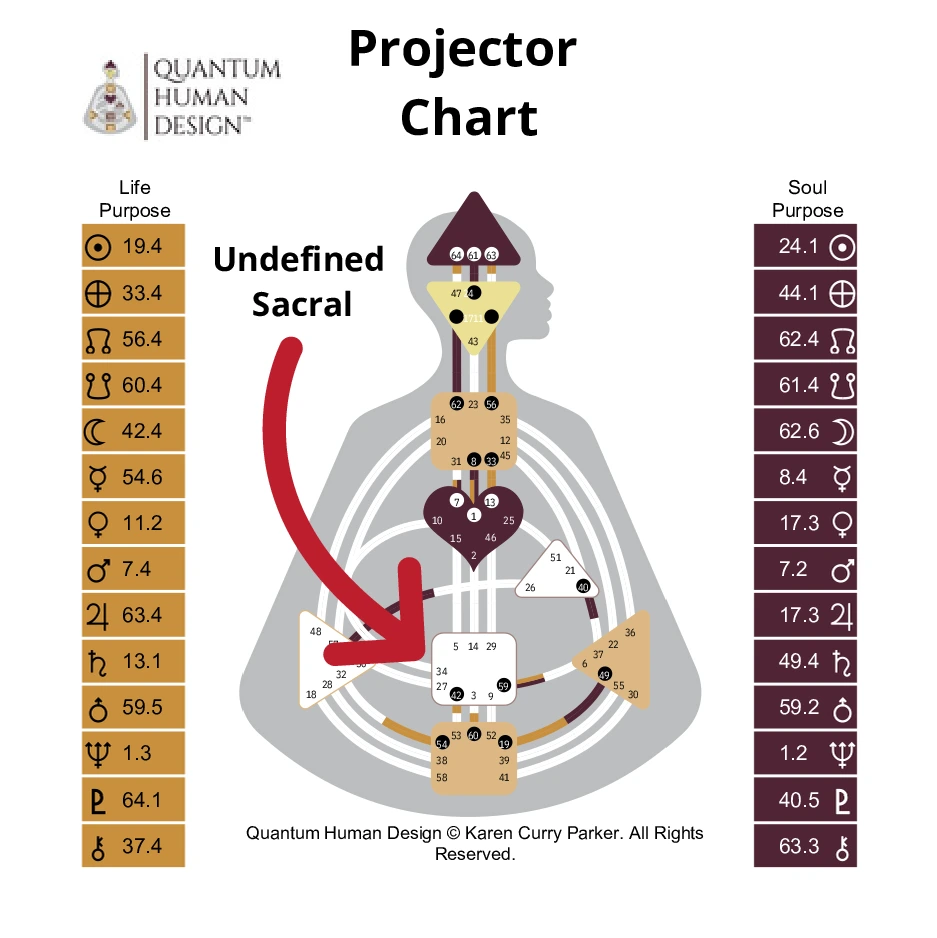
In Human Design, the sacral center is the powerhouse of sustainable energy. Generators and Manifesting Generators have a defined (colored) sacral center, giving them consistent energy for 8-12 hours daily. Projectors have an undefined (white) sacral center, which means they are classified as a non-energy type along with Manifestors and Reflectors.
Key Characteristics of Human Design Projectors:
Population: 20-22% of humanity
Aura Type: Focused, penetrating, and absorbing
Strategy: Wait for recognition and invitation
Signature Emotion: Success (when in alignment)
Not-Self Theme: Bitterness (when out of alignment)
Defining Feature: Undefined/open sacral center (non-energy type)
Natural Role: Guide, advisor, strategist, and energy director
Energy Pattern: Works in focused bursts, needs significant rest
The Human Design Projector energy type excels at seeing the big picture, understanding people deeply, and guiding others to use their energy more effectively. When Projectors wait for genuine recognition and invitation, they experience profound success in their lives and relationships.
The Human Design Projector Aura: Focused and Penetrating
The Projector aura in Human Design is one of the most distinctive features of this energy type. Unlike the open, enveloping aura of Generators or the closed, repelling aura of Manifestors, the Human Design Projector aura is focused, penetrating, and absorbing—almost like a laser beam that locks onto another person’s energy field.
This unique Projector aura design allows Human Design Projectors to:
- See deeply into others, often understanding people better than they understand themselves
- Read energy and potential with remarkable accuracy
- Focus intensely on the G Center (identity center) of others
- Absorb and amplify the energy of people around them
- Penetrate into another’s aura to gain profound insights
Think of the Human Design Projector aura like a spotlight at a theater. While a Generator’s aura is like ambient lighting filling a room, the Projector’s aura is concentrated and directed. It penetrates into the other person’s aura, which is why Projectors in Human Design can feel so intimate and intense in one-on-one interactions.
This penetrating quality is also why Projectors in Human Design need to wait for an invitation. When a Projector’s aura enters someone’s space without invitation or recognition, it can feel invasive or overwhelming to the other person. But when someone genuinely invites the Projector’s guidance, that penetrating aura becomes a profound gift—offering insights that can be truly transformational.
Human Design Projectors Are Non-Energy Types: The Undefined Sacral Center
The defining characteristic of all Human Design Projectors is an undefined or open sacral center. The sacral center is the powerhouse of sustainable life-force energy in Human Design. It’s what allows Generators and Manifesting Generators (who make up 70% of the population) to work consistently for 8-12 hours a day.
Human Design Projectors, along with Manifestors and Reflectors, do not have this consistent energy source defined. This is why Projectors in Human Design are classified as non-energy types.
What the Undefined Sacral Means for Projectors in Human Design:
Energy Comes in Waves: Human Design Projectors don’t have steady, sustainable energy throughout the day. Projector energy ebbs and flows, requiring them to work in focused bursts with rest periods in between.
Amplification, Not Generation: Projectors in Human Design amplify and direct the energy of others but don’t generate it themselves. When a Human Design Projector is around Generators, they may feel energized and productive. When alone, Projectors often feel their natural energy levels, which are lower.
Rest is Non-Negotiable: Because Human Design Projectors don’t generate energy, they deplete faster than energy types. Adequate rest, sleep, and downtime are essential for Projector health and well-being.
Different Work Rhythms: The traditional 9-to-5, 40-hour work week was designed by and for Generators. Projectors in Human Design thrive with more flexible schedules, ideally working 3-5 focused hours per day with breaks.
The undefined sacral center is not a weakness in the Human Design Projector—it’s a design feature. It frees Projectors from the obligation to “do” constantly and positions them perfectly to “see” and guide others.
The Projector Strategy in Human Design: Wait for Recognition and Invitation
The Human Design Projector strategy is one of the most misunderstood aspects of this type, yet it’s crucial for Projector success and wellbeing. The Projector strategy is to wait for recognition and invitation before initiating major life decisions.
Recognition Comes First for Human Design Projectors
Recognition is not the same as attention for Projectors in Human Design. Projectors naturally attract attention because of their magnetic aura—people notice them. But recognition is deeper. It means someone truly sees the Projector’s specific gifts, talents, and wisdom.
For Human Design Projectors, recognition feels like:
- Someone valuing your specific perspective and insights
- Being acknowledged for your unique abilities and wisdom
- People seeking you out for your particular expertise
- Feeling genuinely seen for who you are, not just noticed
Then Comes the Invitation for Projectors
After recognition comes invitation. Invitations are energetic openings where someone asks the Human Design Projector to share their guidance, join a project, enter a relationship, or take on a role.
For Human Design Projectors, invitations for major life decisions include:
- Career and work opportunities (job offers, business partnerships, career moves)
- Romantic relationships (being asked on dates, marriage proposals, moving in together)
- Living situations (invitations to relocate, change homes, or live with others)
- Major commitments (joining organizations, leadership roles, significant projects)
What About Everyday Life for Projectors in Human Design?
Many Human Design Projectors often wonder if they need invitations for every occasion. The answer is no. The Projector invitation strategy primarily applies to the significant, life-changing decisions like those listed above.
For everyday interactions, Human Design Projectors:
- Don’t need an invitation to speak in everyday conversation
- Can initiate casual friendships and social interactions
- Can share their passions and interests online or in person
- Can create content, start a business, or pursue their interests
- Can offer insights in appropriate contexts
The key for Projectors in Human Design is understanding that sharing without imposing your guidance on others who haven’t asked for it helps you avoid resistance and bitterness.
Why the Projector Strategy Matters in Human Design
When Human Design Projectors force, push, or initiate without recognition and invitation:
- They encounter resistance from others
- Their guidance is dismissed or undervalued
- They waste precious energy
- They experience burnout and bitterness (the Projector not-self theme)
When Human Design Projectors wait for correct recognition and invitation:
- Their guidance is valued and implemented
- They have access to the energy resources of those who invited them
- They feel successful and appreciated (the Projector signature)
- Their work has a genuine impact and influence
Projector Authority: How Projectors Make Decisions
While strategy tells Projectors when to act (after invitation), authority tells them which invitations are correct. Not every invitation is right for a Projector, even if it seems appealing on the surface.
Projectors have the most variety in inner authority types of all the Human Design types. Here are the five authority types for Projectors:
1. Emotional Authority
Approximately 47% of Projectors have emotional authority (defined Solar Plexus center).
Emotional Projectors make decisions by riding their emotional wave. They need time to achieve emotional clarity before committing to invitations. Emotional Projectors should never make decisions in the heat of the moment, whether they are excited or deeply discouraged.
Decision-making process: Wait at least 24-72 hours (or longer for major decisions) to experience your emotional wave, checking in with how you feel about the invitation at different emotional states.
Learn more about emotional authority in Human Design.
2. Splenic Authority
Approximately 31% of Projectors have splenic authority (defined Spleen center, undefined Solar Plexus).
Splenic Projectors make decisions through instantaneous intuitive knowing. The Spleen speaks once, in the present moment, as a quiet inner voice or gut instinct. If you miss it, it’s gone.
Decision-making process: Trust your immediate, in-the-moment intuitive hits about invitations. Don’t second-guess or overthink.
Learn more about splenic authority in Human Design
3. Self-Projected Authority
Approximately 11% of Projectors have self-projected authority (defined G Center connected to Throat, undefined Solar Plexus and Spleen).
Self-Projected Projectors find clarity by talking things through and hearing their own voice. The truth emerges through speaking, not thinking.
Decision-making process: Discuss invitations with trusted friends or even talk aloud to yourself. Listen to what you’re saying and the tone of your voice. Your truth will be revealed through your words.
Learn more about self-projected Projectors in Human Design.
4. Ego Authority (Ego-Projected or Ego-Manifested)
Approximately 2% of Projectors have ego authority (defined Heart/Ego center connected to G Center or Throat).
Ego Projectors make decisions based on what they genuinely want and what commitments they’re willing to make. This is about honoring personal desires without guilt.
Decision-making process: Ask yourself, “What do I truly want?” and “Am I willing to commit to this?” If there’s a genuine heart-centered yes, proceed.
Learn more about ego authority in Human Design.
5. Mental/Environmental Authority (No Authority)
Approximately 9% of Projectors are Mental Projectors with no defined centers below the Throat.
Mental Projectors make decisions through their environment and conversations with trusted others. They process information mentally, but shouldn’t “think” their way to decisions.
Decision-making process: Discuss invitations with a variety of trusted friends over time. Visit the physical environment if relevant. Let clarity emerge naturally through conversation and experiencing different spaces.
Learn more about Mental Projector authority.
Projector Signature: Success
The signature emotion for Projectors is Success. This is the emotional indicator that a Projector is living in alignment with their design.
Success for a Projector feels like:
- Being genuinely recognized for your specific gifts
- Having your guidance valued and implemented
- Receiving invitations that feel correct and aligned
- Making a real impact through your insights
- Feeling appreciated and acknowledged
- Being compensated fairly for your wisdom
- Experiencing ease and flow in your work
- Deep fulfillment from guiding others
Success is not just about money or achievement—it’s a felt sense of being in the right place at the right time with the right people, doing what you’re meant to do.
When Projectors experience consistent success, they know they’re:
- Following their strategy (waiting for an invitation)
- Honoring their authority (choosing correct invitations)
- Using their energy wisely
- Being recognized for their actual value
Learn more about Human Design signatures.
Projector Not-Self Theme: Bitterness
When Projectors are not living in alignment with their design, they experience bitterness. This is the not-self theme—the emotional warning sign that something is off.
Bitterness arises when:
- Projectors initiate without waiting for an invitation
- Their guidance is consistently ignored or undervalued
- They’re not recognized for their true gifts
- They’re working in the wrong environment or role
- They’re exhausted from trying to keep up with the energy of the Generators around them
- They give advice that wasn’t asked for and face resistance
- They compromise themselves to fit in
Bitterness can manifest as:
- Resentment toward others who seem to “have it easier”
- Cynicism about life and opportunities
- Feeling invisible or overlooked
- Frustration about wasted effort and energy
- Questioning their own value and worth
- Withdrawal from social interaction
Bitterness is not a character flaw—it’s feedback. When you notice bitterness arising, it’s your body’s way of saying: “Something needs to change. You’re not honoring your design.”
The remedy for bitterness:
- Return to your strategy (wait for invitation)
- Honor your authority (choose wisely)
- Rest and restore your energy
- Reevaluate your commitments
- Seek environments where you’re recognized
Learn more about the Human Design not-self theme.
Common Human Design Projector Myths Debunked
There are several misconceptions about Projectors in Human Design that can lead to confusion, frustration, and living out of alignment with the Projector type. Let’s set the record straight on these Human Design Projector myths.
Myth #1: “Human Design Projectors Are Lazy”
The Truth: Projectors in Human Design are not lazy—they have a different energy design than the Generator types. The confusion arises from comparing Human Design Projectors to Generators, who comprise 70% of the population and possess sustainable sacral energy for 8-12 hours of work daily.
Human Design Projectors work in focused bursts and need more rest to recharge. This isn’t laziness; it’s biological design. In fact, Projectors are often highly efficient and accomplish more in 3-4 focused hours than others do in a full day because the Projector energy type works with laser-like precision.
Myth #2: “Projectors in Human Design Need an Invitation for Everything”
The Truth: Invitations are required for major life decisions (career, relationships, living situations), not everyday interactions for Projectors in Human Design. Human Design Projectors can:
- Start conversations with strangers
- Share their interests and passions online
- Create content and offers in their business
- Initiate casual friendships
- Speak up in normal social settings
The Projector invitation strategy is about ensuring your guidance is wanted in significant, life-changing contexts—not about being passive in all areas of life.
Myth #3: “Human Design Projectors Don’t Have Energy”
The Truth: Projectors in Human Design have energy, but it functions differently than Generator energy. They lack consistent, sustainable sacral energy; however, many Human Design Projectors have defined motor centers (Root, Heart, Solar Plexus) that provide energy.
The key difference is that Projector energy in Human Design operates in waves, rather than a steady stream. Human Design Projectors are designed to direct and amplify energy rather than generate it consistently.
Myth #4: “Projectors Can’t Be Successful in Traditional Careers”
The Truth: Many Human Design Projectors succeed in traditional employment, but they often need to find ways to work within their Projector energy design. This might mean:
- Negotiating flexible schedules
- Taking more breaks during the workday
- Finding roles that value insight over output
- Working 4-day weeks when possible
- Building in rest time
Success for Projectors in Human Design comes from being recognized and invited into the role, not from the type of career itself.
Myth #5: “Waiting Means Being Passive for Projectors”
The Truth: Waiting for invitation is an active, intentional practice for Human Design Projectors. While waiting, Projectors should:
- Develop their mastery and expertise
- Share their passions and interests
- Build their visibility and presence
- Study systems and people
- Rest and restore their energy
Waiting for Projectors in Human Design is about energetic readiness and correct timing, not sitting idle, hoping someone notices you.
Myth #6: “Human Design Projectors Can’t Work with Their Hands or Be Athletic”
The Truth: Projectors in Human Design can excel in any field, including physical work, athletics, sports, and hands-on crafts. Your Human Design type describes how you use energy, not what you do.
Famous Projector athletes include Michael Jordan, Megan Rapinoe, and others who reached the pinnacle of physical achievement. The key for Human Design Projectors is honoring your need for rest and being in the right role where you’re recognized.
Projector Strengths and Characteristics
Projectors bring unique gifts to the world. Here are the key strengths and characteristics:
Strengths
Deep Insight and Perception: Projectors see what others miss. They recognize patterns, potential, and possibilities that are invisible to other types.
Natural Guides and Advisors: Projectors excel at guiding others to use their energy more effectively. They’re strategic thinkers who understand systems intuitively.
Efficiency Experts: Projectors naturally find the most efficient path to a goal. They see shortcuts and streamlined approaches that save time and energy.
Magnetic Presence: Projectors have a natural magnetism that draws people to them. Even without trying, they attract attention and interest.
Understanding of Others: The Projector aura allows them to understand people at a profound level, often seeing others more clearly than they see themselves.
Mastery and Expertise: Projectors are designed to become masters of systems, whether it’s Human Design, business strategy, psychology, or any field they’re passionate about.
Wisdom Keepers: Projectors accumulate wisdom through observation and study. They’re often the wise counsel people seek during difficult decisions.
Potential Challenges
Energy Management: Projectors must learn to manage their non-sustainable energy wisely, which can be challenging in a Generator-paced world.
Recognition Wounds: Many Projectors carry deep wounds from not being seen or valued for who they truly are.
Bitterness: When out of alignment, Projectors can become deeply bitter about their circumstances and others’ success.
Sensitivity: Projectors are highly sensitive to their environment and the energy of others, which can be overwhelming.
Burnout: Pushing to keep up with Generator energy leads to exhaustion, illness, and depletion.
Self-Doubt: Without external recognition, Projectors may doubt their value and worth.
As a Projector: A First-Person Perspective
If you’re a Projector reading this, you may be experiencing a mix of relief (“Finally, someone understands!”) and perhaps some resistance to what you’re learning.
Here’s what I want you to know, as someone who has worked with hundreds of Projectors:
You are not broken. The exhaustion you feel trying to keep up with everyone else isn’t a personal failing. You’re running on a different operating system, and when you try to function like a Generator, you short-circuit.
Your need for recognition is valid. You’re not needy or attention-seeking for wanting to be seen and valued. Recognition is literally part of your energetic design—it’s how you know you’re in the right place with the right people.
Rest is productive. When you rest, you’re not wasting time. You’re recharging, integrating insights, and preparing for the next invitation. Some of your most valuable insights come during rest periods.
You don’t have to prove your worth. The hustle culture message that you must constantly produce to have value is especially toxic for Projectors. Your worth isn’t in your output—it’s in your unique perspective and ability to see what others cannot.
Waiting can feel vulnerable. Trusting that invitations will come requires faith, especially in a world that tells you to “make things happen.” But when you wait for correct invitations, you avoid years of wasted energy on wrong paths.
Your guidance is valuable even when it’s not being asked for. Just because someone isn’t ready to receive your insight doesn’t mean it’s not worthwhile. It means they’re not your correct audience right now.
You’re allowed to be selective. Not every invitation is correct for you. Saying no to invitations that don’t feel right is just as important as saying yes to the ones that do.
Your sensitivity is a gift. Yes, it can be overwhelming, but your ability to read energy and people is what makes you such an effective guide.
You belong here. The world needs guides, advisors, and wise counsel now more than ever. Your role is essential, even if it doesn’t look like traditional productivity.
Types of Projectors: Understanding the Subtypes
While all Projectors share the undefined sacral center and the strategy of waiting for invitation, there are different subtypes based on which centers are defined. Understanding your subtype helps you work with your specific energy design.
Energy Projectors
Defined Motor Center: Solar Plexus, Heart/Ego, or Root (but not Sacral)
Energy Projectors have at least one motor center defined, giving them more available energy than other Projector subtypes. They may not experience the classic “low energy” Projector description as intensely.
These Projectors can sustain more activity but still need to honor their need for rest and avoid pushing through exhaustion. They’re often confused with Manifesting Generators because they have more energetic “umph” than typical Projectors.
Energy management tip: Even with more energy available, you’re still not designed for marathon work sessions. Work in focused bursts with rest periods.
Classic Projectors
No Defined Motors (except potentially Root): Splenic or Self-Projected Authority
Classic Projectors have no motor centers defined (or only the Root center) and typically have Splenic or Self-Projected authority. These Projectors most strongly embody the “lower energy” Projector archetype.
Classic Projectors need significant rest and are most susceptible to burnout when trying to keep up with Generator’s pace. They thrive in roles that value quality over quantity and insight over output.
Energy management tip: Build rest into your daily schedule, not just at the end of the day. You need multiple rest breaks throughout the day.
Mental Projectors
No Defined Centers Below the Throat: Environmental/Mental Authority
Mental Projectors are the rarest Projector subtype, making up only 2-3% of the population. They have no defined centers below the Throat, giving them an incredibly open and fluid energy field.
Mental Projectors take in and sample everyone’s energy around them. They’re designed to be in correct environments and to talk things through with trusted advisors when making decisions.
Energy management tip: Your environment matters more than for other types. Choose your physical spaces carefully and ensure you have trusted sounding boards for decisions.
Learn more about Mental Projectors in Human Design.
A Day in the Life of a Projector
Ever wonder what an ideal day looks like for a Projector living in alignment? Here’s a realistic example:
Morning (7:00 AM – 9:00 AM)
Wake up naturally without an alarm if possible (Projectors often need more sleep than they think). Rather than jumping into work immediately, spend time on gentle morning practices:
- Light stretching or yoga
- Meditation or journaling
- Reading or learning something new
- Having a nourishing breakfast
Key: Don’t rush into energy expenditure first thing. Allow your energy to build naturally.
Focused Work Period #1 (9:00 AM – 12:00 PM)
This is often peak energy time for Projectors. Engage in your most important work during this window:
- Client sessions or meetings
- Strategic planning
- Creative projects
- Deep focus work
Work in 90-minute focused blocks with short breaks. Stop when you feel your energy beginning to wane, not when it’s completely depleted.
Midday Rest & Nourishment (12:00 PM – 2:00 PM)
This is crucial for Projector sustainability:
- Lunch away from your workspace
- A 20-30 minute nap or rest period
- Time in nature or outdoors
- Light movement or errands
Key: This isn’t “lazy”—it’s recharging. Generators can power through; Projectors need restoration.
Focused Work Period #2 (2:00 PM – 4:00 PM)
A second, shorter work period for:
- Administrative tasks
- Communication and correspondence
- Lighter meetings or calls
- Wrapping up the day’s priorities
Notice this is only 2 hours, not 4-5. Honor where your energy actually is, not where you think it “should” be.
Evening Wind-Down (4:00 PM – 7:00 PM)
Transition out of work mode:
- Physical movement you enjoy (walking, dancing, gentle exercise)
- Creative hobbies with no pressure or agenda
- Social connection with people you enjoy
- Meal preparation or sharing dinner
Night Routine (7:00 PM – 10:00 PM)
Projectors benefit from going to bed before they’re exhausted:
- Wind down at least an hour before sleep
- Disconnect from screens and stimulation
- Take a bath or shower
- Read, journal, or gentle practices
- Aim to be in bed by 10:00-10:30 PM (before extreme tiredness hits)
Sleeping alone: Try sleeping alone at least 2-3 nights per week to fully discharge the energy you’ve absorbed from others throughout the day.
Total Focused Work Time: 4-5 hours
This might seem low compared to the standard 8-hour workday, but Projectors working 4-5 focused hours in alignment with their energy are more productive and effective than if they pushed for 8 hours and ended up bitter and burnt out.
The key is quality over quantity. A Projector’s guidance in the right moment can change the trajectory of an entire project. That’s worth more than 40 hours of uninspired grinding.
Energy, Sleep, and Rest for Projectors
Understanding Projector energy management is crucial for long-term health and success.
The Projector Energy Field
Because Projectors have an undefined sacral center, they don’t generate their own consistent life-force energy. Instead:
They amplify surrounding energy: When Projectors are around Generators or Manifesting Generators, they absorb and amplify that sacral energy. This can make them feel energized and productive.
They can mistake borrowed energy for their own: After spending time with high-energy people, Projectors may feel like they have sustainable energy—but it’s not theirs. When they’re alone, they return to their actual energy levels.
They need to discharge absorbed energy: Sleeping alone helps Projectors release the energy they’ve absorbed from others during the day.
Sleep Guidelines for Projectors
Go to bed before you’re exhausted: Generators are designed to work until they’re completely spent, then crash into bed. Projectors need to wind down gradually. Aim to be in bed 30-60 minutes before you’re truly tired.
Sleep alone when possible: Try sleeping alone 2-3 nights per week (or at least in separate beds with your partner 6 feet apart). This allows you to discharge absorbed energy fully.
Create a calming bedtime routine: Since projectors are highly sensitive to energy, establishing a consistent wind-down routine helps signal to your body that it’s time to rest.
Get 8-9 hours of sleep: Many Projectors need more sleep than other types. Honor this rather than forcing yourself to function on less.
Rest ≠ Sleep
Rest and sleep are different. Projectors need both:
Active rest: Gentle activities that restore without depleting (walking, reading, crafts, being in nature)
Passive rest: True downtime with no agenda (napping, lying down, meditation, just being)
Social rest: Time alone to reset from absorbing others’ energy
Mental rest: Breaks from decision-making, planning, and mental load
Build rest breaks into your day, not just at the end. Even 15 minutes of rest every 90 minutes can dramatically increase your sustainable energy.
Keys to Success for Projectors
Living successfully as a Projector requires understanding and honoring your unique design. Here are the keys:
1. Wait for Recognition and Invitation
This is your strategy for a reason. When you force, push, or initiate without invitation, you create resistance. When you wait for correct invitations, your guidance is valued, and you feel successful.
2. Know Your Authority
Study your specific authority type and practice using it. Your authority tells you which invitations are correct for you. Not every invitation is right, even if it seems appealing.
3. Become a Master
Projectors are designed to master systems. Choose something you’re genuinely passionate about and go deep. Your mastery is what attracts recognition.
Study options:
- Human Design itself
- Your professional field or craft
- Psychology and understanding people
- Strategy and systems thinking
- Any area that fascinates you
4. Cultivate Patience
Waiting for invitations requires patience and trust. Practice faith that the right invitations will come when you’re ready for them.
5. Guard Your Energy Fiercely
Your energy is precious and limited. Say no to energy drains:
- Wrong invitations
- Toxic people and environments
- Over-commitment
- Generator-paced expectations
6. Rest Without Guilt
Release the conditioning that rest is lazy or unproductive. Rest is how you recharge and integrate. Rested Projectors are successful Projectors.
7. Seek Recognition-Rich Environments
Place yourself in environments where your specific gifts are seen and valued. This might mean changing jobs, social circles, or even geographic locations.
8. Study People and Energy
Use your waiting time to observe, study, and understand people and systems. This makes you even more valuable when invitations arrive.
9. Build Visibility (Without Forcing)
Share your passions, interests, and insights in ways that feel natural. Create content, teach, write, speak—let people see what you’re about. This attracts correct invitations.
10. Learn to Recognize Bitterness Early
Bitterness is your warning system. When you feel it arising, pause and assess: Where am I out of alignment? What needs to change?
11. Create Projector-Friendly Structures
Design your life to support your energy:
- Flexible work schedules
- Shorter work hours
- Rest breaks built into the day
- Financial buffers to say no
- Supportive relationships
12. Say No to Wrong Invitations
Not every invitation is correct. Practice discerning between invitations that feel right (per your authority) and those that don’t. Saying no protects your energy for the right yeses.
Famous Projectors
Many successful, influential people are Projectors who have followed their design (whether they knew about Human Design or not). Here’s a comprehensive list of famous Projectors:
Political Leaders & Social Change
- Barack Obama – 44th President of the United States
- Nelson Mandela – Anti-apartheid revolutionary and South African president
- Queen Elizabeth II – Longest-reigning British monarch
- Winston Churchill – British Prime Minister during WWII
- Margaret Thatcher – First female British Prime Minister
- John F. Kennedy – 35th President of the United States
- Fidel Castro – Cuban revolutionary and politician
- Abraham Lincoln – 16th President of the United States
Actors & Entertainers
- Marilyn Monroe – Iconic actress and model
- Brad Pitt – Actor and film producer
- Denzel Washington – Actor and filmmaker
- Gerard Butler – Actor
- Woody Allen – Director, writer, actor
- Princess Diana – British royal and humanitarian
Athletes
- Michael Jordan – Basketball legend
- Megan Rapinoe – Soccer player and activist
Authors & Creators
- J.K. Rowling – Author of the Harry Potter series
- Osho (Bhagwan Shree Rajneesh) – Spiritual teacher and author
Artists & Innovators
- Salvador Dalí – Surrealist artist
- Paul McCartney – Musician, The Beatles
Scientists & Thinkers
- Stephen Hawking – Theoretical physicist
- Carl Gustav Jung – Psychologist and psychoanalyst
- Charles Darwin – Naturalist and biologist
Media & Entertainment
- Oprah Winfrey – Media mogul and philanthropist
- Steven Spielberg – Film director and producer
- Tony Robbins – Motivational speaker and coach
- Prince Harry – British royal and activist
Business & Innovation
- Steve Jobs – Co-founder of Apple (disputed by some sources)
Note: Human Design typing of famous people requires accurate birth data. Some famous Projectors may be disputed depending on birth time accuracy.
What these famous Projectors have in common:
- They were recognized for their unique perspective
- They guided and influenced others significantly
- They became masters in their fields
- They had a profound impact through their wisdom and vision
Frequently Asked Questions About Human Design Projectors
What is a Projector in Human Design?
A Projector in Human Design is a non-energy type characterized by an undefined or open sacral center. Human Design Projectors make up approximately 20-22% of the population and are designed to guide and direct the energy of others rather than generate consistent energy themselves. The Projector strategy in Human Design is to wait for recognition and invitation, and the Projector signature emotion is success. Projectors in Human Design have a focused, penetrating aura that allows them to see deeply into others and provide strategic guidance.
Are Human Design Projectors rare?
Human Design Projectors make up about 20-22% of the population, making them the second most common type after Generators (who make up about 70% combined with Manifesting Generators). While Projectors in Human Design are not the rarest type (Reflectors are at 1%), they are still a minority compared to the Generator types. However, certain Projector subtypes are quite rare. Mental Projectors in Human Design with no inner authority make up only 2-3% of the total population, making them one of the rarest configurations in Human Design.
How do I know if I’m a Projector in Human Design?
You can determine if you’re a Projector in Human Design by generating your Human Design chart, which requires your birth date, exact birth time, and birth location – https://freehumandesignchart.com/
The defining characteristic of all Human Design Projectors is an undefined or open sacral center (the square second from the bottom of the bodygraph chart). If your sacral center is white (undefined) rather than colored (defined), you’re likely a Projector, Manifestor, or Reflector.
To distinguish Projectors from other non-energy types: Projectors have an undefined sacral and no motor center connected to the throat. Manifestors have an undefined sacral but DO have a motor connected to the throat.
What does “wait for an invitation” mean for Human Design Projectors?
Waiting for invitation is the Projector strategy in Human Design. It means that Projectors should wait to be recognized and invited before initiating major life decisions such as:
– Career opportunities and job changes
– Romantic relationships and marriage
– Living situations and relocations
– Major commitments and leadership roles
The Human Design Projector invitation strategy does NOT apply to everyday interactions like:
– Casual conversations and socializing
– Starting friendships
– Sharing your interests online or creating content
– Creating businesses or offerings
– Speaking up in normal social settings
An invitation for a Human Design Projector is an energetic opening where someone genuinely wants your guidance, presence, or participation. You’ll feel the recognition behind the invitation when it’s correct for you.
Why do Human Design Projectors need more rest than other types?
Human Design Projectors need more rest because they have an undefined sacral center, which is the center of sustainable life-force energy in Human Design. Without a defined sacral, Projectors don’t generate their own consistent energy throughout the day.
Additionally, the Human Design Projector aura is absorbing—it takes in the energy of everyone around them. This can be energetically overwhelming and depleting. Rest allows Projectors in Human Design to:
– Discharge absorbed energy from others
– Recharge their own energy reserves
– Integrate insights and wisdom
– Avoid burnout and exhaustion
Human Design Projectors who push to keep up with Generator (defined sacral) energy often experience burnout, illness, and bitterness—the Projector not-self theme.
Can Human Design Projectors work full-time jobs?
Yes, many Human Design Projectors work full-time jobs successfully. However, the traditional 40-hour, 9-to-5 workweek was designed for Generator energy, so Projectors may need to adapt:
Strategies for Human Design Projectors in full-time work:
– Negotiate flexible schedules when possible
– Take more frequent breaks during the workday
– Choose roles that value quality and insight over sheer output
– Find work you’re genuinely passionate about (reduces energy drain)
– Ensure you’re recognized and valued in your role (proper invitation)
– Build in extra rest outside work hours
– Consider 4-day work weeks if available
The key for Projectors in Human Design is being invited into the role and working in an environment where your guidance is recognized and valued.
Are Projectors and Generators compatible in Human Design?
Yes, Human Design Projectors and Generators can have successful relationships, though they require understanding and respect for each other’s different energy designs.
What makes Projector-Generator relationships work:
– Generators in Human Design are designed to respond, and Projectors are designed to guide and ask questions
– Generators have consistent sacral energy that Projectors can help direct more efficiently
– Human Design Projectors can help Generators make better decisions about what to respond to
– Generators can provide energetic support, while Projectors provide strategic guidance
Potential challenges in Projector-Generator relationships:
– Generators may not understand the Projector’s need for rest
– Projectors may feel pressure to keep up with Generator energy
– Generators may feel the Projector’s guidance as intrusive if not invited
– Different work paces can create misunderstandings
Success requires both partners to understand each other’s Human Design and respect the differences.
What careers are best for Human Design Projectors?
Human Design Projectors excel in careers that leverage their natural abilities to guide, advise, and see the bigger picture. Some ideal career paths for Projectors include:
Guidance and Advisory Roles for Projectors:
– Coach or mentor
– Consultant or advisor
– Therapist or counselor
– Human Design reader or astrologer
– Career or life advisor
Leadership and Management for Projectors:
– Project manager
– Director or executive
– Strategic planner
– Operations manager
Education and Training for Projectors:
– Teacher or professor
– Workshop facilitator
– Trainer or educator
Creative and Strategic Roles for Projectors:
– Writer or author
– Designer
– Business strategist
– Systems analyst
Important note: Human Design Projectors can succeed in any field, including physical work and athletics. The key for Projectors isn’t what you do, but how you do it—with recognition, invitation, and respect for your energy needs.
How do Projectors in Human Design make money without initiating?
Human Design Projectors make money by building visibility, developing mastery, and attracting invitations—not by forcing sales or pushing their services on others.
Projector-friendly money strategies:
– Share valuable content that showcases your Projector expertise
– Build visibility through teaching, writing, speaking about your mastery
– Create offerings that people can opt into (energetic invitation)
– Allow people to self-select into your programs
– Develop mastery in a specific niche (Projectors are designed for mastery)
– Build a reputation as an expert in your field
– Network and build genuine relationships
– Wait for clients to come to you vs. cold pitching
Many successful Human Design Projector entrepreneurs create content, courses, and offerings that people can discover and choose to invest in—which is energetically an “invitation” because the client is self-selecting.
What is Projector bitterness in Human Design and how do I overcome it?
Bitterness is the Human Design Projector not-self theme—the emotional indicator that you’re out of alignment with your Projector design.
Bitterness arises in Human Design Projectors from:
– Initiating without waiting for invitation
– Not being recognized for your true value and wisdom
– Working in wrong environments
– Exhaustion from trying to keep up with Generator energy
– Giving unwanted advice
– Wrong invitations accepted
How Human Design Projectors can overcome bitterness:
– Return to your Projector strategy (wait for invitation)
– Honor your authority (choose correct invitations)
– Rest and restore your Projector energy
– Leave the wrong situations that don’t recognize you
– Seek environments where you’re recognized and valued
– Say no to invitations that don’t feel right
– Build Projector-friendly structures into your life
Bitterness in Human Design Projectors is feedback, not failure. It’s your body telling you something needs to change.
Can Human Design Projectors have defined motor centers?
Yes! Many Human Design Projectors have defined motor centers (Solar Plexus, Heart/Ego, or Root). These are called “Energy Projectors” in Human Design, and they have more available energy than Classic Projectors.
The defining feature of a Human Design Projector is the undefined sacral center, not the absence of all motor centers. Energy Projectors still need more rest than Generators and should honor their Projector strategy, but they may have more stamina than the typical “low energy” Projector description.
Learn more about Projector energy in Human Design – https://freehumandesignchart.com/human-design-projector-energy/
Discover If You’re a Human Design Projector
Curious whether you’re a Projector or another type? The only way to know for sure is to generate your Human Design chart using your birth date, exact birth time, and birth location.
Get your free Human Design chart now: Free Human Design Chart Calculator
When you get your Human Design chart, you’ll discover:
- Your Human Design type (Projector, Generator, Manifestor, Manifesting Generator, or Reflector)
- Whether you have an undefined sacral center (the key Projector indicator)
- Your authority (how you make decisions as a Projector or other type)
- Your profile (your life theme in Human Design)
- Your defined and undefined centers
- Your channels and gates
- And much more about your unique Human Design energetic blueprint
Understanding your Human Design—especially if you’re a Projector—can transform how you work, relate, make decisions, and live your life in alignment with your true nature.
Final Thoughts on Being a Human Design Projector
Human Design Projectors play an essential role in our world. In a society that often prioritizes action over insight and output over wisdom, Projectors in Human Design remind us that guidance matters profoundly.
You don’t have to be like everyone else to be valuable as a Human Design Projector. In fact, your value as a Projector comes precisely from being different—from seeing what others miss, from guiding with wisdom, from asking the right questions at the right time.
The Human Design Projector journey is about:
- Learning to wait when everything in the culture tells you to push and force
- Trusting your Projector energy design when others don’t understand it
- Valuing rest in a world that glorifies hustle
- Seeking recognition without apology as a Projector
- Choosing wisely which invitations to accept
- Becoming a master of what you love (Projectors are designed for mastery)
- Guiding others when you’re genuinely invited to do so
When Human Design Projectors honor their design, they experience success—not just material success, but the deep fulfillment of being in the right place, with the right people, doing what they’re meant to do.
The world needs your Projector wisdom. Wait for the invitation, trust your authority, and let yourself be seen.
Note: In Quantum Human Design™, Projectors are also known as Orchestrators. This alternative name emphasizes the Projector’s role in orchestrating and directing energy. Both terms—Projector and Orchestrator—refer to the same Human Design type with an undefined sacral center.
Continue Your Human Design Projector Journey
Ready to dive deeper into your Human Design as a Projector? Get your free personalized Human Design chart and discover the specific details of your unique Projector design, including your authority, profile, channels, and gates.
Learn More About Human Design:
- Human Design Types – Explore all five types
- Human Design Centers – Understanding your defined and undefined centers
- Human Design Profiles – Your life theme and role
- Your Incarnation Cross – Your life purpose in Human Design
- Human Design Sacral Center – Why the undefined sacral matters for Projectors
Understanding your Human Design type—especially if you’re a Projector—is just the beginning of a profound journey of self-discovery and alignment.
Curious about the difference between Human Design and Quantum Human Design? Karen Curry Parker explains it in this video above.

If you want to learn more about how to read your Human Design Chart, you might like this post

If this article has inspired you to want to learn about Human Design, click here.

If this has inspired you to want to know more about how to live your Quantum Human Design, click here
Want more content? Why not follow us on YouTube