What is a Mental Projector?
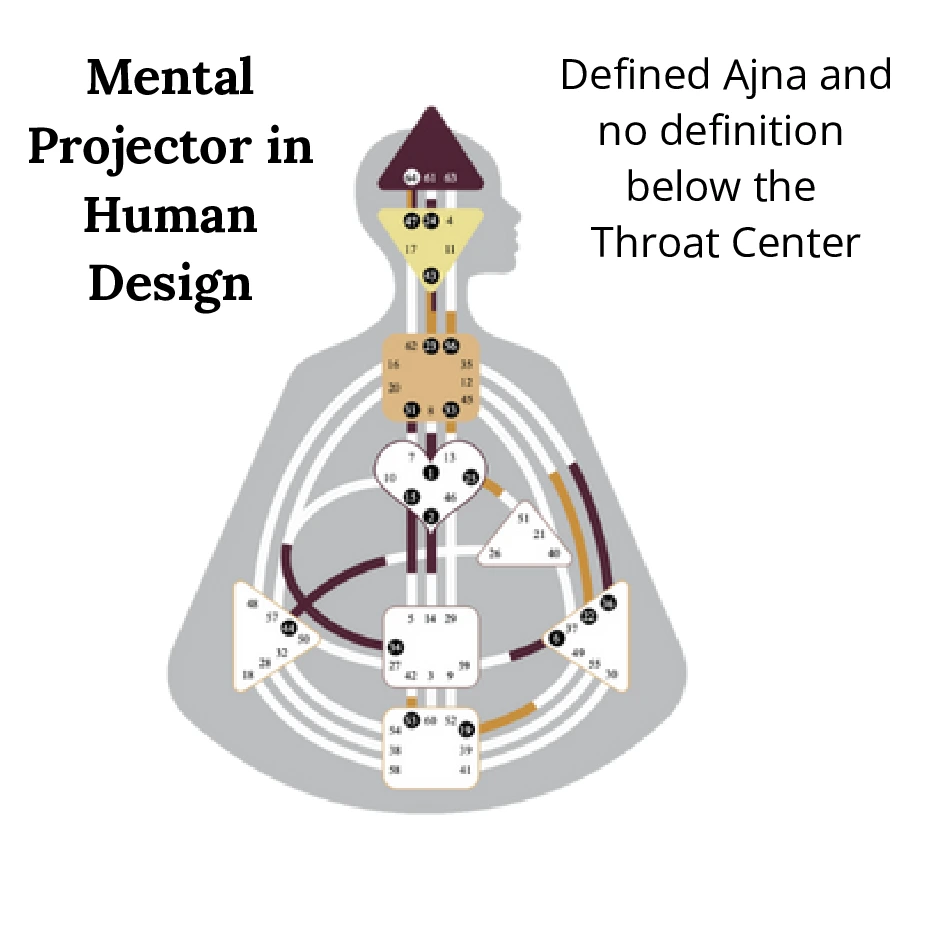
A Mental Projector in Human Design is someone with a defined Ajna center (the mind center) connected to either the Head center or Throat center (or both), and no definition in any centers below the Throat. This means all their motor centers—Will, Emotional, Sacral, and Root—are open and undefined. This unique energetic configuration makes up only about 2-3% of the population, making Mental Projectors one of the rarest types in Human Design.
The name “Mental Projector” comes from the combination of being a Projector type (one of the five energy types in Human Design) with what’s called a Mental or Outer Authority
This open configuration below the throat makes Mental Projectors incredibly sensitive to their environments. They absorb and amplify the energies around them, giving them a unique capacity to read rooms, people, and situations with remarkable accuracy. Yet this same sensitivity creates specific challenges in decision-making and energy management.
The Mechanics of Mental Projector Authority
Mental Authority (also called Environmental Authority or Outer Authority) operates fundamentally differently from other decision-making authorities in Human Design. While other authorities provide internal signals—emotional clarity, gut feelings, intuitive hits, or a sense of personal truth—Mental Authority works through external interaction and verbalization.
The defined Ajna center gives Mental Projectors consistent mental processing patterns. They think in reliable, relatively unchanging ways. However, without defined motor centers below the Throat, they don’t have consistent access to their emotions, intuition, willpower, or physical gut feelings. These centers are open, which means they amplify and reflect the energies they receive from others rather than generating their own consistent signals.
For Mental Projectors, clarity comes through the process of talking. When Mental Projectors verbalize their thoughts, several things happen:
1. They can hear their own words and observe how those words resonate (or don’t)
2. They can notice their physical responses while speaking
3. They can sense the quality of their voice and its changes during different topics
4. They receive subtle feedback from the environment and others present
This is why Mental Projectors often experience breakthrough clarity through conversation, even when the other person barely speaks. It’s not about getting advice—it’s about the external process of articulation in a supportive space.
Decision-Making Process for Mental Projectors
If you’re a Mental Projector, your decision-making process requires specific conditions for success. Understanding these elements can transform how you approach choices, both big and small.
Essential Elements of Mental Projector Decision-Making:
- Verbal Processing:
You need to talk things out. Silent contemplation alone, journaling, or purely internal reflection won’t bring the same level of clarity as speaking aloud. Your authority exists in the bridge between your inner world and outer expression.
- Supportive Listeners:
Find trusted people who can simply listen without interrupting or offering unsolicited advice. You don’t need others’ opinions—you need their presence, their reactions, and the space to hear yourself think out loud. The right listener acts as a mirror, helping you see your own truth more clearly.
- Body Feedback:
Pay close attention to physical sensations while speaking. Since your motor centers are open, they’re extremely sensitive and can register discomfort when something isn’t right for you. Notice changes in:
- Breathing patterns
- Muscle tension
- Voice quality
- Subtle energy shifts
- Overall comfort level
- Patience:
Give yourself time. Mental Projectors often need multiple conversations before reaching full clarity on significant decisions. What feels right in one conversation might shift in another. This isn’t indecision—it’s your process of filtering through conditioning to find your truth.
- Self-Recording:
If no one is available to listen, recording yourself talking can provide similar benefits. Hearing your own voice played back offers the external feedback your authority requires. Some Mental Projectors find this approach even more clarifying than talking with others, as it eliminates potentially distracting energetic influences.
Common Challenges for Mental Projectors
Mental Projectors face unique challenges navigating a world largely designed for and by Generators (who make up about 70% of the population). The pressure to make quick decisions can push Mental Projectors into stressful mental loops, creating anxiety when they can’t achieve immediate clarity. Our culture often equates decisiveness with competence, leaving Mental Projectors feeling inadequate when they need processing time.
- With so many open centers, Mental Projectors easily absorb others’ energies, thoughts, and feelings. This makes it difficult to distinguish between your own authentic thoughts and external influences. You might find yourself certain about a decision when surrounded by strong personalities, only to feel confusion when alone. This isn’t weakness—it’s the natural functioning of your open centers.
- Finding suitable processing partners presents another challenge. Not everyone has the patience or understanding to simply hold space without injecting their opinions or rushing you toward a conclusion. Well-meaning friends and family might interrupt your process with solutions before you’ve had the chance to fully articulate your thoughts.
- Energy management is a constant consideration for Mental Projectors. Without defined motor centers, you don’t have consistent access to sustainable physical, emotional, or willpower energy. You’re designed to work in bursts with ample recovery time, which can create friction in conventional work environments that expect consistent productivity.
- Many Mental Projectors struggle with overthinking. Your defined Ajna gives you tremendous mental capacity, but without the balancing influence of defined motor centers, you can get caught in analytical loops that keep you stuck in perpetual contemplation. Breaking these loops requires external processing, not more internal analysis.
- Perhaps most fundamentally, many Mental Projectors feel fundamentally “wrong” or “broken” in a world that celebrates quick, decisive action and consistent energy output. Your process is different by design, not deficient. Understanding this can bring profound relief and self-acceptance.
The Mental Projector Strategy for Success
The foundation of success for any Projector starts with following their fundamental strategy: wait for an invitation and recognition. This means allowing others to initiate engagement with you for major life opportunities rather than pushing your energy outward. For Mental Projectors specifically, combining this waiting strategy with your outer authority creates a powerful framework for authentic decision-making.
When invitations arrive—for relationships, jobs, projects, or any significant commitment—activate your Mental Authority by processing these opportunities verbally in supportive environments. Talk through how you feel about the invitation, what excites or concerns you, and notice what happens in your body and voice as you speak.
Creating a network of trusted people who understand your processing style is invaluable. Take time to explain your decision-making needs to close friends, partners, and colleagues. Help them understand that when you talk things through, you’re not seeking their input as much as their presence. Clear agreements about this can prevent misunderstandings and frustration on both sides.
For particularly important decisions, consider scheduling multiple “processing sessions” with different people or in different environments. This helps you distinguish between environmental influences and your consistent truth. If you hear yourself expressing similar conclusions in varied settings, that’s a strong signal of alignment.
Remember that for Mental Projectors, saying “I need to think about it” actually means “I need to talk about it.” Give yourself permission to request the time and space you need for your unique decision-making process, especially when others may be pressing for immediate answers.
Cultivating environments that support your sensitivity is essential for ongoing success. Your home, workspace, and frequent gathering places should feel energetically clean and supportive. This might mean making different choices than others would about lighting, sound, decor, or spatial arrangement. Trust your sensitivity—it’s one of your greatest gifts.
With practice, you’ll become increasingly skilled at recognizing when you’re in an unsuitable environment for processing. Learn to gracefully excuse yourself when needed rather than trying to force clarity in spaces that don’t support your energy.
The Mental Projector’s Gifts and Purpose
Mental Projectors bring extraordinary gifts to our collective experience. Your sensitivity allows you to read environments and people with remarkable accuracy, noticing subtle dynamics and energies that others miss entirely. This makes you naturally skilled at improving systems, relationships, and spaces.
The combination of your defined Ajna and multiple open centers gives you unique perspectives on life. You naturally see patterns, possibilities, and connections that others can’t perceive. This makes you a valuable advisor, strategist, and visionary when operating from your authentic design.
In professional settings, Mental Projectors often excel at seeing inefficiencies and suggesting improvements. You can perceive how energy flows (or doesn’t) through systems and organizations. Your guidance can transform stagnant or chaotic situations into harmonious, effective ones when offered at the right time and in the right way.
Your gift lies in guiding energy rather than generating it. While Generators and Manifesting Generators are designed to do the work of the world, you’re designed to direct that energy efficiently. This doesn’t make you less valuable—in fact, without proper guidance, tremendous energy can be wasted on misaligned efforts.
The world needs your unique perspective. In a culture obsessed with doing, producing, and achieving, your natural state of being, observing, and guiding offers essential balance. When operating from your authentic design, you help others connect with deeper purpose and efficiency in their endeavors.
Living as a Mental Projector in Different Life Areas
Career and Work
The ideal work environment for a Mental Projector provides space for verbal processing and respects your energy limits. Look for roles where your guidance is valued and where you’re not expected to maintain the same consistent energy output as Generator types. Consulting, advising, teaching, coaching, strategic planning, and systems analysis often suit Mental Projectors well.

- Establish clear boundaries around your energy in professional settings. You may need more breaks, different work hours, or recovery days than your colleagues. This isn’t laziness—it’s honoring your design. When you respect your energy limitations, the quality of your contributions significantly increases.
- Remote or flexible work arrangements can benefit Mental Projectors, allowing you greater control over your environment and energy management. Negotiate for outcome-based evaluation rather than time-based expectations. Your value lies in your insights and guidance, not in hours logged.
- Make your workspace as supportive as possible. Consider factors like lighting, sound, air quality, and the energetics of those who work near you. These environmental elements directly impact your clarity and well-being in ways that may be more pronounced than for other types.
Relationships
In close relationships, explaining your decision-making process is essential. Help partners, family members, and close friends understand that you need to talk through options and that this doesn’t indicate indecision or insecurity—it’s your natural process for finding clarity.
Your sensitivity makes you highly receptive to others’ emotions, desires, and needs, sometimes to the point where you might lose track of your own. Regular processing time with trusted friends can help you distinguish between what you want in relationships and what you’re absorbing from partners.
Create agreements about how you’ll handle important relationship decisions together. Having predetermined “processing sessions” can prevent misunderstandings during crucial conversations. Your partner should understand that you might need to talk through the same topic multiple times before reaching clarity.
When aligned with your design, your sensitivity makes you an incredibly attuned and insightful partner. You can often sense what others need before they can articulate it themselves. This gift creates a profound connection when appreciated and respected.
Health and Wellness
For Mental Projectors, energy management isn’t just about productivity—it’s fundamental to your physical and emotional health. Regular rest periods aren’t optional luxuries; they’re essential maintenance for your open centers. Schedule downtime proactively rather than waiting until exhaustion forces it.

1. Create a home environment that supports your sensitivity. Minimize noise, chaotic visual elements, harsh lighting, and disruptive electromagnetic fields. Your space should feel like a sanctuary where your energy can reset and clarify.
2. Pay close attention to physical symptoms. With so many open centers, your body often registers environmental misalignment before your mind can process it. Headaches, digestive issues, sleep disturbances, or unusual fatigue might indicate you’re in environments that don’t support your energy.
3. Consider how different foods, supplements, and substances affect your particular system. Your open centers make you more responsive to inputs that others might barely notice. Experimentation and careful observation can help you discover what truly supports your unique physiology.
4. Movement practices that help clear absorbed energies are particularly beneficial. Walking, swimming, gentle yoga, tai chi, qigong, or dancing can help release what you’ve picked up from others and environments. The right movement for you will leave you feeling refreshed rather than depleted.
Deconditioning Journey for Mental Projectors
The deconditioning process—releasing patterns, beliefs, and behaviors that aren’t authentically yours—is especially important for Mental Projectors. With multiple open centers, you’ve likely absorbed countless external influences throughout your life, creating layers of conditioning that can mask your authentic self.
- Begin by simply observing your mental patterns without judgment. Notice recurring thoughts, beliefs, and decision-making tendencies. Pay particular attention to “shoulds” and absolutes in your thinking—these often indicate conditioning rather than authentic preferences.
- Question whether these patterns truly resonate with you or if they’ve been absorbed from others. A useful inquiry is simply asking, “Is this really mine?” Notice what happens in your body when you ask this question about your beliefs and preferences.
- Speak your thoughts consistently. Regular verbal processing accelerates deconditioning. As you speak your thoughts aloud, conditioning often becomes more obvious. You might hear yourself repeating phrases from parents, teachers, or cultural messaging that don’t actually align with your authentic self.
- Track the influence of different environments on your clarity. Notice which spaces support your authentic voice and which seem to amplify conditioning. This awareness helps you make conscious choices about where you spend time and with whom.
- Experiment with your authority by making small decisions using your verbal processing approach. Notice the outcomes of decisions made through authentic processing versus those made from conditioning or pressure. Over time, this builds trust in your unique decision-making process.
- Connect with other Mental Projectors when possible. Sharing experiences with those who share your design can provide validation and accelerate your deconditioning journey. Their insights and observations might highlight aspects of conditioning you haven’t yet recognized in yourself.
- Be patient with this process. Deconditioning happens gradually, often taking years to fully unfold. Each layer revealed and released brings you closer to living as your authentic self. The journey isn’t about reaching a perfect end state—it’s about increasing alignment over time.
Mental Projector Success Stories
Maya’s Story
Maya discovered she was a Mental Projector after years of feeling fundamentally wrong for her need to talk through decisions. Throughout school and early career, she’d been criticized for being “indecisive,” “overthinking,” and “too sensitive” to environments. These judgments created deep insecurity that led her to override her natural process, making quick decisions that often resulted in misalignment and regret.
After learning about her Mental Authority, Maya recognized that her processing style wasn’t a weakness but a feature of her design. She created a support system of friends who understood her need to verbalize thoughts without interruption or advice. She established a home environment that supported her sensitivity and set boundaries around her energy in professional settings.
Today, Maya runs a successful consulting business where clients value her unique perspective and insights. She schedules her work in alignment with her energy patterns and processes important decisions with trusted friends. “I’m not broken—I’m rare and valuable,” Maya shares. “Understanding my design gave me permission to trust my process and honor my sensitivity as a strength.”
James’s Experience
James struggled with repeated burnout in his corporate career. Despite excelling at identifying strategic improvements and guiding teams effectively, he couldn’t understand why he couldn’t maintain the same energy output as his colleagues. He pushed himself to match their pace, resulting in physical illness and eventual resignation from positions that otherwise suited his skills.
Learning he was a Mental Projector explained both his energy limitations and his need for verbal processing. With this understanding, James negotiated flexible working conditions in his next role, including remote days, outcome-based evaluation rather than hours logged, and explicit acknowledgment of his advisory role.
He established clear boundaries around his availability and created a structured processing time for major decisions. “I stopped trying to be a Generator,” James explains. “When I embraced my design and worked with it rather than against it, everything changed. I now contribute more value while working fewer hours because I’m aligned with how I’m actually designed to function.”
Tools and Practices for Mental Projector Alignment
Intentionally Create Your Surroundings
The environment that surrounds you profoundly affects your clarity and energy, especially as a Mental Projector. Creating spaces that support your sensitive system is a vital practice for alignment.
Essential Elements for Your Supportive Surroundings
Lighting: Opt for natural light or warm, adjustable artificial lighting that doesn’t strain your system
Sound Management: Minimize harsh or chaotic noise that can disrupt your processing
Color Selection: Choose calming, clear colors rather than overstimulating ones
Energy Flow: Consider how people and activities move through your space
Personal Processing Space: Create a dedicated area where you can speak aloud without interruption
Sound Protection: Invest in sound-absorbing materials or noise-canceling headphones if you’re sound-sensitive
Sensory Support: Experiment with elements like:
- Aromatherapy
- Plants
- Crystals
- Specific textures
- Temperature control
Workspace Positioning: In shared environments, arrange your space to minimize exposure to others’ energies
The right environment serves as a container for your clarity. Even small adjustments can dramatically improve your decision-making capacity and overall well-being.
Verbal Processing Tools
As a Mental Projector, your authority operates through verbalization. These tools can enhance the quality and effectiveness of your processing:
1. Voice Journaling: Record yourself talking through thoughts and decisions, then listen back to notice patterns and clarity
2. Processing Partners: Find people who understand they don’t need to solve or advise—just listen attentively
3. Clarifying Questions: Develop prompts to guide your verbal processing, such as:
- “What excites me about this possibility?”
- “What concerns arise when I consider this option?”
- “How would this choice affect my energy?”
- “Does this align with my long-term vision?”
- “What am I noticing in my body as I discuss this?”
4. Articulation Practice: Enhance your ability to express thoughts with increasing precision
5. Body Awareness: Notice physical sensations while speaking about different options, including:
- Tension patterns
- Energy shifts
- Breathing changes
- Voice quality variations
- Subtle comfort/discomfort signals
Energy Management
Your open centers require intentional energy management. These practices help maintain your clarity and prevent overwhelm:
Scheduled Solitude: Regular alone time to clear absorbed energies—essential maintenance, not a luxury
Morning Connection: Develop routines that help you establish your own energy before absorbing others’
Energetic Boundaries: Create protection before entering crowded or intense environments through:
- Visualization techniques
- Breathing practices
- Intention setting
- Physical reminders (like specific jewelry)
Energy Clearing Techniques: Experiment with methods that help reset your system:
Energy Tracking: Monitor your levels throughout the day to identify patterns and optimize your schedule
Consistent energy management allows you to maintain clarity even as you navigate various environments and relationships. What seems like extra effort initially becomes second nature with practice.
Frequently Asked Questions (FAQs) About Mental Projector Authority
How do I know if I’m a Mental Projector?
A: You’re a Mental Projector if you have a defined Ajna center connected to either your Head center or Throat center (or both), with no definition in any centers below the Throat. This means all your motor centers (Will, Emotional, Sacral, and Root) are open and undefined. To confirm your design, you’ll need to get your Human Design chart calculated using your birth date, time, and location. Look for the Projector type with no defined centers below the Throat.
Can Mental Projectors ever make quick decisions, or do they always need to process verbally?
A: While verbal processing is your natural decision-making mechanism, Mental Projectors can develop a kind of “shorthand” for minor decisions through experience. After spending time honoring your authority, you’ll recognize patterns in what works for you. For significant decisions that impact your life direction, relationships, or well-being, verbal processing remains essential. For smaller everyday choices, you may develop a more streamlined approach based on your accumulated wisdom about yourself.
What are the differences between Mental Projectors and Reflectors in Human Design?
A: Both Mental Projectors and Reflectors have predominantly open centers, making them highly sensitive to external energies. However, Mental Projectors have a defined Ajna center (and often Head or Throat), giving them a consistent mental processing pattern. Reflectors have all centers undefined, making them even more environmentally sensitive. Mental Projectors follow the Projector strategy of waiting for an invitation, while Reflectors need to wait through a full lunar cycle (29.5 days) before making major decisions. Mental Projectors make up about 2-3% of the population, while Reflectors are even rarer at around 1%.
How can I distinguish between my authentic thoughts and conditioning as a Mental Projector?
A: This distinction becomes clearer through consistent verbal processing. When speaking about different options, notice:
- Physical sensations that arise (tension, relaxation, energy shifts)
- The quality and tone of your voice
- Whether your thoughts feel expansive or constrictive
- Recurring patterns that echo parental or societal messaging
- Ideas that emerge spontaneously versus those you feel you “should” think
Conditioning often feels heavier, more rigid, and accompanied by subtle physical discomfort. Authentic insights typically feel lighter, more energizing, and create a sense of clarity or relief when expressed. Recording your processing sessions can help you identify these patterns over time.
Do Mental Projectors need to talk to other people for ALL decisions?
A: Not necessarily. While the presence of a trusted listener can be invaluable, many Mental Projectors find that recording themselves talking and then listening back provides similar clarity. Some find that talking aloud, even when alone, helps crystallize their thoughts. The key is external verbalization—getting thoughts out of your head and into expressed form where you can “hear” them from a slightly different perspective. Different decisions may require different approaches depending on their significance and complexity.
I’m a Mental Projector who’s been making decisions from my mind my whole life. Why hasn’t this caused more problems?
A: Most Mental Projectors do use their minds to make decisions before discovering Human Design—it’s what we’re taught to do in society. However, upon reflection, you might recognize patterns of misalignment from decisions made purely through mental analysis: energy depletion, recurring disappointments, or a sense of being “off track” despite doing everything “right.”
Many Mental Projectors unconsciously seek verbal processing without realizing it—talking to friends about decisions, thinking aloud, or revisiting the same topics repeatedly. You may have naturally gravitated toward some form of external processing even without understanding your design. Additionally, your defined Ajna gives you consistent mental processing, which provides a degree of stability even when not using your authority correctly.
Can Mental Projectors ever use physical sensations or emotions to make decisions?
A: While your primary authority is external/mental, your open centers are extremely sensitive and do provide valuable information. Your open emotional, splenic, sacral, and will centers don’t generate consistent signals, but they do amplify and reflect energies around you.
Many Mental Projectors develop a refined awareness of how these centers respond during verbal processing. You might notice distinct physical sensations when speaking about different options. These sensations aren’t your primary authority, but they can serve as important supplementary information during your verbal processing. Think of them as adding color and dimension to your decision-making rather than driving it.
How do Mental Projectors handle urgent decisions when there’s no time for full processing?
A: For truly urgent situations, Mental Projectors can still use a compressed version of their authority. Even a few moments of speaking your thoughts aloud can provide more clarity than pure internal contemplation. In emergencies, trust that your sensitivity and intelligence will guide you appropriately.
For decisions that seem urgent but actually aren’t (which is most “urgent” situations in modern life), practice requesting the time you need: “I understand this feels pressing, but I need [timeframe] to process this properly. I’ll get back to you by [specific time].” Most deadlines have more flexibility than initially presented, and decisions made in alignment with your authority will ultimately save time compared to misaligned choices that need correction later.
As a Mental Projector parent, how do I help my children understand my processing needs?
A: Children can actually understand and respect your authority needs when explained in age-appropriate ways. For younger children, you might say, “Mommy/Daddy needs thinking-out-loud time to make good choices. When I need to make a big decision, I might talk to myself or another grown-up to help my brain figure things out.”
Older children can understand more nuance: “Everyone makes decisions differently. The way my mind works best is by talking things through before deciding. Sometimes I need quiet time or conversation time to process, which doesn’t mean I’m ignoring you or that anything is wrong.”
Modeling healthy authority use shows children the importance of honoring their own decision-making processes. You might even discover that some of your children have similar processing needs and appreciate seeing you honor yours.
What careers are best suited for Mental Projectors?
A: Mental Projectors often thrive in roles where their guidance, insights, and unique perspective are valued. Ideal career paths include:
- Advisory roles (consulting, strategy, systems analysis)
- Education (teaching, curriculum development, educational consulting)
- Coaching and counseling (life coaching, therapy, mentoring)
- Research and analysis (trend analysis, market research, academic research)
- Creative direction (art direction, content strategy, editorial guidance)
- Specialized communication (technical writing, translation, interpretation)
- Systems improvement (process optimization, organizational development)
The key is finding environments that respect your energy limitations and value your guidance rather than your labor. Roles with flexibility, recognition for quality over quantity, and opportunities for deep observation before contribution tend to work well. Remote or hybrid work arrangements often benefit Mental Projectors by allowing greater control over environment and energy management.# Comprehensive Guide to Mental Projector Authority in Human Design
Thriving as a Mental Projector
Being a Mental Projector in Human Design means you have a unique and valuable role in our collective experience. Your sensitivity, combined with your defined Ajna, gives you extraordinary perception and insight that the world desperately needs.
Though your decision-making process differs from the majority, it’s perfectly designed for your unique configuration. Embracing your Mental Authority means honoring your need for verbal processing in supportive environments and recognizing the wisdom of your sensitivity.
As you align with your authentic design, you’ll likely experience greater clarity, appropriate energy management, and a deeper sense of purpose. The challenges you’ve faced aren’t signs of personal deficiency—they’re the natural result of operating against your design in a world that often doesn’t understand or accommodate your natural functioning.
Trust your design. Trust your process. You are exactly as you’re meant to be—rare, perceptive, and essential to our collective evolution.
Mental Projector Authority in Human Design – Do You Have This in Your Chart?
Get Your FREE Human Design Chart to check it out.
Why not download your FREE Human Design chart here to find out?
Remember that we all have ALL of the chart. If the Gate is colored in or defined, it’s part of your Soul Curriculum. If it’s white or undefined, it means you learn about this Gate through relationships with others or through the Transits.
At its core, Human Design is a unique system that offers profound insights into your inner self and how you interact with the world around you. Your Human Design chart is a valuable tool that can help you understand your true nature, discover your strengths and weaknesses, and unlock your full potential.
By downloading and reviewing your unique Human Design Chart you are embarking on a journey of self-discovery that will empower you to make conscious choices in all aspects of your life. Your chart is an Energy Blueprint of your unique energy configuration and contains valuable information about your personality traits, your natural talents, and your life purpose. With this knowledge, you’ll navigate life’s challenges with greater ease and clarity.
Human Design is a deeply empowering system that encourages us to embrace our true selves, rewrite our personal narrative, and live in alignment with our inner wisdom. When we align with our authentic nature, we tap into a wellspring of creativity, joy, and fulfillment that flows effortlessly through us.
There’s More – How To Learn More About Human Design
If you are trying to learn and apply Human Design to your life circumstances, but traditional Human Design rings a little off-key, you don’t quite connect with it, or it feels heavy as you read it. We invite you to explore training options with Quantum Human Design, internationally respected and time-tested training courses.
These courses will empower you to create a life filled with more money, better relationships, health and vitality, a rewarding career, and experience profound personal transformation.
Do you want to unlock the secrets of Quantum Human Design?
Why not join our on-demand Masterclass and discover the Transformative Power of Quantum Human Design
Curious about the difference between Human Design and Quantum Human Design? Karen Curry Parker explains it in this video:
BOOK NEWS
Quantum Wellness: Healing Your Mind, Body, and Spirit with Human Design

This comprehensive guide teaches readers to:
- Interpret bodily signals and uncover root causes of imbalance
- Utilize individual energetic blueprints for optimal well-being
- Transform limiting beliefs to align with one’s authentic self
Dr. Parker provides practical tools to unlock potential and create purposeful, vibrant lives.
This essential resource addresses core issues beyond symptoms, guiding readers on a transformative journey of self-realization and deep healing.
This book blends ancient Human Design wisdom with quantum physics, offering a revolutionary approach to holistic healing and personal transformation. Ideal for holistic practitioners, Human Design enthusiasts, and self-discovery seekers.