What is the I Ching?
The I Ching, also known as the Book of Changes, is one of the oldest and most influential Chinese texts. It is both a divination system and a philosophical treatise. The origins of the I Ching can be traced back over 3,000 years to ancient China.
At its core, the I Ching is a symbolic system based on the interaction of two fundamental forces: yin and yang. These forces represent the dualities and complementary aspects of existence, such as light and dark, male and female, and active and passive. The I Ching provides a framework for understanding and navigating the dynamic nature of the universe and the constant changes occurring within it.
The book consists of a set of 64 hexagrams, which are formed by the combination of six broken or solid lines. Each hexagram represents a unique situation or archetype and is accompanied by textual interpretations that offer guidance and insight into the situation at hand. The hexagrams are believed to encompass a wide range of human experiences and circumstances.
The Hexagram
In the I Ching, the hexagram is a six-line figure composed of stacked solid (yang) and broken (yin) lines. It is the fundamental building block of the divination system and provides a symbolic representation of a particular situation, condition, or archetype.
There are 64 possible hexagrams in the I Ching, each with its own unique combination of solid and broken lines. These hexagrams are formed by combining two trigrams, which are three-line figures representing different elemental forces or energies. The trigrams combine to form a hexagram, and each hexagram is associated with a specific name and interpretation.
The lines in a hexagram are typically referred to as either “old” or “young.” Old lines are solid lines, representing a strong and stable presence, while young lines are broken lines, symbolizing a weak and changing state. The positions and interactions of these lines within a hexagram give rise to various interpretations and insights.
How Does the I Ching and the Hexagram Relate to Human Design?
In the Das Human Design System, some may know this as The Black Book, Ra Uru Hu explains,
“The I Ching is rooted in the duality of Yin and Yang. The 64 Hexagrams are divided into two sets of thirty-two. Spanning from the utmost Yin (The Receptive 2) to the utmost Yang (The Creative 1), they encompass the entire spectrum of energy. Each line within the Hexagrams represents a duality, embodying a polarity. The Rave I Ching employs images, examples, stories, and ideas to illustrate the potentials of these energies. By describing these archetypal energies and their facets, one ultimately delineates roles. As these energies serve as the archetypes of Humanity, all fundamental roles come into play.”
How Does This Translate To Your Chart
Your energetic configuration in Human Design is determined by the exact time and location of your birth. It is at the moment of your birth that your personality traits and unique Human Design become fixed.
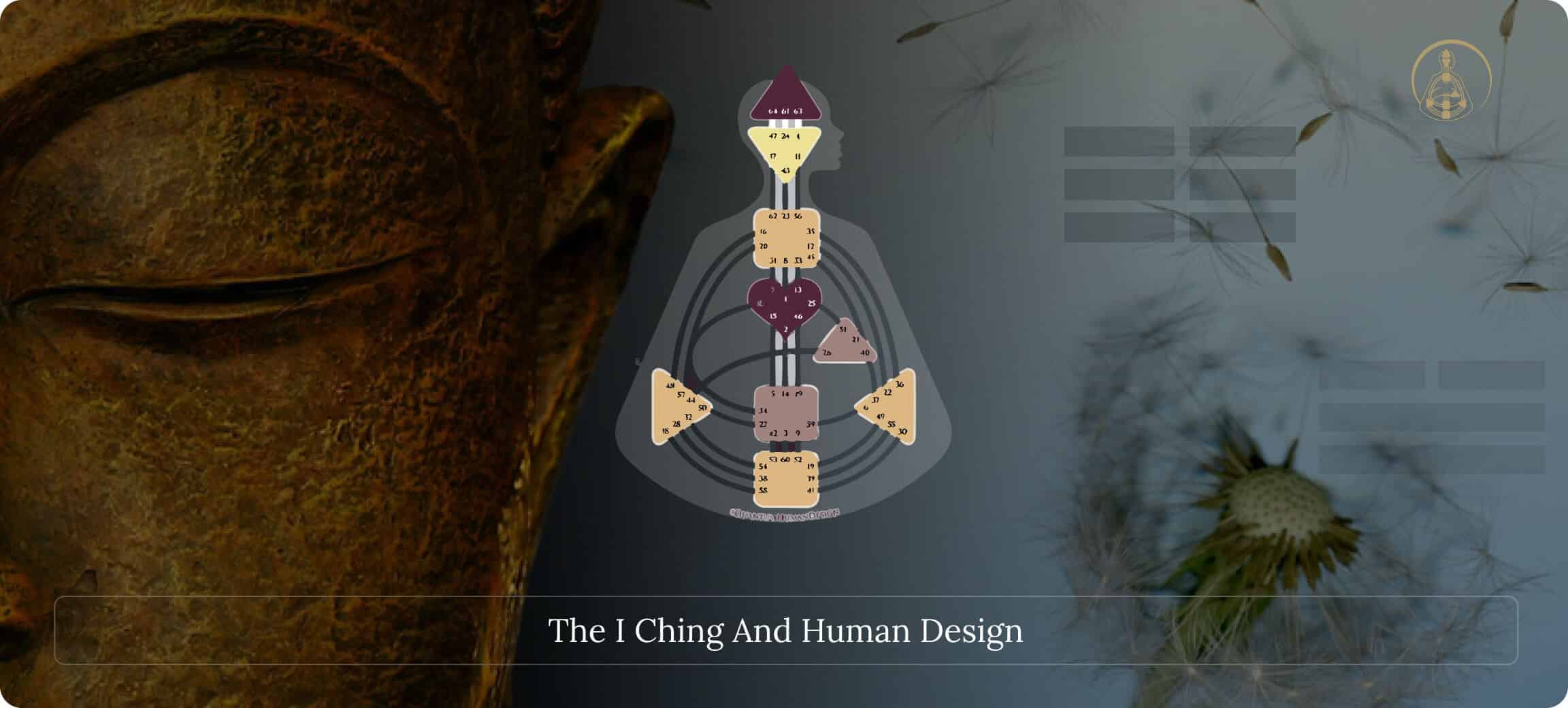
When examining a Human Design chart, we primarily focus on the body graph, which is represented by a triangle and serves as a “map” of your energy. The gates and lines that form the definition on the body graph represent a snapshot of the planetary positions and corresponding gates at the time of your birth.
The complete Human Design chart consists of the body graph within a mandala. The Human Design mandala has two wheels. The inner wheel corresponds to the traditional astrological chart with its twelve houses. The outer wheel features a ring containing the sixty-four gates. The positioning of your gates at birth is measured on these two wheels.
To better understand this concept, imagine each of the two wheels as a measurement of a specific moment in time. Similar to a clock measuring time in minutes and seconds, every moment occupies a specific place on the clock’s “wheel.”
In astrology, the movement of time around the astrological “clock” is measured in degrees and minutes. Each sign encompasses thirty astrological degrees and sixty astrological minutes, providing astrologers with deeper insights into the potential of your astrology chart.
In the context of Human Design, the movement of time is measured in lines on the “clock.” Each of the sixty-four hexagrams is composed of six lines, which denote the progression of time around the mandala. The position of your gates is also expressed in lines, offering further insights into how these gates will manifest in your life.
Each line carries a distinct energy that influences the expression of the corresponding gate. When considering your profile, the lines are derived from the lines of the conscious and unconscious gates in the sun position of your chart.
The Six Lines Of The Hexagram
In the context of Human Design, the movement of time is measured in lines on the “clock.” Each of the sixty-four hexagrams is composed of six lines, which denote the progression of time around the mandala. The position of your gates is also expressed in lines, offering further insights into how these gates will manifest in your life.
Each line carries a distinct energy that influences the expression of the corresponding gate. When considering your profile, the lines are derived from the lines of the conscious and unconscious gates in the sun position of your chart.
Lines 1 to 3 in the profiles represent intrapersonal energies, focusing on personal experience and understanding. They are self-oriented. On the other hand, lines 4 to 6 in the profiles signify transpersonal energies, relating to experiences in relationships with others. Some individuals, according to their design, are more inclined toward their own life processes, while others are more oriented toward relationships.
To learn more about Human Design Profiles CLICK HERE.
Elements in the I Ching
Heaven: The Creative (Associated with Human Design Gate 1)
Heaven, in the context of Chinese Cosmology and the I Ching, embodies pure yang energy and is associated with inspiration, ideas, and continuous motion that sparks creation. It is viewed as the perfect and unyielding sky.
Within the I Ching, Heaven is regarded as the mightiest force, representing warmth, light, and the sun. Consequently, creativity holds immense power, as it taps into the creative force that constructs and manifests perfection, reflecting the essence of Heaven here on Earth.
The first hexagram of the I Ching consists of two Heaven trigrams, and in Human Design, it aligns with Gate 1, known as “The Creative.” This gate is recognized as a potent catalyst for creativity within Human Design, emphasizing the importance of embracing one’s authentic mode of self-expression. Engaging in artistic endeavors, speaking, writing, dancing, and allowing oneself to fully embody their divine essence in its purest form are supportive and significant practices for individuals with this gate.
Lake: The Joyous (Associated with Human Design Gate 58)
The trigram Lake represents a fascinating interplay of action and tranquility. It emerges from two layers of active forces, which eventually give way to a stabilizing yin energy. This imagery is akin to water being propelled by a surge or burst of energy, and then settling into a serene and still state.
In the I Ching, this trigram is referred to as the “joyous” or “open” because it symbolizes a vast body of water that encompasses both earthly and heavenly aspects. Beneath the surface of this wellspring lies the creative force of heaven, infusing the element of water with boundless potential for creation. It beckons us to explore our own connection to divine creativity.
Hexagram 58, associated with Gate 58 in Human Design, embodies abundant joy and vitality. Situated in the root center, this gate encourages us to embrace habits, cycles, or experiences that invigorate and ignite our zest for life.
Reflecting on ancient tales and myths that depict water as the birthplace of heroes, communities, deities, or other profound mysteries can help us grasp the essence of this trigram. Beneath the surface lies a marvelous unknown, while at the surface springs forth the limitless potential for life to flourish.
Fire: The Clinging (Associated with Human Design Gate 30)
The Fire trigram signifies a progression that begins with dynamic action—the spark of creation—and culminates in containment and nurturing by the influence of yin energy. This containment allows for further growth and the potential to ignite and inspire other elements around it. This trigram brims with the energy of transformation.
In the realm of the I Ching, Fire embodies both radiance and clinging, representing enduring qualities as well as the desire to break free and move onward. This tension implies the necessity for movement and decisive action.
Hexagram 30, associated with Gate 30 in Human Design, embodies passion and intense emotions. It symbolizes the capacity to manifest abstract desires or emotions into tangible forms, as well as the ability to transmute feelings into profound understanding. In both instances, there exists an alchemical quality that paves the way for the creation of something entirely new.
Thunder: The Arousing (Associated with Human Design Gate 51)
The Thunder trigram initiates with a clash of yang energy, manifesting as a sudden release of heat and power that gradually disperses and finds equilibrium through the influence of yin as it traverses the atmosphere.
In the realm of the I Ching, Thunder represents the voice of Heaven, embodying a force that possesses both destructive and constructive qualities. It symbolizes the merging of the soul’s intention with the physical realities of earthly existence, illustrating the dynamic interplay between the two realms. Thunder serves as the expression of shock or sudden awakening, which, though unexpected, ultimately leads to greater stability and growth.
Hexagram 51, associated with Gate 51 in Human Design, embodies the energy of shock. Its purpose is to instigate change or redirection in one’s life, often accompanied by a jarring sensation. I like to envision this energy as an electric fence that keeps you aligned with your path, buzzing with a reminder when you stray too far. The hidden desires of the divine interact and shape the physical realm, veiled in mystery and requiring surrender to their unfolding.
Wind: The Gentle (Associated with Human Design Gate 57)
The Wind trigram symbolizes the movement and flow of air, serving as a conduit for the transmission of energy from the ethereal realm to the physical manifestation on Earth. In its physical form, wind stirs and influences material forces such as trees and buildings.
However, this concept extends beyond the physical realm to encompass the transformation of thought forms into ideas, actions, and ultimately reality. Within the I Ching, this trigram is referred to as “gentle” or “obedient,” as the wind typically swirls around objects, unless it rages and becomes a destructive force.
Hexagram 57 corresponds to Gate 57 in Human Design, which resides in the spleen and pertains to intuition. Similar to the wind, this gate possesses the ability to move invisibly and undetected, gathering subtle information that is then distilled into intuitive messages. The guidance received through Gate 57 primarily focuses on what will ensure your safety, security, and alignment with your authentic truth.
Water: The Abysmal (Associated with Human Design Gate 29)
Water stands in stark contrast to fire, yet it requires a certain degree of action to come into existence. It possesses qualities of adaptability, nourishment, and healing, while also holding immense power and unpredictability.
Water carries an air of mystery and fascination as it navigates obstacles, unlocking unexplored possibilities and untapped potential. It is often associated with the abysmal, for it can delve into the depths of the earth like an underground aquifer or spring. Unlike a lake, which exhibits depth primarily at the surface level, water harbors enigmatic clues and insights that are sensed rather than seen.
Hexagram 29, known as Gate 29 in Human Design, bears the name “The Abysmal” and embodies the essence of perseverance. It represents a deep immersion into an experience with unwavering ambition and drive. Aligned with the sacral center, when the response is present, Gate 29 wholeheartedly commits to and receives support in any endeavor it undertakes. Similar to water, this gate always finds a way forward, except when driven by an incorrect response, which may lead to becoming lost in the depths.
Mountain: Keeping Still (Associated with Human Design Gate 52)
The Mountain trigram symbolizes the essence of earth, with two yin lines supporting a solid yang line that reaches towards the heavens. It embodies the energy of construction and the wisdom of endurance. The mountain teaches the virtues of patience and the importance of inner reflection to maintain outer harmony. It reminds us to go inward, finding stillness and tranquility amidst the external world.
The 52nd hexagram of the I Ching consists of two mountain trigrams, and in Human Design, it is referred to as the Gate of Keeping Still. This hexagram offers a valuable lesson: recognizing the distinction between relaxation and rest.
It emphasizes the wisdom of moving swiftly with intention and purpose, while also trusting that taking moments to pause and rejuvenate does not impede progress. Instead, it creates a more sustainable and resilient path forward.
Earth: The Receptive (Associated with Human Design Gate 2)
Earth consists entirely of yin lines, embodying qualities of restoration and containment. It represents the purest expression of yin, the feminine force, which is receptive and capable of encompassing the various cycles of existence.
Unlike the mountain that reaches towards the heavens, Earth operates in the realms beneath the surface. It nurtures growth like a deep-rooted system, supporting life in every season. Even during winter when the Earth may appear barren, it is undergoing a process of rejuvenation, preparing the stage for the forthcoming spring.
Hexagram 2 in the I Ching, known as “The Receptive,” corresponds to Gate 2 in Human Design. This gate is associated with direction and is located in the identity center, opposite Gate 1. It represents the receptivity to one’s purpose and direction, facilitating forward movement. Through delving deep into self-discovery, one awakens to the understanding that guidance for the next steps originates from within.
How To Get Your Free Human Design Chart
Get Your Free Human Design Chart to enlighten, educate, and empower yourself to achieve your goals using Quantum Human Design™.
Ultimately, understanding Human Design empowers you to live a more authentic, fulfilled, and purpose-driven life by honoring your unique energetic blueprint. It serves as a valuable tool for self-awareness, decision-making, relationships, and personal growth, guiding you toward a more aligned and meaningful existence.
If this has inspired you to want to know more about how to live your Quantum Human Design, click here
Want more content? Why not follow us on YouTube