Get access to your free Human Design chart calculator here.
Why A Human Design Chart/Bodygraph from a Human Design Calculator Can Be Your Best Friend
As social creatures, we are all subject to sociocultural conditioning. We are all taught explicitly and implicitly how to think, act, speak, define success, and so much more. These social rules make us feel inadequate and broken because we can’t seem to do it right. Human Design teaches us that each energy type has a different way of creating and making decisions.
We all have unlimited potential for wealth, health, good relationships, and happiness. We are each uniquely designed, so our definitions of wealth, health, good relationships, and happiness will be different for each of us. Your Human Design chart created using a Human Design Calculator software will be your best friend because it shows you how to approach your life energetically.
The Information You Need To Run A Human Design Calculator
In mainstream astrology, you only need to know your date of birth to know your sign. Many refer to Human Design as the “new” astrology, and to start your journey in Human Design, you will need your: date of birth, time of birth, and the city, state, and country where you were born.
How Important Is Time Of Birth For An Accurate Human Design Chart?
Time of birth is vitally important for an accurate Human Design chart. There can be up to four gate changes in a 24-hour period and sometimes even more than four gate changes. Without an accurate birth time, your chart will be inaccurate. If you are unable to get your birth time, you have a few options: run a chart every 2 hours for 24 hours and see which fits you the best, invite others to tell you how they see you to determine which characteristics are closest, locate a Human Design Specialist who does birth chart rectifications.
What Your Personal Human Design Chart Will Look Like
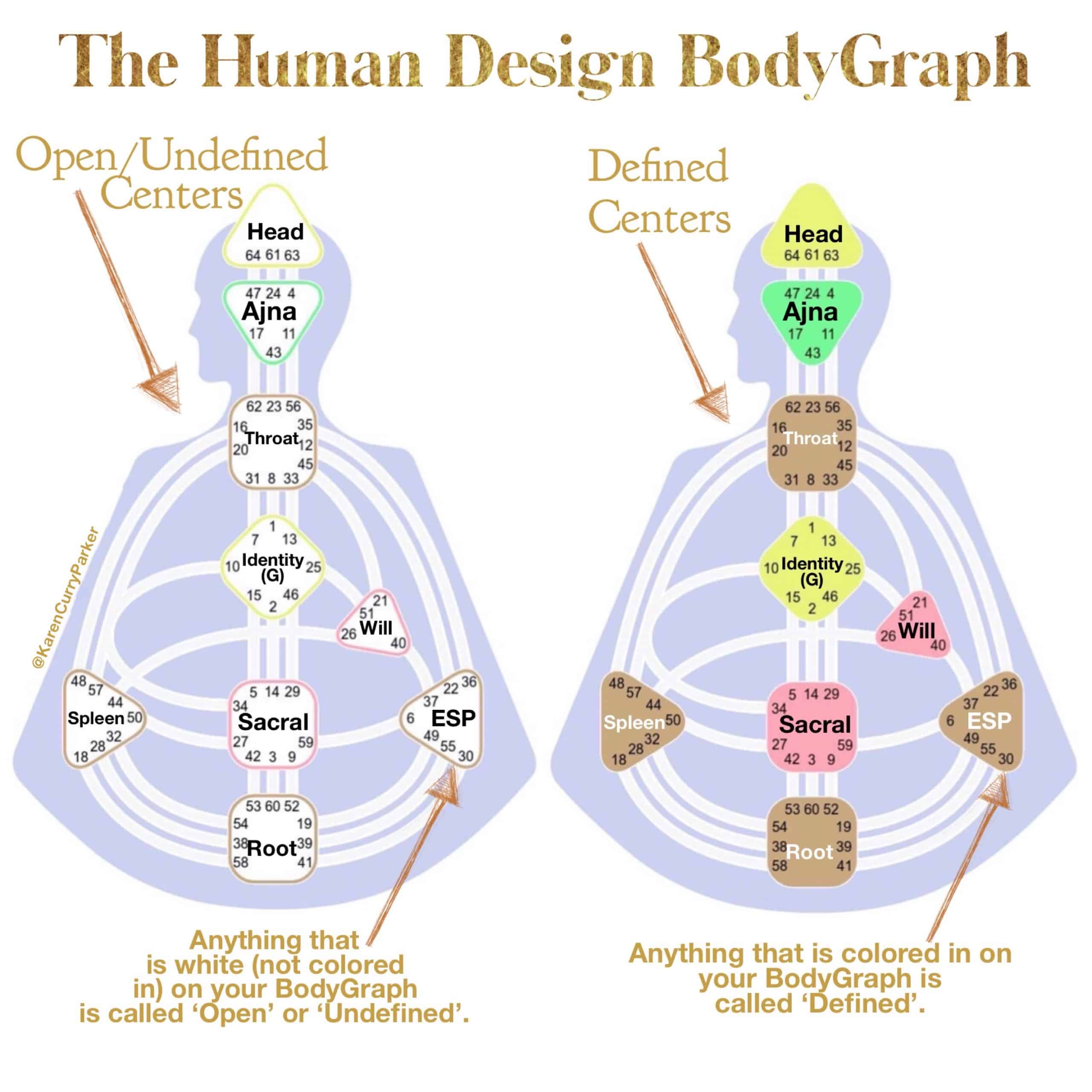
Each Human Design chart has three parts: the body graph, the birth chart, and the keynotes. To start, we need to look at the chart as a whole. Looking closely at the chart, you might see some visual evidence of the influencing wisdom behind Human Design. For example, the geometric shapes (called centers) look very similar to the seven chakras. If you turn the chart upside down, it looks very similar to the Tree of Life from the Kabbalah. Or you may notice that sixty-four numbers appear on the chart. These numbers, called gates, correlate to the sixty-four hexagrams from the I Ching. In the I Ching, a hexagram is composed of six stacked horizontal lines where each line is either yang (an unbroken or solid line) or yin (broken, an open line with a gap in the center).
Though you can see pieces of these ancient wisdom teachings in the chart, Human Design is something new and unique, a brand-new tool to help people in a brand-new way.
What Your Personal Human Design Chart Will Tell You
When you receive your Human Design chart, you will see a series of numbers and planetary symbols next to a triangle composed of all kinds of lines, geometric shapes, colors, and a person’s profile. This triangle, called the body graph, is the visual compilation of all the numbers and written information on your chart. The body graph is, in essence, a “map” of your unique energy configuration.
The Nine Centers
The nine geometric shapes are the first things you may notice when you look at your chart. These shapes represent the nine centers, and their role is similar to the seven chakras. Each center is responsible for carrying and managing a certain energy frequency, and it relates to a specific theme in our lives.
The nine centers and their themes are:
Head: Inspiration
Ajna: Thinking, analysis and data
Throat: Communication and action
Identity: Self, love, and life direction
Will: Willpower and value
Emotional Solar Plexus: Emotional clarity
Root: Adrenaline energy
Sacral: Workforce and life-force energy
Spleen: Survival, intuition, immune system, and time
Next, you might notice that some of the centers in your chart are white while others are colored in. The white centers are undefined or open. The defined centers are colored in.
Defined Centers
If a center is colored in, it is “defined.” Defined centers represent the energy that you radiate out into the world consistently, the aspects of your personality that are true all of the time, independent of any other factors in your environment. It can be raining, Mercury can be in retrograde, and Mars can disappear out of the solar system, but your definition (the colored-in parts of your chart) always stays the same. Your definition comes from the position of the gates and the planets at the moment of your birth.
As you will learn, defined centers have their own issues, but overall they are much easier to manage than the sometimes traumatic experiences of open centers. Some good general advice is to know and live your Human Design strategy. It will empower you always to know what to do.
Open Centers
If a center is white, then it is undefined or open. Open centers take in and amplify energy and information from the world around you. The energy in open centers is inconsistent because it changes depending on who you are with. It can also feel more intense than defined energy because it comes in waves and is always changing.
It is easy to assume that the energy in your open centers is yours, and sometimes you will try to fix an aspect of your personality, not realizing that you are behaving according to outside factors. Notice where your open centers are; these are the places where you have the potential to have the most pain until you understand how your energy works. But these open centers also hold the potential for your greatest wisdom as well.
Motor Centers
Four centers on the body graph are the motors: the Sacral Center, the Will Center, the Root Center, and the Emotional Solar Plexus. Motors help define the kind of energy you have.
-
- Sacral Center: This is the energy for working, nurturing, and sexuality. It is sustainable energy. It can keep going without breaks or rest.
-
- Will Center: This is where your willpower is located in your chart. Willpower in Human Design is the energy for managing and creating physical resources and endurance for short periods of time. It is an energy that requires cycles of rest.
-
- Root Center: Adrenaline is located in the Root Center. This is energy that gives you an adrenaline rush. It operates in on/off cycles.
-
- Emotional Solar Plexus: This is where your emotional energy is located. Emotional energy cycles through inward integration and outer expression, and your mood is often influenced. When the mood is right, this is the energy for creating.
Pressure Centers
There are two pressure centers: the Head Center and the Root Center. The configuration of the pressure centers in a chart helps you understand what kind of pressure you might be experiencing in your life and gives you new ways to work with the pressure so you can reduce stress and make more relaxed choices.
-
- Head Center: This can be a source of mental pressure. When the Head Center is open or undefined, you may experience pressure to figure things out or always feel like you need to find the answers to your questions.
-
- Root Center: This is the center for adrenaline energy. When the Root Center is open or undefined, you may experience pressure to get things done to feel “free.” Sometimes this leads to making rash decisions in an attempt to avoid pressure or stress.
The beauty in the defined and undefined centers lies in the fact that, individually, we are all simply parts of a greater whole. We all become completely defined when we are all together. We each bring pieces that energetically unify us all and offer us the opportunity to express all of the human experience
Human Design Channels
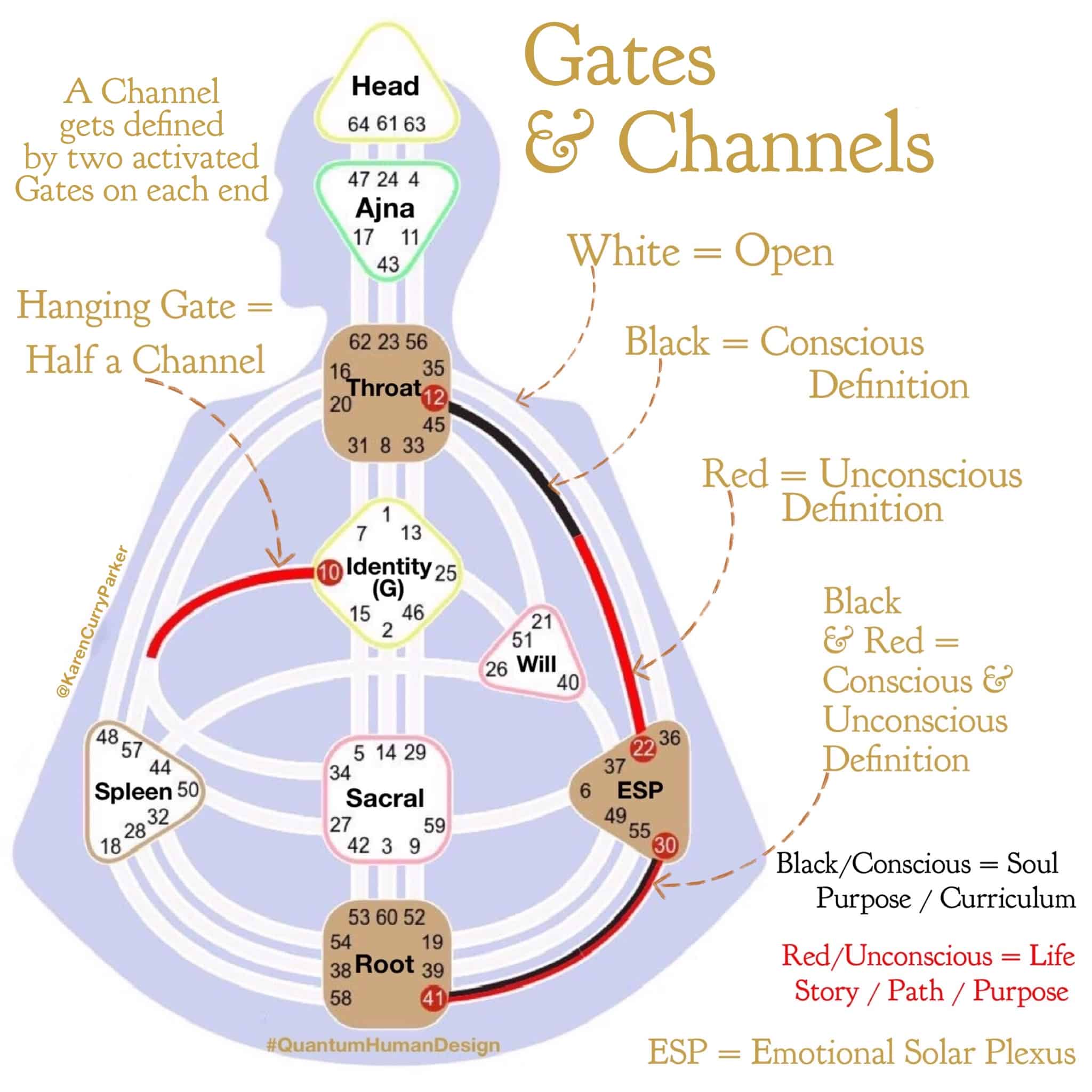
Notice how the nine centers are connected to one another through many lines. These lines are called channels, and there are thirty-two of them. The channel’s color tells you about an aspect of your personality:
-
- Black channels carry personality traits that you are consciously aware of.
-
- Red channels carry personality traits that you are not consciously aware of.
-
- Checkered channels represent those particular personality aspects that are in your conscious and unconscious definition.
-
- White channels represent open gates. You will always take in the energy of both gates from the world around you, and its expression through you will depend on your environment.
Human Design Gates
At the end of each channel is a numbered gate, and the channel is named using these two gate numbers. For example, we might talk about the 34/20 channel, the Channel of Charisma, which connects Gate 34, the gate of power, to Gate 20, the gate of metamorphosis. The sixty-four gates correlate to the sixty-four hexagrams in the I Ching. Each defined gate in your chart adds a different “flavor” to your personality.
Definition
Definition of the chart refers to the colored-in channels between centers. Single definition means all of the centers that are colored in or defined in the chart are connected.
Split definition means there are two distinct groups of energy centers that are connected within the group but are not connected to each other.
Triple split definition means three distinct groupings of energy centers are not connected to one another.
Quadruple split definition means there are four distinct groupings of energy centers that are not connected to one another.
An energy split can make you feel like you have certain very distinct aspects to your perception of yourself. We often attract partners with gates that “bridge” our defined splits. When we are with that person, we feel “whole” or that all the parts of ourselves are unified, which is indeed what happens, at least energetically.
Birth Charts are Generated by a Human Design Calculator Software
Let’s move now from the human figure to the table with all the numbers and planetary symbols. On the left side of the chart or flanking either side of the body graph, you will see a series of red and black numbers and planetary symbols. This is called your birth chart. Your birth chart is fixed; it does not change during the course of your life.
Your Unconscious Personality
Your unconscious personality is defined by the red elements on your birth chart—these are aspects of your personality that are consistent but unconscious, meaning you don’t really have much control over these parts of your personality. Usually, with age, we become more aware of our unconscious personality. Your family and loved ones also usually know the unconscious elements of who you are.
The date in red is your unconscious birthday. The unconscious birthday is roughly three months prior to your birth and coincides with a large spurt in brain development in the cerebral cortex while a baby is in utero. It is approximately eighty-eight astrological degrees from the moment of your birth
Your Conscious Personality
The black elements on the chart are aspects of your personality that you are consciously aware of and, to a certain degree, have some control over.
The birth date in black is your actual birthday, called your conscious birthday. This is your conscious personality.
Gate Numbers
The large numbers listed in either red or black are gate numbers. There are sixty-four of these gates represented in the body graph.
Gate Lines
You will see next to each gate number is a smaller number that looks like an exponent. This is a gate line. They are numbered one through six.
The gate lines are unique to each chart. Not every chart has all six lines. It depends on the position of the planets at the moment of birth. Lines are like seconds when we measure time. Here are the gate lines’ six unique archetypes:
Line 1: Investigator
Line 2: Hermit
Line 3: Martyr
Line 4: Opportunist
Line 5: Heretic Line 6: Role Model
Profiles
Everyone comes into the world with a specific profile and purpose. Profiles tell you about major life themes that you will encounter, and they illustrate how your personality interacts with the world as you move toward fulfilling your purpose. Your profile can be thought of as an explanation of your conscious and unconscious archetypes and the themes associated with those archetypes. Most people are aware of their unconscious profile, but because it is unconscious, they do not have much control over their expression of it.
The twelve profiles are combinations of two gate lines (the conscious line followed by the unconscious line):
1/3 Investigator/Martyr
1/4 Investigator/Opportunist
2/4 Hermit/Opportunist
2/5 Hermit/Heretic
3/5 Martyr/Heretic
3/6 Martyr/Role Model
4/6 Opportunist/Role Model
4/1 Opportunist/Investigator
5/1 Heretic/Investigator
5/2 Heretic/Hermit
6/2 Role Model/Hermit
6/3 Role Model/Martyr
The Planetary Symbols
The planetary symbols indicate the astrological position of the energies in your chart at the moment of your birth. Each planet is covered, starting with the position of your sun gate at the top and ending with the position of your Pluto gate.
Incarnation Cross
The final piece of the chart generated from a human design calculator software system that ties the whole thing together is called the Incarnation Cross. The Incarnation Cross comprises the energies that make up your conscious and unconscious Sun and Earth signs—the top four black and red numbers in your birth chart.
These four energies combined comprise about 70 percent of your personality expression. The Incarnation Cross is basically a person’s life purpose. It tells us who they are, what they are driven to do, their foibles, follies, and ultimately their destiny if they choose.
The meaning of each cross is a combination of the four gate energies that comprise it. The gate energy in the conscious sun position—the top right black number—is the most significant of the four. All of the other energies in your cross and in your chart are expressed through the conscious sun gate energy. Over the course of a year, the sun will move through all sixty-four gates. There are 192 possible Incarnation Cross combinations, each one a reflection of the solar and earth transits. The Incarnation Cross gives us much more information than a mere sun sign in astrology. It offers a deeper explanation of the path of a soul and the journey of a lifetime.
The Keynotes
At the bottom of your chart, you will see a section called Keynotes, which is a short summary of the most important parts of your chart. The keynotes tell you:
-
- your type and your unique decision-making strategy,
-
- your authority—whether you are spontaneous or whether you need time to make good choices—and
-
- your emotional theme—which emotion you may find most challenging in your life. (Rest assured, if you live true to who you really are, you dramatically improve your experience of your emotional theme.)
Your Type
The five types written in the language of Quantum Human Design™, and traditional Human Design are the Initiator/Manifestor, the Time Bender/Manifesting Generator, the Alchemist/Generator, the Orchestrator/Projector, and the Calibrator/Reflector. You can find your type at the bottom of your Human Design chart in the Keynotes.
Each of the five personality types has a unique strategy for making decisions and being in the world. Knowing your type can help you develop confidence and trust in your ability to make reliable decisions.
Your Strategy
Your strategy comes from your type, and it is probably the most important knowledge offered by your Human Design chart. It gives you key information about making the right choices for you and recognizing when you are on the right path.
Following your strategy offers you the opportunity to experience events and circumstances that are correct for you, while not following your strategy can bring events and experiences into your life that may not be beneficial in the long run. Follow your strategy, and you will truly fulfill your personal destiny.
Because learning to follow strategy effectively can take months or years of practice, you can benefit from coaching by a Human Design analyst who can provide you with feedback and encouragement
Your Authority
Although decision-making is tied directly to your strategy, your authority flavors the way you use your strategy. Your defined centers will determine your authority. Not all centers carry authority, so your personal authority will depend on your type and your definition.
Authority will also depend on your life conditioning and your level of emotional well-being. When you receive a Human Design analysis, you are taught to understand patterns of pain and behaviors that may keep you from living out the beauty of the mythology of who you really are. With cognitive awareness of old patterns, you begin to heal and transform these energies into deep sources of wisdom. The more you clear your old energy patterns, the more effectively your natural decision-making skills (your authority) can function. You can then begin to use your authority and your strategy to help you make better decisions for your life.
It’s very important to note that authority does not override your strategy—it just shifts the way you use your strategy so that your decisions and choices are even more in alignment with the overall energy in your chart.
There are six kinds of authority:
-
- Generated
-
- Splenic
-
- Emotional
-
- Ego
-
- Self-Projected
-
- Mental
Some kinds of authority have a strong influence on the chart. Others are more subtle and don’t require much, if any, change in how you live your strategy.
Emotional Theme
Each Human Design type has an emotional theme. The emotional theme is simply part of a person’s life and brings lessons and opportunities for growth. You will either be experiencing the emotions of your theme yourself, or you may be experiencing them through the other people around you who are responding to your behavior.
When you experience your emotional theme in a strong way, it’s usually a sign that you are not living true to yourself. For example, the emotional theme for Alchemist/Generators is frustration. Generators must wait for things to show up in their outer reality and then respond to them as part of their decision-making strategy. If you are a Generator, and you are forcing things to happen in your life without waiting to see if they are right for you, you will most likely experience a lot of frustration because things won’t work out the way you’d hoped.
It’s always good to take a step back and evaluate your life if you’re feeling your emotional theme in a powerful way. When you live your life according to your Human Design strategy, you lessen the intensity of your experience of your emotional theme. You might feel it here and there, but it won’t be a roaring monster that dogs you day and night.
The parts of your Human Design chart—the body chart, the birth chart, and the keynotes—are each in and of themselves important and give insights into a personality. Understanding each part and the role it plays in your life story helps you put together a bigger picture and a deeper understanding of who you truly are.
Remember that each part is a piece of a whole. While we have to take the chart apart to understand its key pieces, the real beauty of the chart is in synthesizing all its parts. The true story of who you are is revealed when all of the pieces come together.
You may also enjoy this post:
How To Read Your Chart – Resources To Help You Understand Your Human Design Chart
Want more content? Why not follow us on YouTube