
Understanding Solar Plexus Inner Authority In Human Design
We’ve always been told to, “trust our gut”, or to make life-altering decisions with a simple Pro/Con list.
What if your decision-making process isn’t designed to come from your gut or your mind?
In Human Design, everyone is designed with an Authority that guides them in making decisions. Trusting in your design and accessing your Inner Authority ensures you make the best decisions for you – even if that’s not what the Pro/Con list said you should do.
For those with Emotional Authority (Creative Authority in Quantum Human Design), this means navigating an ever-moving emotional wave. These fluctuations often occur without a clear cause, making those with Emotional Authority seem moody, or indecisive to others. They feel emotions deeply, which can be challenging when faced with opportunities. Meeting new people or receiving a job offer can trigger these emotions, leading to premature reactions.
The key challenge with Emotional Authority is the need to wait. You must let the emotional wave settle before making a decision. Resist the pressure to “make up your mind” quickly, as hasty decisions are likely to lead to regret.
Instead, give yourself the time to find emotional clarity, ensuring your choices truly align with your inner authority.
Two Kinds of Authorities
Your Human Design Type and Strategy enables you to use your Authority as a tool to determine if an opportunity is right for you.
Authority is categorized into two types: Inner and Outer.
Inner Authority
According to the founder of Human Design, Ra Uru Hu, “What you can trust to make decisions, and it is never the mind.” Inner authority relies on your internal intelligence, meaning that when you listen to your body, you have all the information you need. The challenge lies in quieting the mind and ignoring external opinions. You have inner authority if you have a defined Spleen, Solar Plexus, Sacral, or Ego center. Learn more about your Centers here.
Outer Authority
Only 3% of the population has outer authority, which includes Mental Projectors and Reflectors. Those with outer authority are here to share their perspectives and knowledge with others. Mental Projectors gain clarity by discussing their ideas with others, while Reflectors rely on their strategy of waiting for a lunar cycle before making decisions.
By understanding and trusting your unique authority, you can make decisions that are truly aligned with your authentic self.
The Solar Plexus Center and Emotional Authority
The Solar Plexus Center governs and regulates our emotions. As an Inner Authority, emotions, and the Solar Plexus are at the top. You have Emotional Authority if you have a defined Solar Plexus in your chart- even if you have other defined Centers.
The Solar Plexus Center is both a motor and center of awareness, this duality is notable because the definition of emotion is energy that is always moving. Humans do incredible things purely for the sake of how we feel. If you pause and reflect on your life, you will see how life-altering your emotions can be. Emotions have the power to move us along the spectrum of feeling in an instant.
As anyone who has ever tried to hold back tears can tell you, emotions are a unique force that we can not truly control.
As with all wave cycles, emotional waves need time to play out to have a complete picture. We can’t judge the ocean on low tide alone because you will miss the glory of the ocean. Emotional waves are useless if they are examined in a single moment because there is no clarity in a single moment.
Just as we know that the tide will go out and come back in, emotional waves will always come and go. Those with Emotional Authority need to trust in that. Emotions are not logical like the Spleen. If you have the Sacral and or Spleen defined in your Human Design chart, acknowledge your immediate response but give yourself the gift of time for your emotions to run their course before making any decisions.
The Defined Emotional Solar Plexus Center
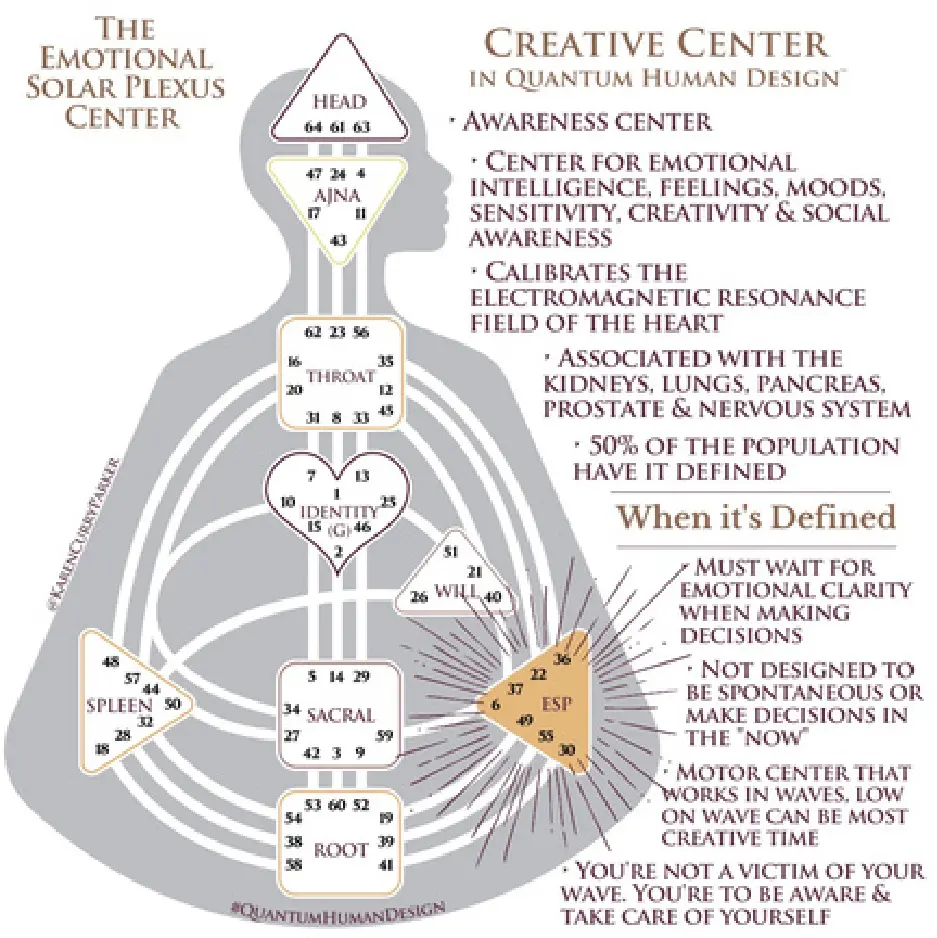
About half of the world’s population has a defined Emotional Solar Plexus Center in their chart, meaning that they carry emotional energy at all times.
The Channels connecting your Emotional Solar Plexus to other energy Centers dictate the types of emotional waves you will experience. Some people have gentle, small waves, while others ride intense highs and lows, with plateaus in between.
Due to the variable nature of emotional energy, the melancholy at the low end of the wave can easily be mistaken for depression. For those with a defined Emotional Solar Plexus, depression can become a significant issue if you try to find a specific reason for feeling down. Our culture often judges negative emotions harshly, but not all negative emotions are harmful. Melancholy, or the low end of an emotional wave, is a crucial creative energy, allows you to evaluate issues from various emotional perspectives.
Regardless of your Human Design Type, if you have a defined Emotional Solar Plexus, you possess Emotional Authority. Your emotional waves are essential to your decision-making process, enabling you to make clear decisions once the emotions settle. Waiting for the right emotional state before acting prevents hasty decisions that you might regret later. Keeping a daily log of your emotional energy is advisable. Each person has a unique emotional rhythm, and understanding your pattern will help you make healthy decisions and recognize the timeframe needed to achieve emotional clarity on any issue.
The Undefined Emotional Solar Plexus Center
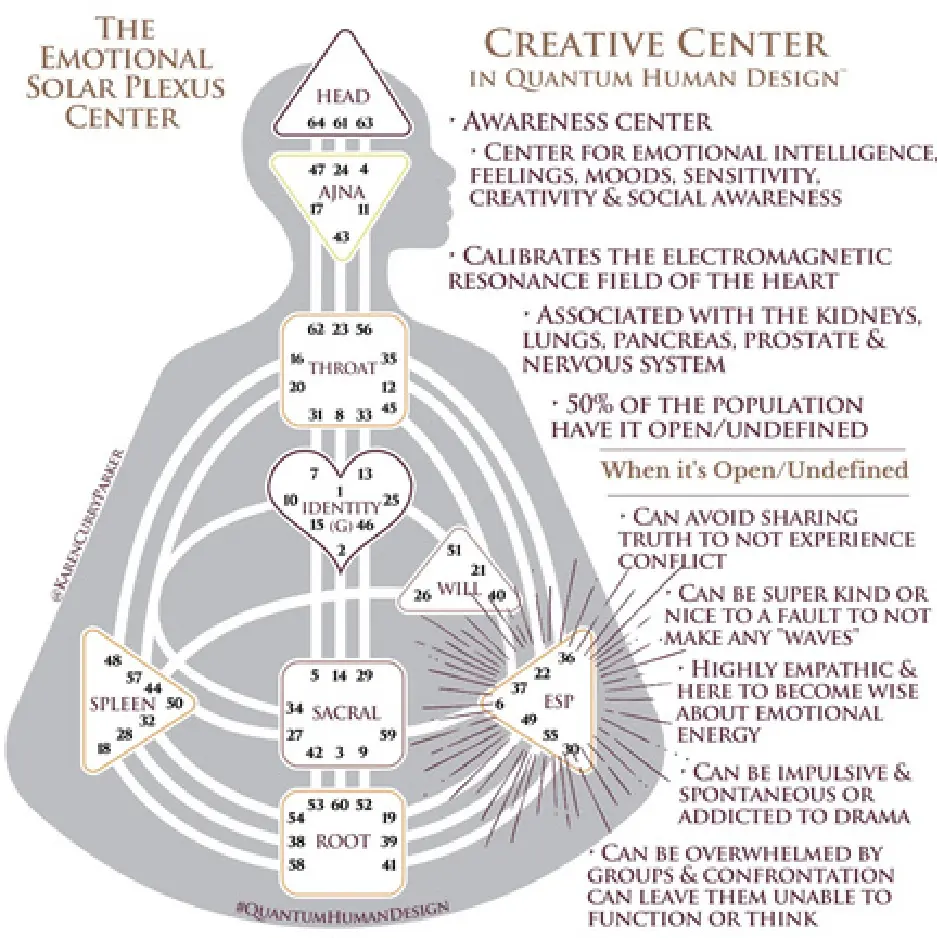
About half of all people have an open Emotional Solar Plexus Center. If you are among them, you are here to learn about emotional energy and develop wisdom around feelings. Your empathic nature allows you to amplify and read the emotions of those around you, making this openness a powerful gift.
This empathy can pose a challenge for those with an undefined Solar Plexus because you take in and amplify emotional energy, this can be a draining center t if you don’t understand how it works. It’s easy to mistake the amplified emotions for your own, which can be particularly painful when absorbing negative energy from others.
This sensitivity often leads emotionally undefined people to adopt coping strategies such as being overly nice, people-pleasing, avoiding conflict, and leading a secret life.
This doesn’t mean that emotionally open people are weak or lack character. The reality is that feeling highly charged emotional situations is more painful for them. It’s essential to become aware of emotional energy, allowing it to flow through you without taking responsibility for it or feeling the need to fix it. Aim to be an emotional screen, not a sponge.
The Significance of Gates and Channels in Emotional Authority
Enhancing your knowledge of Gates and Channels is significant to understanding Emotional Authority in Human Design. Everyone’s Human Design chart features a set of 64 gates, defined or not they all exist in the chart, which represent different energies. Channels exist between the Centers and can be defined or undefined depending on the definition present in the chart.
It’s important to note that the presence of a defined Channel indicates a defined Center, and these definitions affect how each individual experiences their Authority.
Recognizing and Trusting Your Emotional Waves
Those with Emotional Authority will experience one or more of four wave types.
When you understand the mechanics of your wave type, it will allow you to flow with your emotions, and not feel the pressure to make decisions until you are ready.
The Emotional Waves
Source Wave: Channel 59-6
This wave is the source of all the waves coming out of the Emotional Solar Plexus. This channel in itself is very powerful and is known to penetrate the aura of others. The energy breaks through barriers, and because it is so inviting others tend to feel the power generated from it and want to tap into it-invited or not. People with this channel or either of these gates may find that people want to tell them their deepest, darkest secrets, even random strangers they’ll never see again!
This type of wave tends to be stable but can be triggered by others.
Tribal Wave: Channels 19-49 and 37-40:
This wave is all about needs because it’s based in the tribal circuitry. This wave goes up and up until it’s set off, then it comes crashing back down. This is the person who lets things go and doesn’t bring it up at the moment. One day, they explode on you for something that doesn’t seem like a big deal, but it is to them because they never told you all the other things that bothered them as they happened.
Individual Wave: Channels 22-12 and 39-55
This wave is all about moodiness. This wave is also very passionate, when it’s in the mood it’s all about the auditory. It can literally fall in love with a voice. Think of this wave like a heartbeat, moving along with short spikes up and down, but seems to be stable most of the time. This wave needs to tune in to when to be social or not (12-22 is the only social individual channel.) It needs to follow how it feels in the moment to know if it can be around others or not.
Collective Wave: Channels: 41-30 and 36-35
This wave goes through a steady rise and sharp fall. It’s all about the desires and feelings of those around them. This wave tends to crash due to unmet expectations. If you have this wave, be cautious about attaching expectations to things. This is all about doing things for the experience and not for expectations.
Embracing the Power of Waiting
Understanding the power of waiting is challenging. In a world that rewards quick action, waiting for emotional clarity can be very uncomfortable. It is in this waiting period that the true power of Emotional Authority takes place.
During an emotional wave, there will be an internal pressure to make decisions and the key to making aligned decisions is to wait for the wave to fully pass. In the calm after the wave, a profound and deep knowing peace will emerge. It is in this peace where the Authority will show its power.
Living Authentically with Emotional Authority
Living in alignment with your design, as someone with Emotional Authority, involves respecting and caring for your emotional wave. This is a practice and could look like setting firm boundaries around your need to take time before making a decision, setting aside time to track your emotional waves, and making a conscious decision to avoid decisions during your emotional waves.
This practice requires a strong dose of courage to go against the social grain. Immediate answers are common in our society, but staying true to your design and honoring your emotional Authority will prove worthwhile.
Living authentically with Emotional Authority also requires continuous awareness of self and understanding. Observing your emotional wave, setting boundaries, and understanding your personal process will all contribute to more aligned decisions.
Communicating Your Decision-Making Process
Effective communication is another aspect of living with Emotional Authority. Because those with Emotional Authority’s process around decision-making differs from the norm, it is crucial for them to communicate this process with others.
This communication doesn’t mean that you have to explain to your boss what Human Design is, or what Emotional Authority means. This act of communicating your decision-making process can be as simple as, “I really appreciate this offer and I will have a decision for you later this week.”
The Role of Emotional Authority in Relationships
Emotional Authority has a profound impact on relationships. Emotional clarity is not only vital for decision-making but also plays a role in interactions and relationships with others. Communication is key for those with Emotional Authority to articulate their decision-making process and the need for time.
If you are in a relationship with someone who has Emotional Authority, the best gift you can give them is time and space. Allow them to take the time they need to make decisions and the energetic, or physical, space to do so.
Someone with Emotional Authority often brings a wealth of emotional wisdom to their relationships. They carry wisdom from their emotional journeys, which can help develop deep and meaningful connections with others.
Navigating Life Purpose with Emotional Authority
Having Emotional Authority extends through many aspects of life. Decision-making leads us to our life’s purpose.
Emotional Authority often signifies a lifelong theme of emotional wisdom, where the individual is designed to experience and understand the depth, of human emotions.
This journey can be fulfilling, yet challenging at times. This journey requires honesty, patience, and bravery to face emotions openly and without judgment. It’s a journey of learning to trust in the emotional process and to find the unique wisdom within it.
Interacting with Others with Emotional Authority
With Emotional Authority, engaging with others can feel like an emotional roller coaster. It’s important to recognize that your emotional waves influence not only you but also those around you. Your emotions can be contagious, impacting the energy of the room and the people in it.
For someone with Emotional Authority, communication is key. It’s essential to convey to others that you may need more time for decision-making. Additionally, clearly expressing your emotional state is important, especially when it affects your interactions with those closest to you.
Cultivating understanding and patience from others is crucial for maintaining healthy relationships as someone with Emotional Authority. Remember to also be understanding and patient with yourself. Embrace your emotional nature as a strength, not a weakness, and clearly express your needs and boundaries to others.
The Challenges of Emotional Authority
Having Emotional Authority comes with its challenges. Navigating your emotional waves can be difficult, especially in a society that often promotes immediate decision-making and may even stigmatize emotional processes.
As someone with Emotional Authority, you might feel pressured to make quick decisions and be misunderstood or judged for needing time to achieve emotional clarity. These external pressures can create internal conflict as you struggle between honoring your design and meeting societal expectations.
However, it’s crucial to remember that your process is not only valid but essential for your well-being and authentic self-expression. Embracing your unique decision-making process over time can lead to greater self-acceptance, empowerment, and alignment with your true self.
Do you have Solar Plexus Inner Authority in Human Design?
The first thing you need to do is to download your FREE Human Design Chart here to discover your personal Authority.
Working with a Quantum Human Design Specialist provides a personalized journey into understanding your Human Design Authority. Through their expert guidance and interpretation of your chart, you will delve into the intricacies of your unique design, uncovering insights into your nature, and decision-making processes.
Together, you explore how to align with your Human Design Authority, empowering you to navigate life with greater clarity and authenticity. With the specialist’s support, you embark on a transformative exploration, gaining deeper self-awareness and unlocking your potential to live in harmony with your true essence.
Find your Quantum Human Design Specialist Here
It’s important to note that while each one of us is different and magnificent, it is truly in the sum total of the parts of who we are as humans that the true elegance of Human Design and humanity is revealed.
If you want to learn more about the true elegance of Human Design and how it can work for you, why not check out our Quantum Human Design School here
Note: The names in brackets above are the Quantum Human Design (QHD) names for the Types and Profiles. QHD helps us to reframe the ‘Not Self’ or conditioned self shown in Human Design to explore the potential of the deconditioned self and to live more in alignment with our inner truth.
Curious about the difference between Human Design and Quantum Human Design? Karen Curry Parker explains it in this video