What Are Keynotes in Human Design?
Keynotes in Human Design are concise, essential phrases or words that encapsulate the core meaning, theme, or energy of a specific component in a Human Design chart. They serve as quick reference points or summary descriptors for various elements such as Gates, Channels, Centers, or other aspects of the chart.
These keynotes are used to quickly convey the fundamental essence or primary characteristics associated with each element, allowing for a rapid understanding of its significance within the broader context of a person’s Human Design.
Human Design is complex and chock full of information. Keynotes serve as the essential gateway into the analytical realm of Design. Keynoting is the process of translating the visual elements of the chart into language.
To delve into the realm of Design, the pathway is clearly laid out for you. It unfolds through the framework of keynotes, which hold relevance in every facet. You’ll find keynotes dedicated to circuits, channels, gates and lines.
These keynotes manifest across the spectrum, each with its distinct specificity. They provide insights into various aspects—streams, perspectives within the body graph, and even intimate facets like sexual dynamics. Diverse and intricate, these keynotes are, in essence, a set of formulas that guide our exploration.
There are keynotes for each of the major elements of Human Design, including:
- Type: There are five main Types in Human Design (Manifestor, Generator, Manifesting Generator, Projector, and Reflector). Each Type has its own keynotes related to energy usage and life strategy.
- Strategy: Each Type has a recommended decision-making strategy. The keynotes here relate to how a person should approach life and make decisions.
- Authority: This refers to the body’s inner guidance system. Keynotes for Authority describes how a person should make important decisions.
- Profile: Made up of two numbers, the Profile describes a person’s life theme and approach to relationships. Keynotes here relate to social dynamics and life purpose.
- Centers: There are nine energy Centers in Human Design. Keynotes for each Center describe its function and themes when defined or undefined.
- Gates and Channels: These are more specific energies within the chart. Keynotes for Gates and Channels describe particular qualities, talents, or challenges.
- Variables: These include things like Determination, Motivation, Environment, and Perspective. Keynotes here describe cognitive and sensory processing styles.
Some Key Points About Keynotes
- Specificity: Each Gate, Channel, Center, and other components of a Human Design chart has its own unique set of keynotes.
- Layered meanings: Keynotes often have multiple layers of interpretation, from literal to metaphorical.
- Contextual use: The meaning of a keynote can shift slightly depending on its context within the chart and in relation to other elements.
- Origin: Many keynotes are derived from or influenced by the I Ching, astrology, and other systems that contribute to Human Design.
- Practical application: Keynotes are used in readings and self-study to quickly identify themes and potentials in a person’s design.
- Evolving interpretations: As the Human Design system continues to develop, the understanding and application of certain keynotes may evolve.
- Learning tool: For those studying Human Design, memorizing keynotes is often an important step in mastering the system.
Keynotes serve as a bridge between the complex, detailed information in a Human Design chart and practical, applicable insights. They allow for efficient communication of core concepts and themes within the Human Design framework.
Where Do I Find the Keynotes on My Human Design Chart?
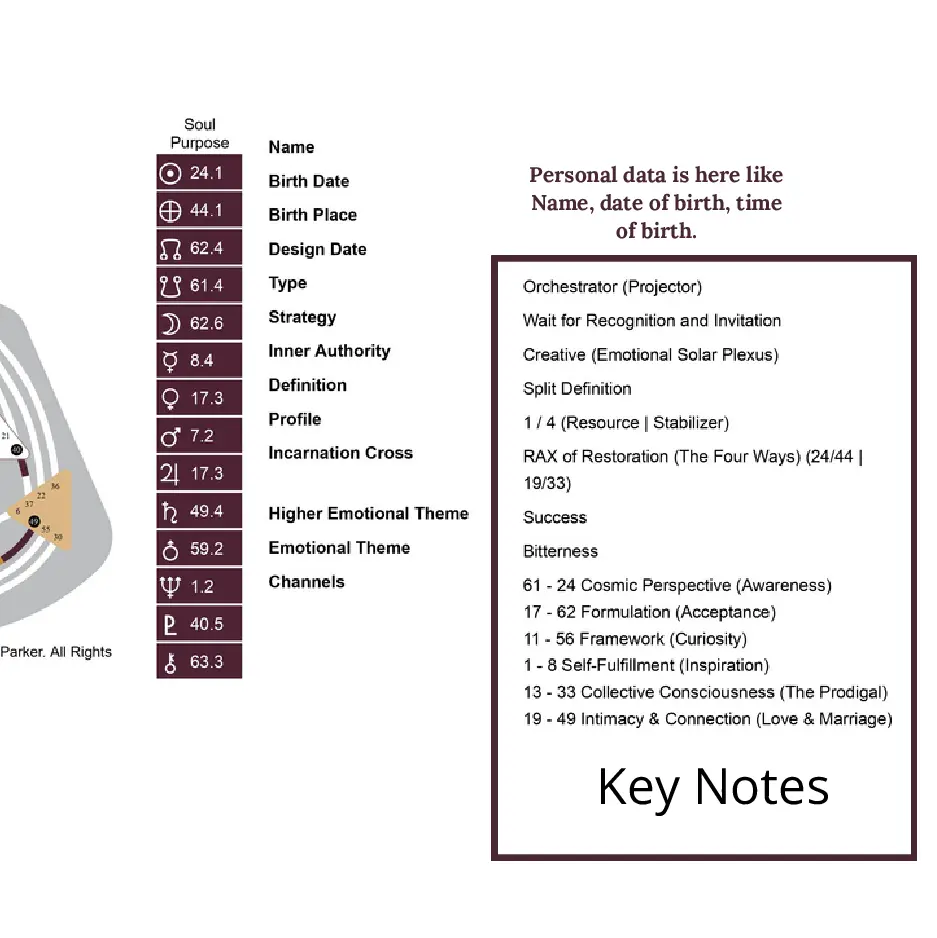
At the base of your chart, you will find a section referred to as “Keynotes.” This section provides a concise overview of the most significant aspects of your Human Design chart.
How Will My Keynotes Help Me?
The most important keynotes to pay attention to:
Your Type and Decision-Making Strategy:
This reveals your unique type and the strategy that best suits you when making decisions. The five types are Manifestor (Initiator), Manifesting Generator (Time Bender), Generator (Alchemist), Projector (Orchestrator), and Reflector (Calibrator). Identifying your type helps you align with your innate decision-making style, fostering self-confidence and trust in your choices.
Your Authority:
Your authority influences how you utilize your strategy. It is linked to your defined centers and is influenced by factors like life conditioning and emotional well-being. Recognizing your authority can aid in understanding your decision-making process, facilitating better choices aligned with your chart’s energy dynamics.
Your Emotional Theme:
Each Human Design type has an associated emotional theme. This theme brings valuable lessons and opportunities for growth. Experiencing your emotional theme strongly often signals a misalignment with your true self. Adhering to your Human Design strategy helps mitigate the intensity of your emotional theme, creating a more harmonious emotional experience.
Type and Strategy Keynotes
A simple entry point into Human Design is discovering your type and embracing the corresponding strategy.
Your Type
Manifestor (Initiator), Manifesting Generator (Time Bender), Generator (Alchemist), Projector (Orchestrator), and Reflector (Calibrator) — shape how you navigate the world and make decisions. This foundational understanding supports you in developing confidence in your decision-making abilities.
Your Strategy
Central to your Human Design chart is your strategy, directly derived from your type. It imparts essential information on making optimal choices and staying on the correct path.
Following your strategy aligns events and circumstances with your unique energy while disregarding it can lead to less favorable outcomes. Mastery of your strategy may require guidance from a Human Design analyst to refine your skills over time.
Inner Authority Keynotes
Your authority, intertwined with your decision-making strategy, stems from your defined centers and other variables. Its effectiveness depends on your emotional well-being and personal growth. Exploring your life patterns and behaviors through a Human Design analysis helps uncover transformative insights. As you heal and shift old energy patterns, your authority becomes a more potent tool for making sound decisions.
There are six types of authority:
- Generated (Evolutionary)
- Splenic (Actualizing)
- Emotional (Creative)
- Ego (Resource)
- Self-Projected (Orchestrated)
- Mental (Orchestrated)
Emotional Theme
Each Human Design type possesses a distinctive emotional theme that imparts lessons and growth opportunities. Intense experience of your emotional theme often arises from living out of alignment with your true self. Recognizing and adhering to your strategy mitigates the intensity of this emotional theme, allowing you to navigate it with greater ease.
Profile Keynotes
Each individual enters the world with a distinct Profile and a designated purpose. The twelve Profiles delineate significant life themes that will unfold, shedding light on how your personality engages with the world. Familiarizing yourself with your Profile aids in recognizing these pivotal life themes on your journey toward fulfilling your life’s purpose.
Within a Profile, each number carries specific significance. The initial number in your Profile signifies the conscious facet of your personality that you readily recognize. Conversely, the second number within the Profile often remains concealed in your unconscious, operating more covertly.
Your Profile serves as an elucidation of both your conscious and unconscious archetypal traits, along with the associated themes. While some individuals are conscious of their hidden Profile, its expression often eludes direct control due to its unconscious nature.
There are 12 Profiles:
1/3 – The Investigating Martyr (The Resource Explorer)
1/4 – The Investigating Opportunist (The Resource Stabilizer)
2/4 – The Hermit Opportunist (The Responder Stabilizer)
2/5 – The Hermit Heretic (The Responder Visionary Leader)
3/5 – The Martyr Heretic (The Explorer Visionary Leader)
3/6 – The Martyr Role Model (The Explorer Adept)
4/6 – The Opportunistic Role Model (The Stablizer Adept)
4/1 – The Opportunistic Investigator (The Stabilizer Resource)
5/1 – The Heretic Investigator (The Explorer Resource)
5/2 – The Heretic Hermit (The Explorer Responder)
6/2 – The Role Model Hermit (The Adept Responder)
6/3 – The Role Model Martyr (The Adept Explorer)
How to Get Your Own Human Design Chart For Free
Every Human Design chart consists of three distinct components: the body graph, the birth chart, and the keynotes.
To initiate our exploration, it’s essential to regard the chart in its entirety. Upon closer examination, you might discern visual indications of the profound wisdom that shapes Human Design. As an illustration, the geometric configurations, referred to as centers, bear striking resemblance to the traditional seven chakras.
In an intriguing alignment, if you invert the chart, it remarkably mirrors the Tree of Life from Kabbalah. Another intriguing facet is the presence of sixty-four numerical values, known as gates, which correspond to the sixty-four hexagrams found in the I Ching. In the I Ching, a hexagram is crafted from six vertically stacked lines, each characterized as yang (solid or unbroken) or yin (open, with a central gap).
While vestiges of these age-old wisdom teachings manifest within the chart, Human Design emerges as an innovative and distinct entity—a fresh and unparalleled instrument crafted to empower individuals in novel and transformative ways.
To run your Human Design chart you will need your: date of birth, time of birth, and the city, state, and country where you were born. Click Here for your free Human Design Chart
By embracing and integrating your Human Design, you can embark on a journey of self-discovery and personal growth. It provides a framework for understanding and embracing your shadows, challenges, and areas for growth, helping you evolve into your highest potential.
Ultimately, understanding Human Design empowers you to live a more authentic, fulfilled, and purpose-driven life by honoring your unique energetic blueprint. It serves as a valuable tool for self-awareness, decision-making, relationships, and personal growth, guiding you toward a more aligned and meaningful existence.
Visit THIS LINK to learn more about understanding Human Design.
To learn more about Karen Curry Parker and Quantum Human Design please visit our School.
Note: The names in brackets above are the Quantum Human Design (QHD) names for these Types. QHD helps us to reframe the ‘Not Self’ or conditioned self in Human Design to explore the potential of the deconditioned self and to live more in alignment with our inner truth.
Curious about the difference between Human Design and Quantum Human Design? Karen Curry Parker explains it in this:
If this has inspired you to want to know more about how to live your Quantum Human Design, click here
Want more content? Why not follow us on YouTube