
Why Your Emotional Theme in Human Design is Important
Each Human Design type has an emotional theme, sometimes called the not-self. Quantum Human Design uses the term, emotional theme because in Human Design everything is an opportunity for growth. When we experience our emotional themes we are alerted to an opportunity to enhance our lives. When you experience your emotional theme in a strong way, it’s usually a sign that you are not living in alignment with your design.
For example, the emotional theme for Generators is frustration. Generators have to wait for things to show up in their outer reality and then respond to them as part of their decision-making strategy. If you are a Generator, and you are forcing things to happen in your life without waiting to see if they are right for you, you will most likely experience a lot of frustration, because things won’t work out the way you had hoped.
It’s always good to take a step back and evaluate your life if you’re feeling your emotional theme in a powerful way. When you live your life according to your Human Design strategy, you lessen the intensity of your experience of your emotional theme. Emotional themes are normal human emotions, it is when they become chronic that they are alerting you to realign.
How Knowing Your Emotional Theme Can Help You
Knowing your emotional theme in Human Design provides valuable guidance for personal growth and self-discovery. The themes reveal areas of life where individuals may be operating from a place of social conditioning, rather than from their design. By identifying and acknowledging our emotional themes, we can work towards releasing these patterns and embracing our true design. In essence, emotional themes serve as powerful tools for personal transformation, empowering us to reclaim authenticity and align with our highest potential.

Emotional Themes by Human Design Type
Generator (Alchemist) Emotional Theme: Chronic Frustration
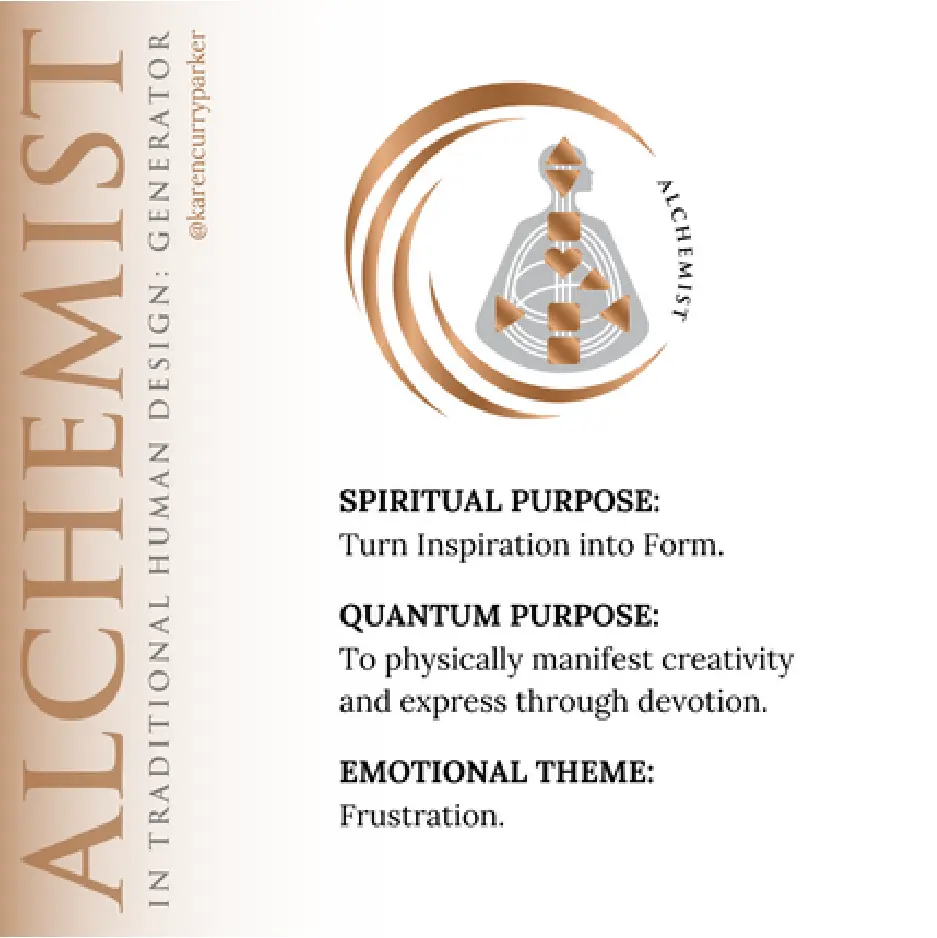
The Alchemist has the role of turning inspiration into reality. The Alchemist is here to become the expert in fulfilling themselves. The process of turning inspiration to reality is not about ruling over a particular skill, or job, but knowing how to navigate life itself with skilled confidence.
The Alchemist’s role in the world is to do the work that builds the world. It is vital for the Alchemist to have work that is fulfilling or fulfills a purpose that is more significant to the world than just a job.
The Alchemist is designed for dancing responsively with life. It is not the job of the Alchemist to figure things out. It is their job to engineer a course through life allowing opportunities, and experiences, to show up. When these opportunities present themselves, the Alchemist waits to respond to the ones that feel good.
The Alchemist must train themselves to tune into their Authority and follow the choices that light them up. Even if those choices go against what their mind is saying.
To become especially skilled, an Alchemist must do things repeatedly, to work towards perfection. The Alchemist has a stair-step learning curve.
Once an Alchemist responds to an opportunity, they usually experience an immediate growth cycle and surge in skillful accomplishment. It is expected for the Alchemist to feel stuck and frustrated once an Alchemist has learned all they can from a particular experience or cycle.
This part of the learning cycle is essential to the Alchemist process. This plateau is a cycle of building momentum, and the energy of frustration that builds up during this part of the learning process is necessary for the next surge in learning.
The biggest challenge for the Alchemist is not to quit because of the frustration. When the Alchemist hits the plateau in the learning process, it is essential to do nothing except realign and explore potentials, envision what’s next, and wait for clues and signs to respond to.
Sometimes a plateau indicates it’s time to quit, but Alchemists must respond to an opportunity to quit—not simply get frustrated and throw in the towel. When the time is right, the next step in the process will reveal itself, and the Alchemy process begins again.
Frustration indicates that the energy for the next opportunity or the next growth cycle is building. It’s a signal to Alchemists to re-calibrate, set clear intentions, and then nurture their energy while they wait for the next step in their genius to appear.
Manifesting Generator (Time Bender) Emotional Theme: Chronic Anger and Frustration
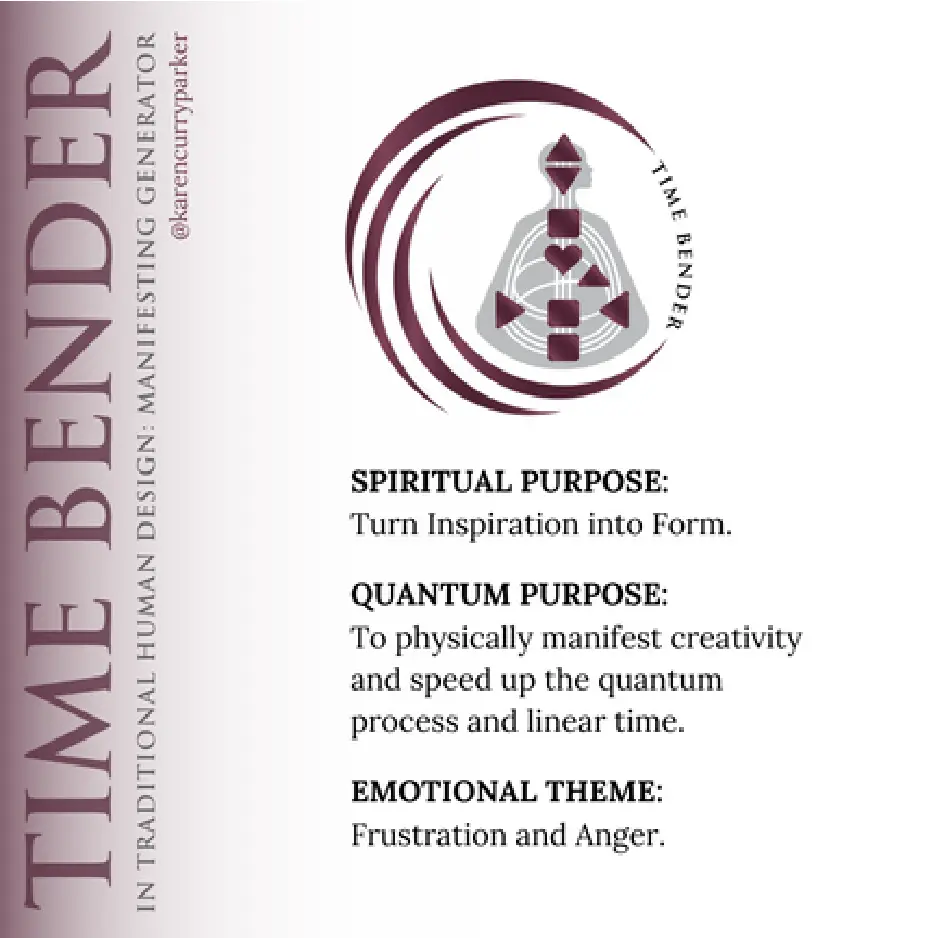
The Time Bender is a hybrid type. A blend of the manifesting energy similar to that of the Initiator and the proficiency of the Alchemist.
Like the Initiator, the Time Bender has an internal, non-verbal, creative flow. But, unlike the Initiator, the Time Bender cannot initiate but must wait for the inner signal, the Sacral response, making them, first and foremost, a Generator Type.
Once the Time Bender has an opportunity to respond, they can spring into action with the same speed and inner alignment as an Initiator.
The speed of the Time Bender gives them the role of finding the fastest, easiest way to complete tasks and to experience proficiency. It is the role of the Time Bender to speed up the experience of time by finding the fastest route and the quickest path.
Like the Alchemist, the Time Bender experiences the cycles of frustration that indicate change is on the horizon. Like the Initiator, the Time Bender also experiences the anger that comes from a disruption in the internal, non-verbal, creative flow.
Frustration and anger for the Time Bender signal that change is coming and that they need to improve their advanced skill over their creative flow by informing those impacted by their actions.
When Time Bender aligns with their inner signal of timing and their creative flow, they are powerful forces that promise to bring to the world an expedited way to create something new.
Multitasking is essential to most Time Benders, not just because they can create multiple things simultaneously (They can!), but because they need to be busy to expend their excess energy.
Not everything that the Time Bender starts will be completed, which others can often judge as sloppy. The expectation that they should finish everything they start can lead to the experience of frustration and anger in the Time Bender if they fail to realize that some creative projects simply serve the function of burning off extra energy.
Manifestor (Initiator) Emotional Theme: Chronic Anger
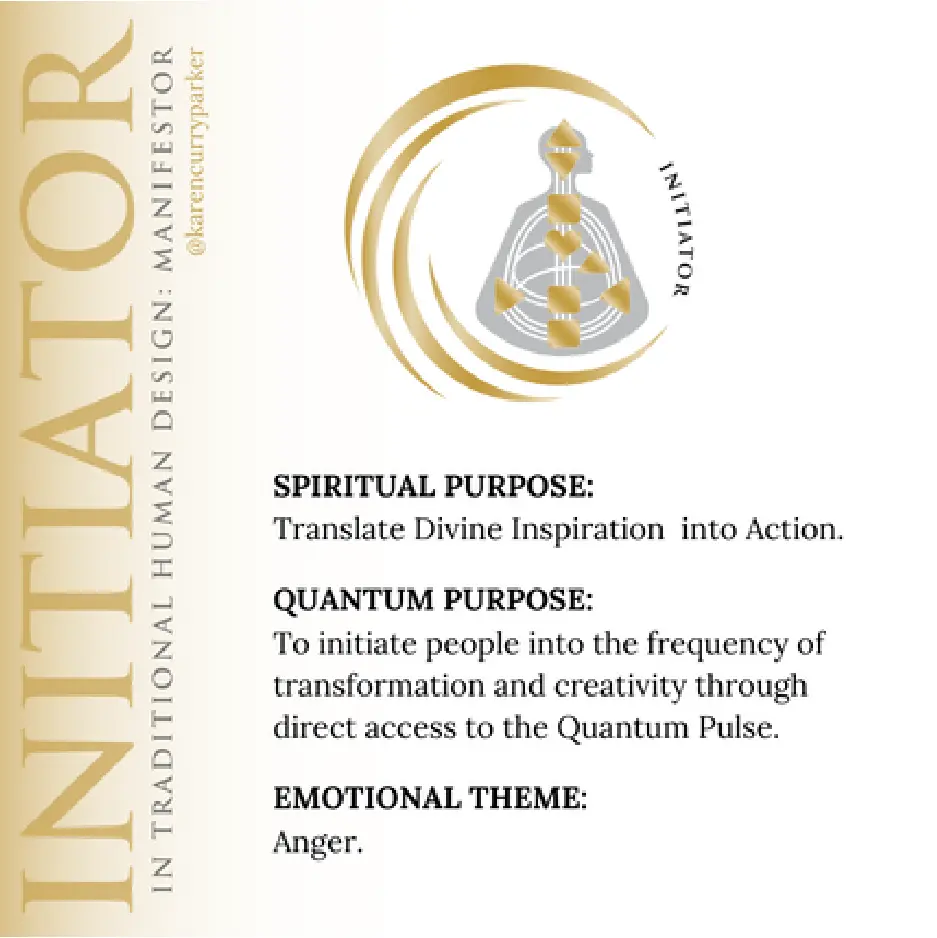
The Initiator has a direct, non-verbal, connection to Divine Inspiration.
When an Initiator feels the internal alignment and a sense of right timing for action, the role of the Initiator is to follow through on the inspiration with the matching action.
If an Initiator cannot follow their inspiration, if they are interrupted while they are in their creative flow,or if they are stopped for a verbal explanation, the Initiator can experience the emotional theme of anger.
Anger signals that the Initiator’s creative flow has been interrupted. The anger is the force of their creative energy that has nowhere else to go because it is no longer being channeled into action.
Projector (Orchestrator) Emotional Theme: Chronic Bitterness
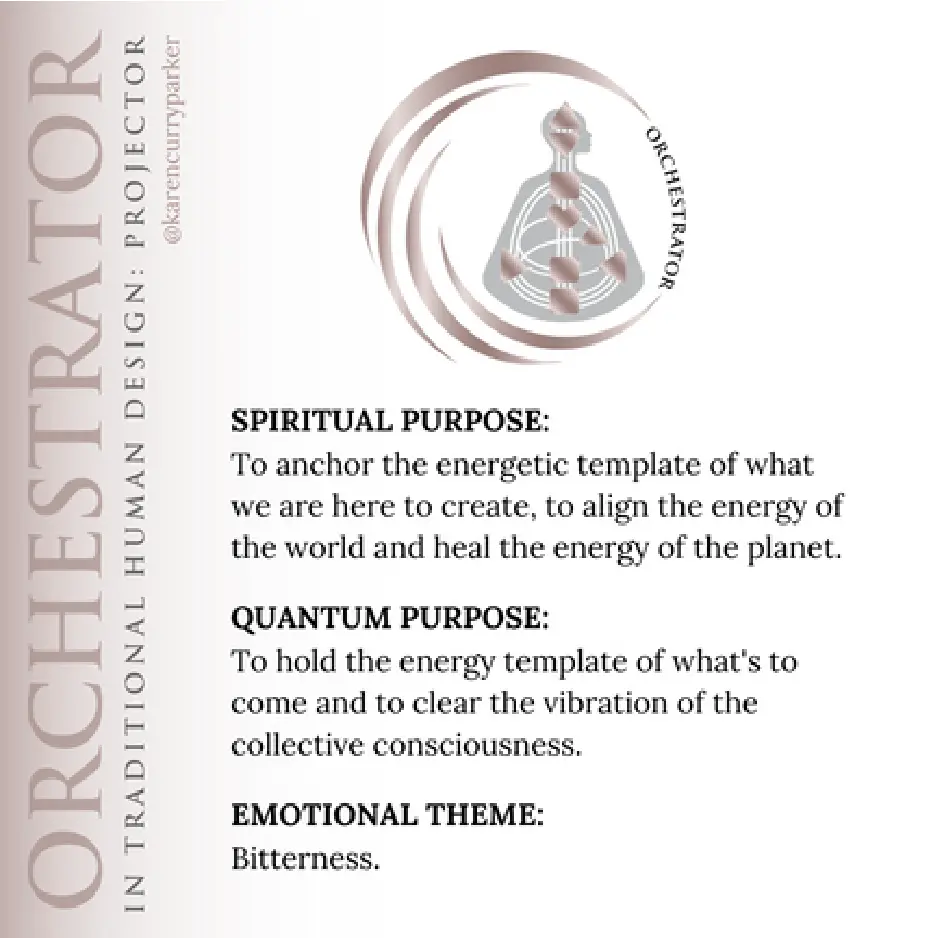
The Orchestrator plays a very special role in the world. They carry knowledge, insights, and wisdom that have the potential to transform and improve the world.
They process and work with energy. The Orchestrator intuitively understands how energy works and how energy flows. This awareness gives them insights into how to translate the world’s energy into form.
The Orchestrator’s internal energy and wisdom are activated through recognition and invitation. They need to be seen, valued, and truly heard to be able to transmit their wisdom effectively.
Energy is at a premium for the Orchestrator. They rely on the creative process of others to best serve the world, so if the Orchestrator is not engaging in the correct alignment with the creative process, they run the risk of using their own energy to try to force a project into form.
Consequently, they can burn themselves out pushing for recognition, doing all the work instead of allowing others to do the building, and offering up their wisdom to those who are not willing to hear it.
An exhausted Orchestrator can be bitter. Bitterness signals two vital things in the Orchestrator experience. First, when an Orchestrator is bitter, it means that they are not following their Strategy to wait for the invitation. When an Orchestrator doesn’t wait for their invitation their wisdom falls on deaf ears, and they use their valuable energy trying to make others hear them. Second, Orchestrators require frequent rest, and a tired Orchestrator can be bitter.
Reflector (Calibrator) Emotional Theme: Chronic Disappointment
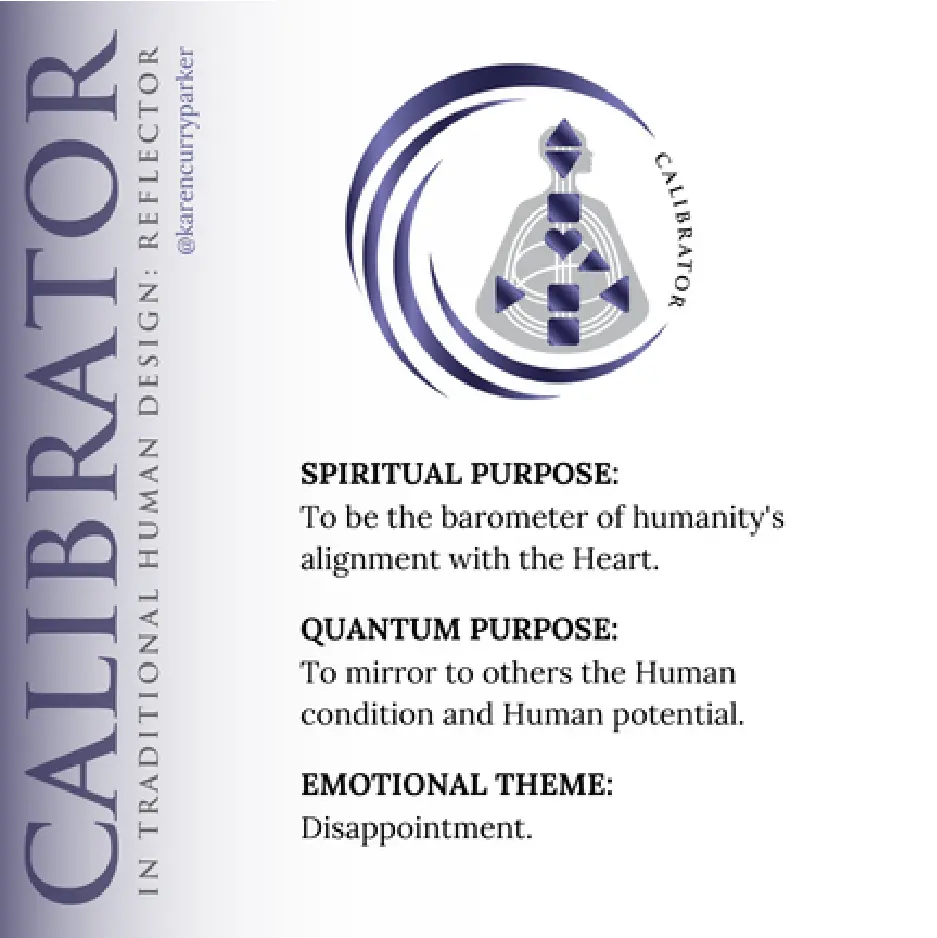
The theme of disappointment for the Calibrator has two important sources.
The first source of disappointment is in the world around them. Through their nine Open Centers, the Calibrator has a deep, visceral knowledge of what is possible for all of humanity. They can sense and feel deeply the potential that lives within all of us. When Calibrators look at the world and perceive the gap between our potential and what we are actually creating, they experience disappointment.
This disappointment is genuine on a collective level, and on a personal level. This can often lead to the Calibrator falling in love with a person’s potential, and being disappointed that their loved ones don’t fulfill the potential that the Calibrator sees in them.
Without a clear understanding of how their energy works, the Calibrator can often merge with others and struggle to fulfill their own potential. They can sense that they need and want something different.
Still, their experience of the energies of others can cause the Calibrator to lose connection with their own energy, direction, and identity. Often the Calibrator experiences this as a disappointment in themselves.
Disappointment signals the Calibrator that they may not be in the right place with the right people and may need to change their community to reflect a different potential for fulfillment.
The second source of disappointment for the Calibrator involves the need for time. The Calibrator’s decision-making process, waiting a full lunar cycle, involves taking time to clarify what they need, and want. This time allows the Calibrator to rid themselves of the energies of others and make decisions that align with their true selves.
Is Your Emotional Theme Currently Activated?
Human Design operates without categorizing things as universally good or bad. A significant aspect of navigating Human Design involves grasping the concept that value judgments, like positive or negative, don’t apply—things simply exist as they are.
It is tempting to focus on the negativity associated with emotional themes. If a Generator is chronically frustrated, how are they going to notice that they are out of alignment? The opposing force of emotional themes are the signatures. Your signature is the clue that you are moving toward your true self.
Think of signatures as your trusty compass, pointing you toward your highest potential. They help you make choices that match your actions to live in alignment with your design. When you tune into your signature you’re getting closer to your real purpose.
Recognizing and giving attention to your signature is a big deal on your Human Design journey. It’s like a treasure map guiding you to a path filled with meaningful adventures. When you consciously tune into your signature, you gain clarity, focus, and the ability to know yourself even better.
When the Generator, who is stuck in chronic frustration, suddenly feels deep satisfaction, they are alerted to bring their attention to the events or circumstances that sparked that satisfaction. This awareness allows the Generator to adjust to experience their signature more frequently.
How We View Not-Self Themes and Traditional Not-Self Themes
Traditional interpretations of the not-self in Human Design can feel disempowering and are often oversimplified. Traditional views of the not-self can make some feel that they are meant to feel 100% in alignment all the time. That if you are following your strategy and your authority everything will be perfect. And if you are not following your strategy and authority, you are stuck in the not-self.
Strategy and authority are pillars of Human Design because they work, but they do not fix everything. As humans, we will experience a range of emotions that can fluctuate from moment to moment depending on our circumstances.
Our emotional themes are clues to check in with ourselves and see what is going on. Sometimes we need to experience our emotional theme as a reminder that we might be backsliding into social conditioning, or we are wasting our precious energies in some manner.
The Power of Focusing on the Positives of Your Emotional Theme
So you’re feeling frustrated, bitter, or angry. Okay, what should we do with that information?
It’s common to feel disempowered when learning about our emotional theme. If the theme indicates we’re out of alignment with our design, yet we believe we’re following our strategy and authority, what does that mean?
We inevitably transmit our unresolved trauma, codependence, stigma, and dogma to those around us. This cycle continues until we consciously choose to embrace a different narrative. Society could greatly benefit from spreading this knowledge to empower people emotionally, mentally, and spiritually.
Human Design isn’t a magic solution that makes everything perfect. Perfection is unattainable, and the pursuit of it can lead us to feel we’re doing something wrong when we can’t achieve it. Life is full of both beautiful and tragic moments, happiness and sadness, success and failure. These experiences define the human condition, and even if you live your design perfectly, you’ll still encounter moments considered “bad.”
The concepts of good and bad can cut us off from complexity and emotional integrity. While simplifying ideas can make them easier to understand, it’s important to recognize that emotional themes encompass a range of emotions and actions. On any given day, we may experience all these emotions, but when we consistently encounter our emotional theme, it’s time to tune into our design and reflect on our experiences.
What Message Does Your Emotional Theme Have For You?
The message within our emotional themes is that everyone falls out of alignment with their design. Human Design is ongoing and experimental. Every time you move yourself back into alignment with your design, you get better at recognizing when your emotional theme may be creeping back in. The faster we recognize our themes, the faster we are able to check in with ourselves and determine if we are on the best path.
Discover Your Emotional Theme in Human Design
The first thing you need to do is to download your FREE Human Design Chart here to discover your personal Human Design Theme.
Working with a Quantum Human Design Specialist provides a personalized journey into understanding your Human Design Theme. Through their expert guidance and interpretation of your chart, you will delve into the intricacies of your unique design, uncovering insights into your nature, and decision-making processes.
Together, you explore how to align with your Human Design Theme, empowering you to navigate life with greater clarity and authenticity. With the specialist’s support, you embark on a transformative exploration, gaining deeper self-awareness and unlocking your potential to live in harmony with your true essence.
Find your Quantum Human Design Specialist Here
It’s important to note that while each one of us is different and magnificent, it is truly in the sum total of the parts of who we are as humans that the true elegance of Human Design and humanity is revealed.
If you want to learn more about the true elegance of Human Design and how it can work for you, why not check out our Quantum Human Design School here
Note: The names in brackets above are the Quantum Human Design (QHD) names for the Types and Profiles. QHD helps us to reframe the ‘Not Self’ or conditioned self shown in Human Design to explore the potential of the deconditioned self and to live more in alignment with our inner truth.
Curious about the difference between Human Design and Quantum Human Design? Karen Curry Parker explains it in this video