
In your journey to self-discovery through Human Design, you’ll encounter the concept of definition. This crucial aspect of your Human Design Chart can provide profound insights into how you operate in the world and interact with others. Let’s explore what definition means, its various types, and how you can apply this knowledge to enhance your life.
What is Definition in Human Design?
Definition in Human Design refers to the energy channels in your bodygraph. These are the colored lines connecting your defined centers. When you have a complete channel—meaning both ends are connected to defined centers—you have a specific type of definition. This definition represents the aspects of yourself that are fixed and reliable, the parts of your personality and energy that remain constant regardless of your environment or the people around you.
The Importance of Definition in Your Human Design Journey
Your definition plays a significant role in shaping your experiences and interactions. It influences how you process information, make decisions, and engage with the world around you. Understanding your definition can help you:
- Recognize your innate strengths and consistent traits
- Identify areas where you might be more susceptible to influences of others
- Understand your decision-making process
- Improve your relationships by recognizing your natural way of interacting
- Align your life choices with your inherent energy flow
Types of Definition in Human Design
Human Design recognizes several types of definition, each offering unique insights into your energetic makeup.
- Single definition
- Split definition
- Triple-split definition
- Quadruple-split definition
- No definition
Let’s explore each type in detail.
1. Single Definition: Focused Energy
If you have a single definition, all your defined centers are connected in one group. This means your energy flows in a concentrated manner, giving you a focused and consistent way of operating in the world.
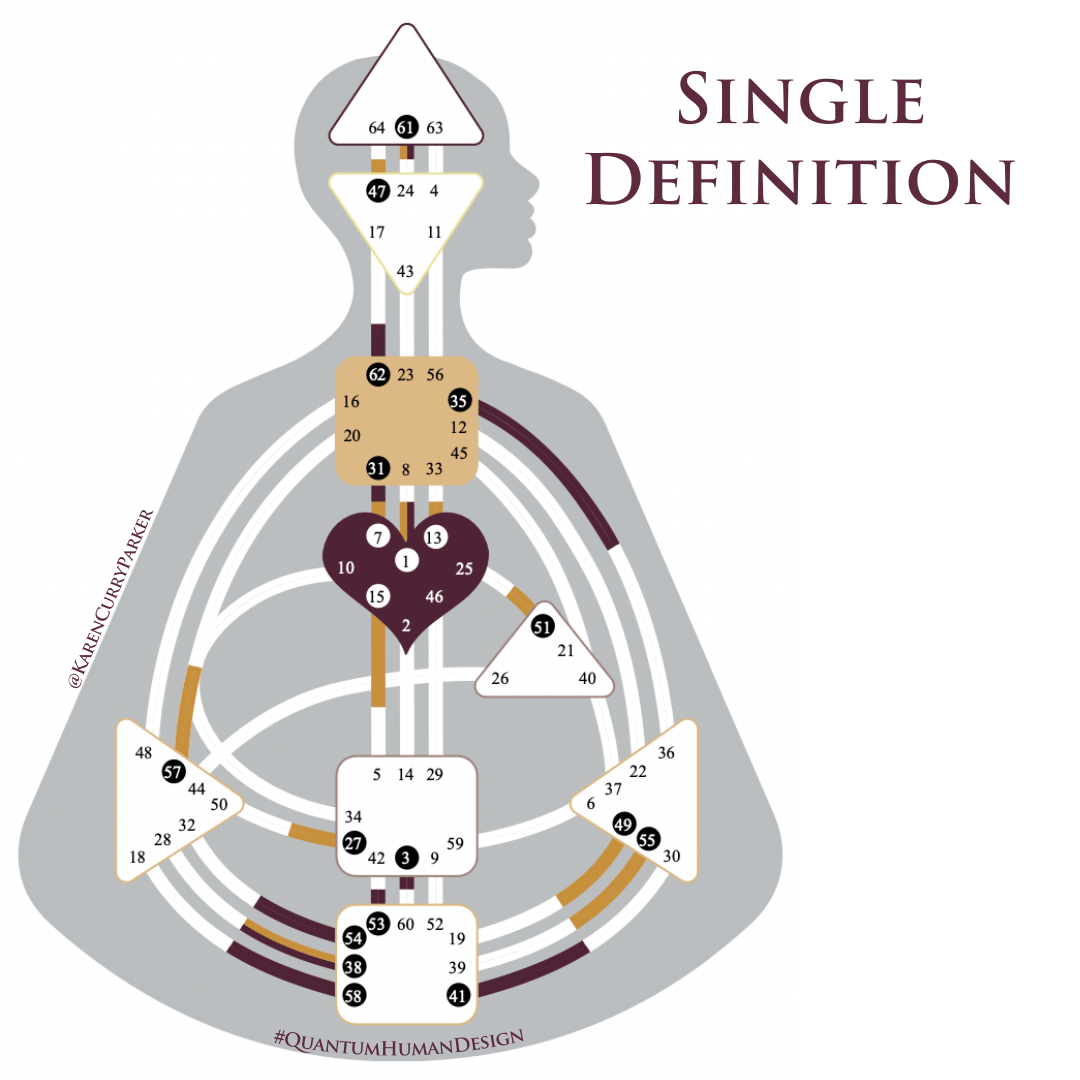
If you have a Single Definition in Human Design, you may notice the following characteristics and tendencies:
- Self-Sufficiency: You are generally more self-contained and self-sufficient. You do not need others to complete your energy or provide a sense of wholeness.
- Independence: You often feel more independent and are comfortable making decisions on your own. You don’t rely as much on external input or validation from others to feel complete.
- Consistency: There is a consistency in how you process information and energy. Your internal experience tends to be stable, and you can rely on your inner resources.
- Focused and Direct: You can be focused and direct in your approach to life. You often have a clear sense of direction and purpose.
- Quick Processing: You may process information and experiences more quickly since there is no interruption in the flow of energy within your chart.
- Clear Boundaries: You are likely to have clear personal boundaries and a strong sense of self. You know what you need and can communicate that effectively.
- Resilience: You can bounce back from challenges and setbacks without needing extensive external support.
- Less Need for External Influence: You may not feel a strong need to seek out partnerships or collaborations to feel complete, although you can still enjoy and benefit from relationships.
How to use this information:
- Leverage your focused energy to excel in areas aligned with your definition
- Be mindful of potential blind spots in areas outside your definition
- Seek diverse perspectives to broaden your understanding of others
Meet Sarah, a single-definition Generator
Sarah, a 32-year-old graphic designer, has a single definition connecting her Sacral, Emotional, and Throat centers. She’s always been known for her unwavering focus and ability to immerse herself completely in her creative projects.
One day, Sarah’s team was tasked with a challenging rebranding project for a major client. While her colleagues felt overwhelmed by the complexity, Sarah approached it with her characteristic focus. She instinctively knew how to break down the project into manageable parts and worked steadily, tapping into her consistent energy flow.
However, when it came to presenting the final design to the client, Sarah struggled. The presentation required skills outside her defined centers, such as reading the room and adapting on the fly. This experience helped Sarah recognize the importance of collaborating with team members whose strengths complemented her focused but sometimes inflexible approach.
Learn more about single definition here.
2. Split Definition: Bridging Energies
With a split definition, you have two or more groups of defined centers that are not connected to each other. This creates distinct energy circuits within your bodygraph.
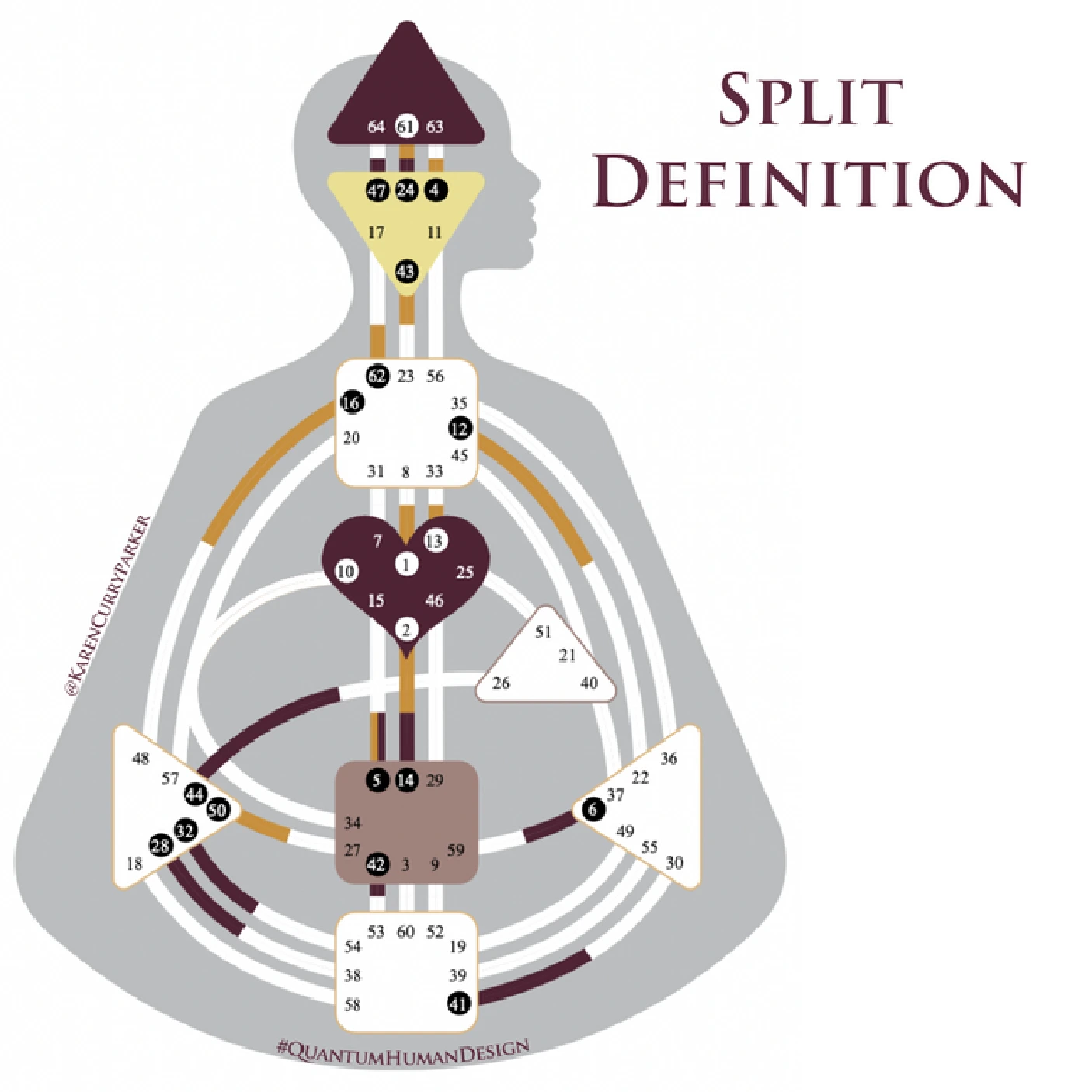
If you have a Split Definition in Human Design, you may notice the following characteristics and tendencies:
- Need for Connection: You often feel the need for connection with others to bridge the gaps in your defined centers. Relationships and interactions can help you feel more complete and integrated.
- Collaborative Nature: You may naturally seek out partnerships and collaborations. Working with others can bring out your best qualities and provide a sense of wholeness.
- Seeking Completeness: You might feel a sense of something missing when alone, prompting you to seek out connections that complete your energy flow.
- Diverse Perspectives: You tend to appreciate and incorporate diverse perspectives, valuing the input and insights of others to help bridge your splits.
- Adaptability: You can be adaptable in different social settings, often finding ways to connect with others and create a sense of cohesion.
- Interdependence: While you have your own strengths, you recognize the value of interdependence and how collaborating with others enhances your experience.
- Exploration: You might enjoy exploring different relationships and environments to find the connections that feel most fulfilling and supportive.
- Sensitivity to Relationships: You are likely sensitive to the dynamics of relationships, as these connections play a crucial role in your sense of completeness and integration.
How to use this information:
- Embrace your ability to see situations from multiple angles
- Practice integrating your different energy circuits for more balanced decision-making
- Recognize that your internal conflicts can lead to deeper understanding and creativity
John’s journey as a split definition Manifestor
John, a 45-year-old entrepreneur, has a split definition with one group connecting his Head and Ajna centers, and another linking his Heart and Throat centers. This split often manifested as a tension between his visionary ideas and his ability to communicate them effectively.
In the early days of his startup, John would have brilliant insights about market trends (Head-Ajna connection) but struggled to articulate these ideas convincingly to investors (Heart-Throat connection). He often felt like he was operating in two different modes.
The turning point came when John embraced his split definition. He started using visual aids to bridge the gap between his abstract thinking and communication. He also partnered with a co-founder whose energy complemented his own, helping to integrate his split energies. This self-awareness and strategic approach led to a successful funding round and rapid company growth.
Learn more about split definition here.
3. Triple Split Definition: Diverse Energy Dynamics
If you have a triple split definition, your defined centers are divided into three distinct groups. This creates a complex and multifaceted energetic landscape within you.
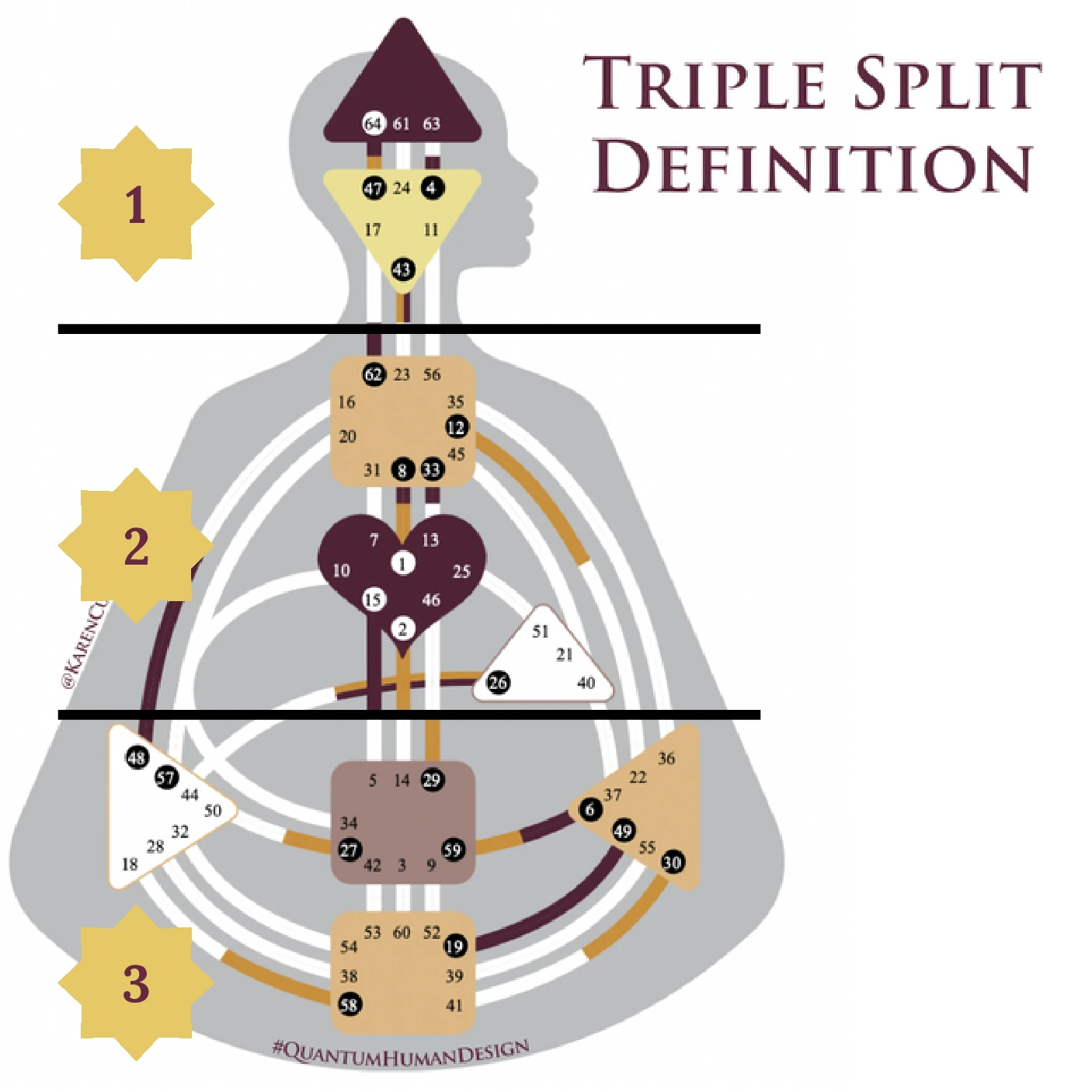
If you have a Triple Split Definition in Human Design, you may notice the following characteristics and tendencies:
- Dynamic Interactions: You thrive in dynamic environments with diverse interactions. Being around different groups of people helps you feel more complete and energized.
- Movement and Variety: You often benefit from movement and variety in your life. Changing environments and activities can help you integrate your energy and feel more balanced.
- Multiple Connections: You may have multiple sets of connections that fulfill different aspects of your life. Each group or relationship can provide something unique that contributes to your overall sense of wholeness.
- Flexible Boundaries: You can adapt to various social settings and are comfortable shifting between different groups of people. This flexibility allows you to bridge your energy splits effectively.
- Natural Networker: You are likely a natural networker, enjoying the process of meeting new people and creating connections. Your diverse social interactions help you integrate different parts of your energy.
- Complex Inner World: You might have a rich and complex inner world, with different aspects of your personality expressing themselves in different contexts. This diversity can make you multi-faceted and interesting.
- Need for Stimulation: You may need regular stimulation and new experiences to feel engaged and energized. Routine and monotony can feel stifling, while variety keeps you vibrant.
- Balancing Act: You are skilled at balancing various aspects of your life and finding ways to integrate them. This can make you resourceful and adept at managing multiple responsibilities and interests.
How to use this information:
- Appreciate the richness of your inner world
- Develop strategies to navigate and integrate your diverse energy circuits
- Use your multifaceted perspective to solve complex problems or mediate conflicts
Emma’s triple split journey in education
Emma, a 28-year-old teacher, has a triple split definition involving her Root-Sacral, Emotional-Ego, and Throat-Mind centers. This diverse energy landscape made her an incredibly versatile educator, but it also presented challenges in maintaining consistency.
In her first year of teaching, Emma noticed she would alternate between periods of high-energy, hands-on lessons (Root-Sacral), emotionally connective storytelling (Emotional-Ego), and analytical, discussion-based classes (Throat-Mind). While this variety kept her students engaged, Emma often felt scattered and unsure of her teaching identity.
Through studying her Human Design, Emma learned to appreciate her diverse approach. She developed a teaching style that intentionally incorporated all three aspects of her definition, creating a rich, multifaceted learning experience for her students. Her unique approach earned her the “Innovative Teacher of the Year” award at her school.
Learn more about triple-split definition here.
4. Quadruple Split Definition: Maximum Diversity
A quad split definition is the rarest type, where your defined centers are divided into four separate groups. This creates an incredibly diverse and complex inner landscape.
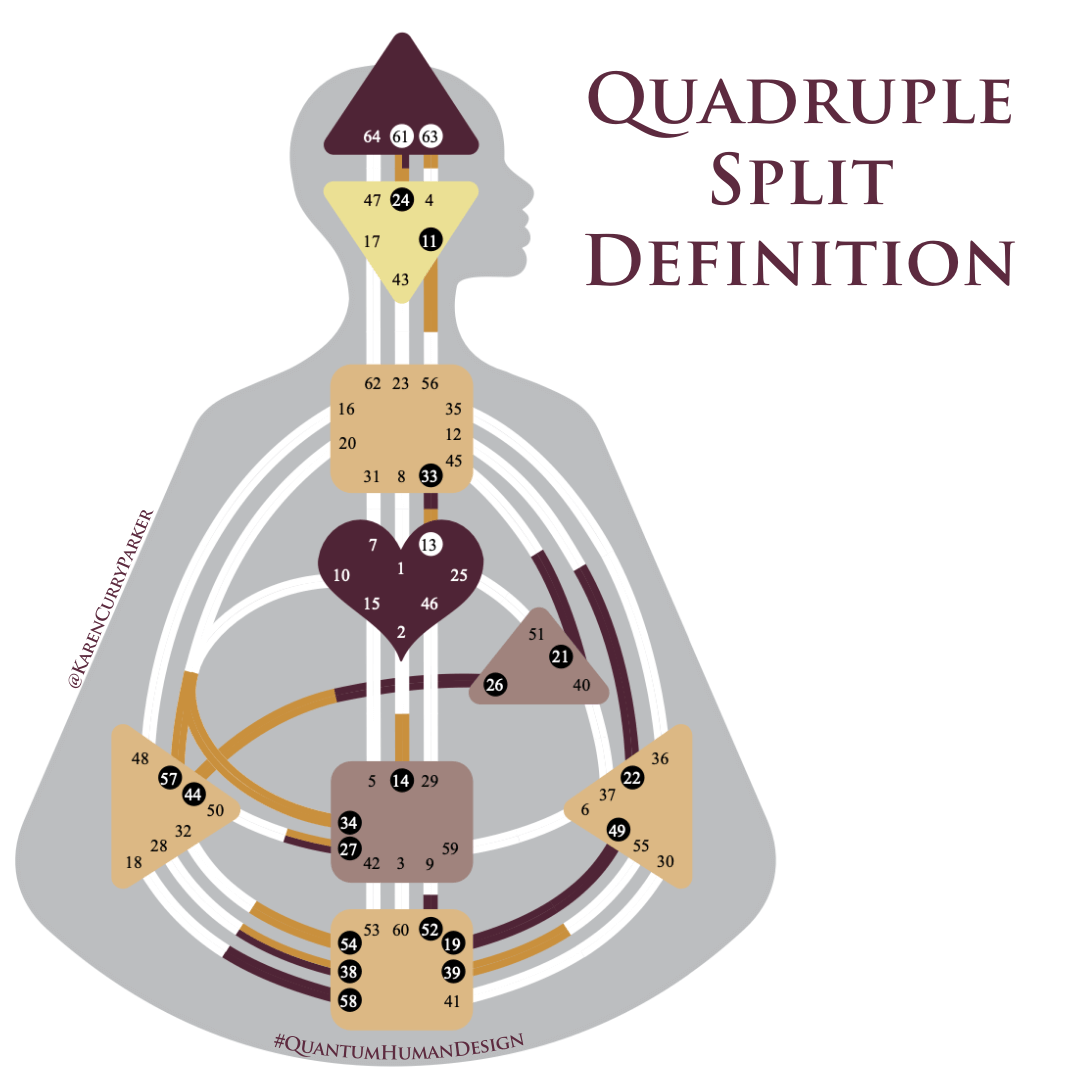
If you have a Quadruple Split Definition in Human Design, you may notice the following characteristics and tendencies:
- Diverse Connections: You benefit from having a wide range of connections. Different people and environments fulfill different aspects of your life, helping you feel more integrated and whole.
- Complex Social Needs: Your social needs are complex, and you may find that no single relationship or environment can fulfill all your needs. You thrive when engaging with a variety of people and situations.
- Adaptability: You are highly adaptable and can easily move between different social groups. This ability allows you to bridge the gaps in your energy by interacting with diverse individuals.
- Need for Variety: You require variety and change to feel balanced and energized. Stagnation can make you feel incomplete, while new experiences and interactions help you integrate your energy.
- Resourcefulness: You are resourceful and adept at finding ways to connect different parts of your life. This can make you good at problem-solving and managing multiple aspects of your personal and professional life.
- Seeking Integration: You may have a strong desire to find ways to integrate the different parts of your energy. This can lead you to seek out new experiences, relationships, and environments that help you feel more complete.
- Social Fluidity: You can navigate social situations with ease, moving fluidly between different groups and settings. This social fluidity helps you bridge your splits and find the connections you need.
- Multi-faceted Personality: You likely have a multi-faceted personality, with different aspects of yourself expressing in different contexts. This diversity makes you interesting and versatile.
How to use this information:
- Embrace your unique ability to see life from many different angles
- Develop strong self-awareness to navigate your complex inner world
- Use your diverse perspectives to foster understanding and bridge differences in your communities
Michael’s quadruple-split adventure in diplomacy
Michael, a 50-year-old diplomat, has a quad-split definition. This rare configuration made him exceptionally skilled at understanding and navigating complex international relations, but it also led to internal conflicts and decision-making challenges.
During a crucial peace negotiation, Michael found himself able to deeply understand and represent the perspectives of all parties involved, thanks to his diverse energy centers. However, this same diversity made it challenging for him to decisively guide the talks towards a resolution.
Michael’s breakthrough came when he learned to use each aspect of his quad split strategically. He used one energy circuit to analyze the situation, another to empathize with participants, a third to communicate effectively, and the fourth to drive towards action. By consciously integrating these diverse aspects, Michael successfully mediated a historic peace agreement.
Learn more about quadruple-split definition here.
5. No Definition: Open and Receptive
If you have no definition in your chart, it means you don’t have any complete channels connecting defined centers. This is also known as being “reflective.”
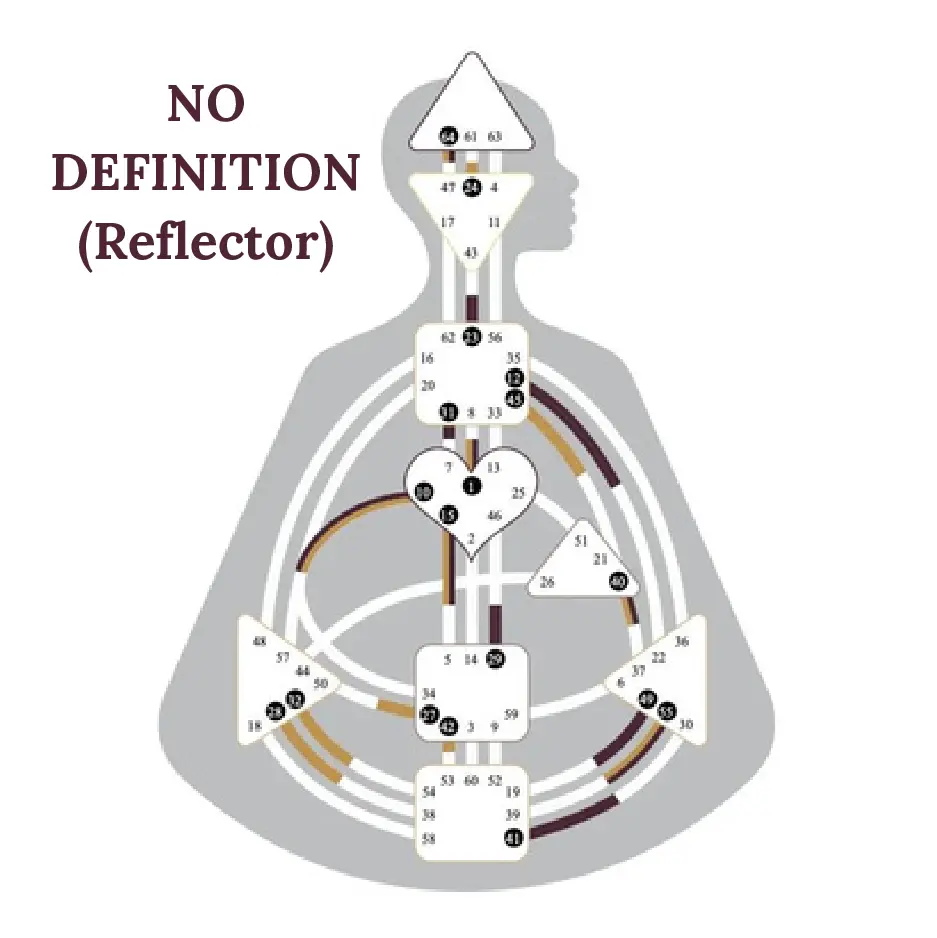
If you have a No Definition in Human Design, you may notice the following characteristics and tendencies:
- Open and Receptive: You are highly open and receptive to the energies and influences of those around you. This can make you adaptable and able to fit into a variety of situations and environments.
- Fluid Identity: Your sense of self can be fluid, often shaped by the people you are with and the environments you find yourself in. This flexibility allows you to connect deeply with others.
- Empathetic and Sensitive: You are likely very empathetic and sensitive to the needs and feelings of others. This can make you a supportive friend and an understanding companion.
- Learning Through Others: You often learn and gain insights through your interactions with others. Their defined energies can help you understand yourself better and explore different aspects of your personality.
- Adaptable: Your lack of fixed definitions means you can easily adapt to new situations and changes. You are not tied down by a specific way of being, which gives you a unique kind of freedom.
- Challenge of Consistency: You may find it challenging to maintain consistency in your behavior and identity, as you are so influenced by external factors. This can sometimes make it hard to know exactly who you are.
- Strong Connection Needs: You might have a strong need for connection with others to feel grounded and complete. Being around people with defined centers can provide a sense of stability and structure.
- Versatile and Resourceful: You are versatile and can navigate various social settings with ease. Your ability to understand and adapt to different people and situations makes you resourceful in finding solutions and making connections.
How to use this information:
- Embrace your ability to understand and mirror others
- Develop strong boundaries to manage your sensitivity
- Recognize the value of your adaptability and openness to experience
Tom’s journey as a Reflector
Tom, a 40-year-old consultant, is a Reflector with no definition in his chart. Throughout his life, he struggled with a sense of inconsistency, feeling like a different person depending on his environment and company.
In his consulting work, Tom initially saw his adaptability as a weakness. However, as he learned about his Human Design, he realized his openness was actually a unique strength. He could deeply understand and mirror his clients’ energies, providing insights that others missed.
Tom began to use his reflector nature intentionally, taking time to “sample” different environments and people before making decisions. He also learned the importance of regular alone time to distinguish his own feelings from those he absorbed from others. This self-awareness transformed Tom’s consulting practice, making him highly sought after for his unique perspective and adaptability.
Applying Definition Knowledge in Your Daily Life
Understanding your definition type is just the beginning. Here are some practical ways to apply this knowledge in your everyday life:
1. Enhance Self-Awareness
Your definition type provides a framework for understanding your consistent traits and energies. Use this knowledge to:
- Recognize your natural strengths and tendencies
- Identify areas where you might be more susceptible to outside influence
- Understand why you react to certain situations in specific ways
2. Improve Decision-Making
Your definition influences how you process information and make choices. Apply this understanding by:
- Aligning your decision-making process with your natural energy flow
- Recognizing when you’re being influenced by energies outside your definition
- Developing strategies to integrate different aspects of your definition in complex decisions
3. Optimize Your Environment
Your definition affects how you interact with your surroundings. Use this insight to:
- Create spaces that support your natural energy flow
- Recognize environments that may be challenging for your definition type
- Adjust your surroundings to promote balance and well-being
4. Enhance Relationships
Understanding your definition can significantly improve your interactions with others:
- Recognize how your definition influences your communication style
- Understand potential areas of misunderstanding or conflict based on differing definitions
- Appreciate and leverage the complementary aspects of different definition types in your relationships
5. Career and Purpose Alignment
Your definition offers clues about the types of work and activities that may feel most natural and fulfilling:
- Seek roles that align with your definition’s strengths
- Understand potential challenges in certain career paths based on your definition
- Develop strategies to thrive in work environments that may not naturally suit your definition
6. Personal Growth and Development
Use your definition as a guide for personal evolution:
- Focus on developing skills that complement your natural strengths
- Work on integrating aspects of yourself that feel disconnected or challenging
- Embrace the unique perspective your definition offers as a tool for growth and self-discovery
Embracing Your Unique Definition
Your Human Design definition is a powerful tool for self-understanding and personal growth. By recognizing the consistent energies within you, you can navigate life with greater awareness, make decisions that align with your true nature, and cultivate relationships that honor your unique way of being.
Remember, no definition type is better or worse than another. Each offers its own set of strengths, challenges, and opportunities for growth. The key is to understand and embrace your particular energy configuration, using it as a guide to live authentically and purposefully.
As you continue to explore and apply the insights from your Human Design definition, you’ll likely find yourself moving through life with greater ease, confidence, and alignment. Embrace your unique energetic makeup, and let it guide you towards a more fulfilling and authentic life experience.
What is Your Definition in Human Design?
Why not download your FREE Human Design chart here as a start?
At its core, Human Design is a unique system that offers profound insights into your inner self and how you interact with the world around you. Your Human Design chart is a valuable tool that can help you understand your true nature, discover your strengths and weaknesses, and unlock your full potential.
By downloading and reviewing your unique Human Design Chart you are embarking on a journey of self-discovery that will empower you to make conscious choices in all aspects of your life. Your chart is an Energy Blueprint of your unique energy configuration and contains valuable information about your personality traits, your natural talents, and your life purpose. With this knowledge, you’ll navigate life’s challenges with greater ease and clarity.
Human Design is a deeply empowering system that encourages us to embrace our true selves, rewrite our personal narrative, and live in alignment with our inner wisdom. When we align with our authentic nature, we tap into a wellspring of creativity, joy, and fulfillment that flows effortlessly through us.
There’s More – How To Learn More About Human Design
If you are trying to learn and apply Human Design to your life circumstances, but traditional Human Design rings a little off-key, you don’t quite connect with it, or it feels heavy as you read it. We invite you to explore training options with Quantum Human Design, internationally respected and time-tested training courses.
These courses will empower you to create a life filled with more money, better relationships, health and vitality, a rewarding career, and experience profound personal transformation.
Explore the life-changing options in our Quantum Human Design School
Curious about the difference between Human Design and Quantum Human Design? Karen Curry Parker explains it in this video: