
The Solar Plexus Center
Nearly half the world’s population operates through emotional waves they don’t understand—are you one of them? The Solar Plexus Center in Human Design is arguably the most impactful energy center in the entire system, influencing how 53% of people make decisions and process emotions.
If you’ve ever wondered why you can’t make quick decisions, why your emotions seem to have a mind of their own, or why you feel other people’s feelings so intensely, understanding your Solar Plexus design holds the key. This comprehensive guide will walk you through everything you need to know about the Solar Plexus in Human Design, from the basics of emotional authority to the specific wave patterns that govern your decision-making process.
Whether you have a defined Solar Plexus (making you an “emotional” being) or an undefined one (making you an emotional amplifier), this guide will help you understand your unique emotional blueprint and learn to work with it rather than against it.
What is the Solar Plexus Center in Human Design?
The Emotional Powerhouse
The Solar Plexus Center is unique in the Human Design system because it serves as both a motor center and an awareness center—the only center with this dual function. As a motor center, it generates tremendous energy that can drive action and manifestation. As an awareness center, it provides emotional intelligence and the capacity for deep feeling and empathy.
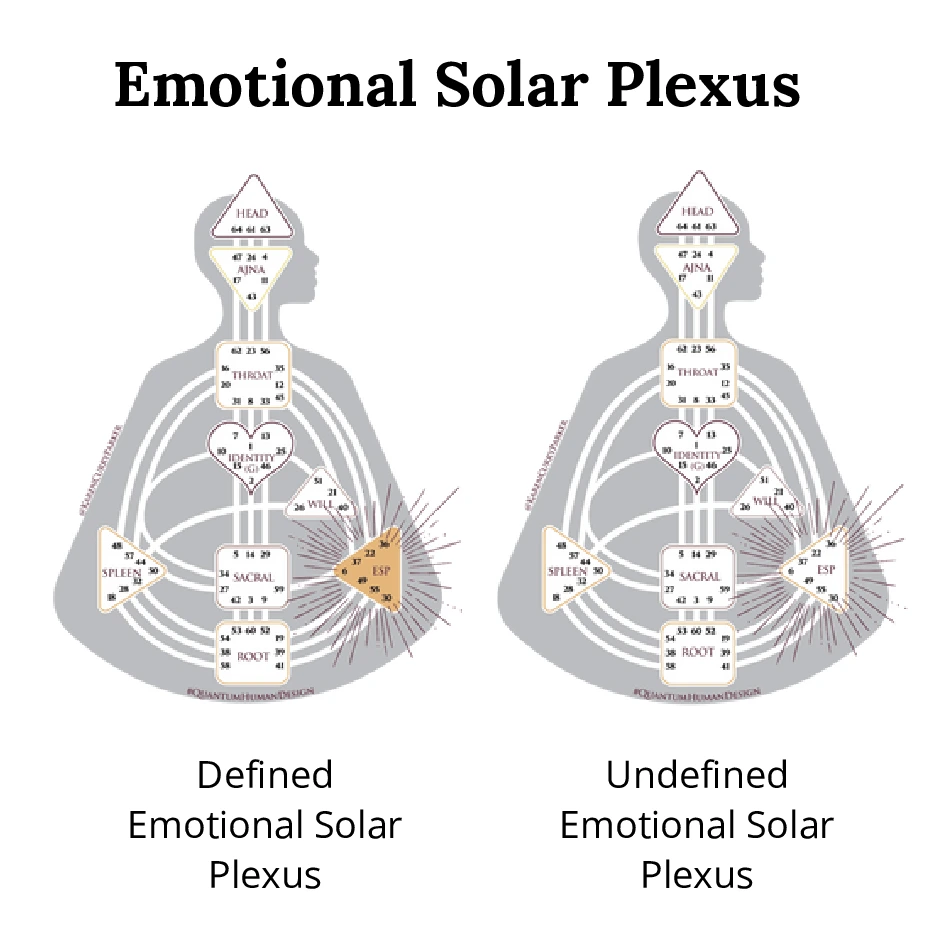
Located on the right side of your Human Design chart (also called a bodygraph), the Solar Plexus appears as a triangle. When it’s colored in, you have a defined Solar Plexus. When it’s white, it’s undefined or open.
Physical Connections
The Solar Plexus Center connects to several vital organs and systems in your body, including:
- The nervous system
- Kidneys and pancreas
- Lungs and prostate gland
- The actual solar plexus region
This physical connection explains why emotional stress often manifests as stomach problems, why anxiety can affect breathing, and why emotional release is so important for overall health.
The Energy of Emotions
In Human Design, the Solar Plexus represents far more than just “having feelings.” It’s the center of human emotional evolution, housing our capacity for empathy, compassion, passion, and deep emotional wisdom. It’s where we process the full spectrum of human experience—from joy and excitement to fear and melancholy.
The Solar Plexus operates through what Human Design calls “the emotional wave”—a continuous cycle of emotional highs and lows that creates the chemistry for emotional clarity over time. This is fundamentally different from mental decision-making and requires patience and understanding to master.
Visual Identification
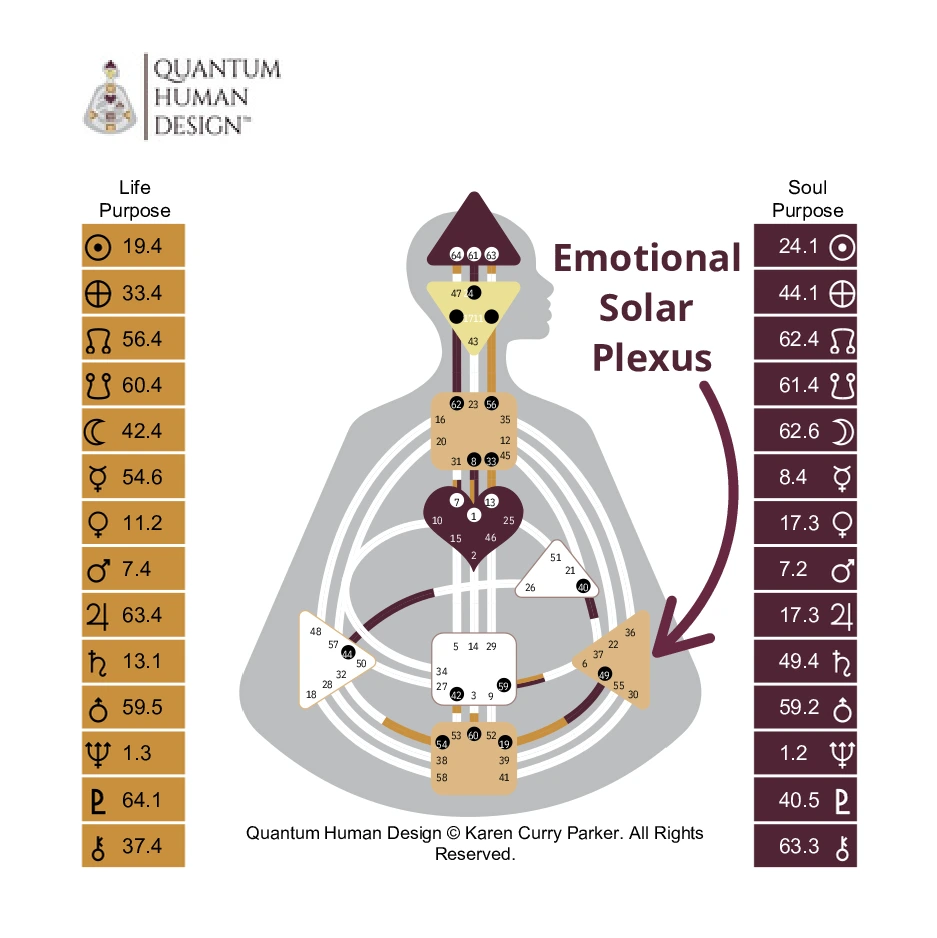
To identify your Solar Plexus on your chart, look for the triangle on the right side of your bodygraph. If any gates in this center are colored in, and especially if you have a complete channel connecting it to another center, then your Solar Plexus is defined. The gates in this center are: 6, 22, 30, 36, 37, 49, and 55.
Defined Solar Plexus: The Emotional Authority
Understanding Your Emotional Authority
If you have a defined Solar Plexus, congratulations—you possess Emotional Authority, the most common authority type in Human Design. This means that, regardless of any other centers you have defined, your Solar Plexus takes precedence over all other decision-making methods. In that case, your emotions are, in fact, your inner guidance system.
This might sound overwhelming if you’ve been taught that emotions are unreliable or that logical thinking should drive decisions. However, Human Design reveals that for emotional beings, trying to make decisions from the mind actually leads to frustration and poor outcomes. Your emotional wave contains the wisdom you need—you just need to learn how to read it.
Emotional Authority operates on a hierarchy system. Even if you have a defined Sacral (Generator energy) or defined Spleen (splenic authority), your emotional center takes precedence. This is because emotions provide the deepest level of truth for your unique design.
The Emotional Wave Phenomenon
The foundation of Emotional Authority is understanding that “there is no truth in the now.” This phrase, coined by Ra Uru Hu (the founder of Human Design), means that whatever you’re feeling in any given moment is not the complete picture. Your emotional truth emerges over time as you ride the full wave.
Think of your emotions like weather patterns. Just as you wouldn’t judge the entire climate based on one stormy day, you can’t make accurate decisions based on one emotional moment. The wisdom comes from experiencing the whole cycle—the highs, the lows, and everything in between.
This is why people with Emotional Authority are often told to “sleep on it.” The time frame might be one night for smaller decisions or weeks to months for major life choices. The key is waiting until you reach a place of emotional neutrality or clarity—where the decision feels calm and clear rather than charged with emotional intensity.
For emotional beings, 80% certainty is equivalent to 100% certainty. If you’re waiting to feel entirely sure, you’ll wait forever. That remaining 20% of uncertainty is actually your body’s memory of the emotional wave you just experienced. It’s normal and healthy.
The Three Types of Emotional Waves
There are three main types of emotional waves, depending on which channels define the Solar Plexus:
The Individual Wave (Channels 12–22 and 39–55)
This wave creates high highs and low lows. It is intense, creative, and deeply emotional. It is often associated with the archetype of the ‘tortured artist.’
What it feels like: Intense creativity, passion, and sometimes deep melancholy.
The challenge: The lows can feel overwhelming, especially in a culture that tells us to be happy all the time.
The reframe: Low mood isn’t wrong. It simply means you’re down on your wave. Often, what you need is alone time or gentle self-nurture.
The Collective Wave (Channels 41–30 and 36–35)
The collective wave moves gradually upward, then suddenly crashes down. Once the bottom is reached, it slowly rises again — like a train climbing a mountain cogwheel track.
What it feels like: You’re fine one moment, then suddenly not. Once you hit bottom, you gradually climb back up.
The challenge: Boredom. This often leads people with this wave to leap into chaos just to feel something new.
The reframe: Boredom signals it’s time to try something different. The key is to wait for the right opportunity rather than jumping from the frying pan into the fire.
The Tribal Wave (Channels 40–37, 59–6, 19–49)
This wave is the most subtle, often showing up as gentle undulations rather than dramatic highs and lows.
What it feels like: Many people hardly notice their emotional waves unless something significant happens in their close relationships.
The challenge: Intimacy, responsibility, money, and agreements. When breakdowns or struggles arise in these areas, emotions can surge.
The reframe: Because this wave is tied so closely to relationships, the work is about honouring your feelings and recognising that waves pass — clarity always comes with time.
Overall, Emotional Authority is not about rushing or being spontaneous. It is about honouring your natural rhythm, waiting for clarity over time, and trusting that your emotional waves are part of your unique design. By observing, nurturing, and working with your waves, you move into alignment with your authentic decision-making process.
Practical Decision-Making Strategies
Working with Emotional Authority requires developing new habits and strategies:
The “Sleep on It” Principle:
For any significant decision, give yourself at least one sleep cycle. Notice how you feel about the decision when you wake up, compared to how you felt the night before.
Recognize Emotional Neutrality:
Clarity feels calm, not excited or anxious. It’s a place of peace where the decision doesn’t carry an emotional charge. You might describe it as feeling “settled” or “clear.”
Track Your Patterns:
Keep a simple emotional journal to start recognizing your unique wave patterns. Note your emotional state and any decisions you’re considering. Over time, you’ll see how your clarity emerges.
Trust the Process:
Even when others pressure you for quick decisions, honor your need for time. A simple “Let me get back to you” or “I need to sleep on this” protects your decision-making process.
Undefined Solar Plexus: The Emotional Amplifier
Understanding Your Open Emotional System
If your Solar Plexus is undefined (white in your chart), you’re what Human Design calls “non-emotional”—but this doesn’t mean you don’t have emotions. Instead, it means you don’t generate emotions consistently from this center. Instead, you’re designed to be emotionally flexible, taking in and amplifying the feelings of others.
Think of yourself as an emotional amplifier or wise mirror. You experience emotions in various ways, depending on who you’re around and what’s happening in your environment. This inconsistency is actually your superpower—it enables you to understand and relate to the diverse ways humans experience emotions.
Approximately 47% of the population has an undefined Solar Plexus, placing you in a significant group of emotional amplifiers and wisdom keepers. Your role is to sample different emotional experiences and develop wisdom about the full spectrum of human feeling.
The Challenges and Gifts
Having an undefined Solar Plexus comes with both challenges and extraordinary gifts:
Challenges:
- Emotional overwhelm in emotionally charged environments
- Difficulty distinguishing your emotions from others’
- Tendency toward people-pleasing to avoid emotional conflict
- Feeling like you’re “too sensitive” or absorbing others’ moods
Gifts:
- Deep empathy and emotional intelligence
- Ability to relate to many different emotional experiences
- Wisdom about emotions that comes from variety
- Natural counseling and healing abilities
- Objectivity about emotions (when not overwhelmed)
Strategies for Undefined Solar Plexus
Set Emotional Boundaries:
Learn to recognize when you’re taking on others’ emotions. Ask yourself, “Is this feeling mine, or am I amplifying someone else’s emotional state?”
Create Emotional Space:
Regular alone time is crucial for clearing out absorbed emotions. This might be a quiet walk, a meditation, or simply time in your own space, free from others’ emotional influence.
Use Your Inconsistency:
Rather than seeing your emotional variability as a problem, recognize it as a wisdom-gathering opportunity. You get to experience how different types of people process emotions, making you incredibly empathetic and wise.
Trust Your Other Authorities:
Since your Solar Plexus isn’t your decision-making authority, learn to recognize and trust your actual authority—whether that’s Sacral, Splenic, Ego, or another type.
Practice Emotional Regulation:
Develop tools for managing emotional overwhelm, such as breathing techniques, grounding exercises, or physical movement, to discharge absorbed emotional energy.
Common Misconceptions About the Undefined Solar Plexus
One of the biggest misconceptions about the undefined Solar Plexus is that you’re “non-emotional.” This is entirely false. You experience the full range of human emotions—you just experience them differently and inconsistently.
You’re also not broken or overly sensitive. Your emotional sensitivity is a feature, not a bug. It’s how you gather wisdom about the human emotional experience. The key is learning to work with this sensitivity rather than against it.
Remember that everyone has access to the entire Human Design chart. Having an undefined center doesn’t mean you lack that energy—it means you experience it in a flexible, sampling way rather than a fixed, consistent way.
The Seven Gates of the Solar Plexus
Gate Overview and Significance
The seven gates of the Solar Plexus each carry specific emotional themes and potential fears. Understanding which gates you have activated (colored in your chart) helps you understand your unique emotional signature and the particular lessons you’re here to learn.
Even if you have an undefined Solar Plexus, any activated gates in this center will influence how you experience and amplify emotions. These gates act as specific channels through which emotional energy flows in your system.
The Solar Plexus Gates
Gate 6 – Friction
Gate 6 is the source of all emotional waves and connects the Solar Plexus to the Sacral Center. This gate brings penetrating energy that can break through emotional barriers, but it also carries the fear of intimacy. If you have this gate, you’re here to explore emotional intimacy and the creative tension that fosters deeper connection.
Gate 22 – Openness
Gate 22 is the gate of grace and openness, connected to your ability to listen and be heard. This gate is deeply tied to mood and creative expression. When you’re in the right mood, you can be incredibly graceful and charming. The fear here is silence—the worry that no one is listening or that you have nothing worthwhile to say.
Gate 30 – Desire
Gate 30 brings intense desire and the drive for new experiences. This gate is called “clinging fire” in the I Ching and represents passionate intensity. If you have this gate, you’re driven by desire and the need to feel things deeply. The fear is of fate or destiny—anxiety about what may or may not happen.
Gate 36 – Crisis
Gate 36 is the gate of emotional crisis and new experiences. This gate creates the impulse to explore and try new things, often driven by boredom or a desire for change. If you have this gate, you’re here to learn emotional intelligence through crisis and new experiences. The fear is inappropriateness—worry about not handling situations correctly.
Gate 37 – Friendship
Gate 37 is all about harmony, peace, and tribal connections. This gate aims to foster emotional bonds and promote group harmony. If you have this gate, you’re deeply motivated by the need for peace and emotional connection. The fear is of tradition—resistance to conventional roles or expectations.
Gate 49 – Principles
Gate 49 is the gate of revolution and principles, determining what the tribe needs and who gets resources. This gate can create revolutionary energy when principles are violated. If you have this gate, you’re here to establish emotional principles and fight for what’s right. The fear is of rejection and the unpredictability of nature.
Gate 55 – Spirit
Gate 55 is the gate of abundance and spirit, but it’s also associated with moods and melancholy. This gate brings faith and the potential for spiritual abundance, but it operates through emotional highs and lows. If you have this gate, you’re here to learn about faith through emotional experience. The fear is emptiness—worry about lack or spiritual void.
How Your Gates Influence Your Wave
The specific combination of gates in your Solar Plexus creates your unique emotional signature. For example, if you have Gates 39 and 55, you’ll experience the Individual Wave with a strong melancholic component. If you have Gates 37 and 40, you’ll experience the Tribal Wave, featuring themes centered around friendship and community.
Understanding your specific gate combination helps you work with your fears more consciously and recognize the wisdom each gate brings. Rather than seeing your emotional patterns as problems, you can understand them as the specific curriculum your soul chose for this lifetime.
Solar Plexus in Relationships
Romantic Relationships

Understanding Solar Plexus dynamics is crucial for healthy relationships. When both partners have defined Solar Plexus centers, you’re both riding emotional waves that may not sync up. Learning to give each other space for your respective decision-making processes becomes essential.
When one partner has a defined Solar Plexus and the other has an undefined one, the undefined partner will amplify the defined partner’s emotions. This can create intensity but also deep empathy. The defined partner needs to take responsibility for their emotional state, while the undefined partner needs to learn when they’re taking on their partner’s emotions.
The most important relationship principle for emotional beings is: never make relationship decisions from the peak of your emotional wave, whether high or low. Wait for clarity before having important conversations or making commitments.
Family and Professional Relationships
In family dynamics, understanding each family member’s Solar Plexus design can profoundly transform how you relate to them. Children with defined Solar Plexus need time and space to make decisions—pressuring them for quick answers goes against their design and creates frustration.
In professional settings, emotional authority can be challenging in fast-paced environments that demand quick decisions. However, emotional beings often make the best decisions when given proper time. Learning to communicate your need for decision-making time as a strength rather than a weakness is key to professional success.
Creating emotionally safe spaces—whether at home or work—benefits everyone but is especially crucial when emotional beings are present. This means allowing for emotional expression, not taking others’ emotional waves personally, and respecting their decision-making processes.
Common Challenges and Practical Solutions
For People with a Defined Solar Plexus
Challenge: Impatience with the decision-making process
Solution: Reframe waiting as wisdom-gathering. Your emotional wave is collecting the information you need to make the best decision. Trust that clarity will come.
Challenge: Emotional overwhelm and reactivity
Solution: Develop emotional regulation tools. This might include breathwork, physical exercise, creative expression, or simply removing yourself from stimulating environments when you’re emotionally charged.
Challenge: Pressure from others for quick decisions
Solution: Practice boundary-setting language, such as “I need time to feel into this decision” or “Let me get back to you tomorrow.” Educate important people in your life about your decision-making process.
For People with an Undefined Solar Plexus
Challenge: Emotional confusion and overwhelm
Solution: Regular emotional clearing practices. Spend time alone to discharge absorbed emotions. Learn to distinguish between your feelings and amplified emotions from others.
Challenge: People-pleasing and conflict avoidance
Solution: Remember that avoiding conflict often creates more problems. Trust your non-emotional authority to guide you in difficult conversations. Your role isn’t to manage others’ emotions.
Challenge: Difficulty setting boundaries
Solution: Practice saying no to emotionally draining situations. Your sensitivity is valuable, but it needs protection. Create physical and energetic boundaries around your emotional space.
Daily Practices for Both Types
Morning emotional check-ins:
Begin your day by acknowledging your emotional state without trying to alter it. Simply observe where you are on your wave.
Decision-making tools:
For any significant decision, ask yourself: “How do I feel about this right now?” Then wait. Notice how your feelings change over time.
Evening emotional release:
End your day with some form of emotional discharge—journaling, gentle movement, or simply acknowledging the emotions you experienced.
Frequently Asked Questions (FAQs) About Solar Plexus Human Design
How do I know if my Solar Plexus is defined or undefined?
Look at your Human Design chart (bodygraph) and find the triangle on the right side. If this triangle is colored in (usually brown or another color), your Solar Plexus is defined. If it's white, it's undefined. You can also check if any of the seven Solar Plexus gates (6, 22, 30, 36, 37, 49, 55) are connected to other centers through colored channels.
Can my definition of the Solar Plexus change over time?
No, your Solar Plexus definition is fixed from birth and never changes. However, your understanding of how to work with it can evolve dramatically. Many people feel like their emotional experience has "changed" when they start living according to their design, but this is actually them aligning with their natural patterns rather than fighting against them.
How long should I wait before making decisions with Emotional Authority in Human Design?
The timing varies based on the size of the decision. Small decisions might require just one sleep cycle (overnight), while major life decisions could take weeks or even months. The key isn't a specific timeframe—it's waiting until you feel emotionally neutral or clear about the decision, rather than emotionally charged.
What if I have an undefined Solar Plexus but feel very emotional?
Having an undefined Solar Plexus doesn't mean you don't experience emotions—quite the opposite! You experience a wide variety of emotions by amplifying what's around you. This can actually make you feel more emotional than people with a defined Solar Plexus because you're experiencing multiple people's emotional states. The key is learning to distinguish what's yours versus what you're amplifying.
Can two people with defined Solar Plexus have a successful relationship?
Absolutely! Many successful couples possess both emotional authority. The key is understanding that you're each riding your own emotional wave, which may not sync up. Give each other space for your decision-making processes, avoid making relationship decisions based on emotional highs, and communicate about where you are on your respective journeys.
What's the difference between the three emotional wave types in Human Design?
The Tribal Wave (channels 37-40, 49-19) builds slowly, like a ratchet, before releasing, focusing on relationships and community needs, and responding well to touch. The Individual Wave (channels 55-39, 22-12) exhibits emotional spikes from a stable baseline, characterized by creative melancholy. The Collective Wave (channels 30-41, 36-35) creates the highest highs and lowest lows, driven by desires and experiences.
Is it normal to feel melancholy with a defined Solar Plexus?
Yes, especially if you have the Individual Wave pattern. Melancholy is a natural part of the emotional spectrum and often indicates a fertile period for creativity and insight. It's not depression—it's your natural emotional rhythm. Learning to appreciate these quieter emotional periods, rather than trying to artificially elevate your mood, is part of honoring your design.
How do I stop taking on other people's emotions if I have an undefined Solar Plexus?
Start by practicing emotional awareness: regularly ask yourself, "Is this feeling mine?" Create physical and energetic boundaries—spend time alone to clear absorbed emotions, limit time in emotionally charged environments when possible, and practice grounding techniques. Remember that your sensitivity is a gift that allows you to develop emotional wisdom, but it needs conscious management.
What should I do if others pressure me to make quick decisions when I have Emotional Authority in Human Design?
For those with Emotional Authority, practice boundary-setting language like "I need to sleep on this" or "Let me get back to you tomorrow." Explain that your best decisions come when you have time to feel into them. For undefined Solar Plexus, identify your actual authority (Sacral, Splenic, etc.) and learn to respond from that center rather than from emotional overwhelm.
Can children have Emotional Authority in Human Design?
Yes, children can absolutely have defined Solar Plexus and Emotional Authority. It's crucial for parents to understand this and allow emotional children the time they need to make decisions. Pressuring them for immediate answers goes against their design and can create frustration and poor decision-making patterns that persist into adulthood.
The Solar Plexus in Human Design
Understanding your Solar Plexus authority is one of the most transformative aspects of Human Design. Whether you have a defined Solar Plexus and need to learn to honor your emotional wave, or an undefined Solar Plexus and need to understand your role as an emotional amplifier, this knowledge can revolutionize how you navigate relationships, make decisions, and understand yourself.
The key insight is that emotions in Human Design aren’t obstacles to overcome—they’re guidance systems to master. For emotional beings, learning to ride your wave with patience and trust leads to decisions that feel deeply correct. For non-emotional beings, learning to work with your emotional sensitivity can lead to profound wisdom and empathy.
Your emotional design is not a limitation—it’s your unique contribution to the world. Emotional beings bring depth, passion, and emotional intelligence. Non-emotional beings bring flexibility, wisdom, and emotional objectivity. Both are essential for the full spectrum of human experience.
Your Next Steps
To continue your Human Design journey, begin by obtaining your complete Human Design chart and identifying your unique Solar Plexus configuration. Notice which gates you have activated and start observing your unique emotional patterns.
If you have a defined Solar Plexus, practice the “sleep on it” principle with your next few decisions. If you have an undefined Solar Plexus, begin noticing when you’re amplifying others’ emotions versus experiencing your own.
Most importantly, be patient with yourself as you learn to work with your emotional design. Like any new skill, mastering it takes time. But the reward—making decisions that align with your true nature and understanding your emotional world—is worth every step of the journey.
Remember: your emotions are not the enemy. They’re the gateway to your authentic self and your unique wisdom. Honor them, learn from them, and let them guide you toward a life that feels genuinely right for who you are.
Check Out Your Solar Plexus in Human Design – Get Your Free Human Design Chart and Start Your Journey.
Get your FREE Human Design Chart to check it out. Use your best guess to start with, and then you may want to find a Quantum Human Design Specialist to help you find the right time for you.
Remember that we all have ALL of the chart. If the Gate is colored in or defined, it’s part of your Soul Curriculum. If it’s white or undefined, it means you learn about this Gate through relationships with others or through the Transits.
At its core, Human Design is a unique system that offers profound insights into your inner self and how you interact with the world around you. Your Human Design chart is a valuable tool that can help you understand your true nature, discover your strengths and weaknesses, and unlock your full potential.
By downloading and reviewing your unique Human Design Chart you are embarking on a journey of self-discovery that will empower you to make conscious choices in all aspects of your life. Your chart is an Energy Blueprint of your unique energy configuration and contains valuable information about your personality traits, your natural talents, and your life purpose. With this knowledge, you’ll navigate life’s challenges with greater ease and clarity.
Human Design is a deeply empowering system that encourages us to embrace our true selves, rewrite our personal narrative, and live in alignment with our inner wisdom. When we align with our authentic nature, we tap into a wellspring of creativity, joy, and fulfillment that flows effortlessly through us.
There’s More – How To Learn More About Human Design
If you are trying to learn and apply Human Design to your life circumstances, but traditional Human Design rings a little off-key, you don’t quite connect with it, or it feels heavy as you read it. We invite you to explore training options with Quantum Human Design, internationally respected and time-tested training courses.
These courses will empower you to create a life filled with more money, better relationships, health and vitality, a rewarding career, and experience profound personal transformation.
Do you want to unlock the secrets of Quantum Human Design?
Why not join our on-demand Masterclass and discover the Transformative Power of Quantum Human Design
Curious about the difference between Human Design and Quantum Human Design? Karen Curry Parker explains it in this video:
BOOK NEWS
Quantum Wellness: Healing Your Mind, Body, and Spirit with Human Design

This comprehensive guide teaches readers to:
- Interpret bodily signals and uncover root causes of imbalance
- Utilize individual energetic blueprints for optimal well-being
- Transform limiting beliefs to align with one’s authentic self
Dr. Parker provides practical tools to unlock potential and create purposeful, vibrant lives.
This essential resource addresses core issues beyond symptoms, guiding readers on a transformative journey of self-realization and deep healing.
This book blends ancient Human Design wisdom with quantum physics, offering a revolutionary approach to holistic healing and personal transformation. Ideal for holistic practitioners, Human Design enthusiasts, and self-discovery seekers.