
Understanding Human Design – Its Importance In Your Life
Human Design emphasizes the importance of honoring our unique design and following our own internal guidance system. It suggests that by aligning with our true nature, we can make better decisions, experience more fulfillment, and live a life that is in harmony with the universe.
This system offers practical tools and strategies for self-discovery and personal growth. By understanding Human Design and our unique chart, we can gain insights into our strengths, challenges, and the most effective ways to navigate our relationships, career choices, and overall life journey.
It is worth noting that Human Design is not a belief system or a religion. It is a tool for self-awareness and empowerment, providing a framework for understanding Human Design for ourselves and others more deeply. While it can be a valuable resource for personal growth, it is ultimately up to each individual to decide how to apply and integrate the insights gained from Human Design into their own lives.
What Is Human Design?
Human Design is a fascinating system that combines elements of astrology, the I Ching, the Kabbalah, and quantum physics to provide insight into our unique individuality. It is often described as a “user manual for life” because it offers a comprehensive blueprint of who we are at a fundamental level and how we can live in alignment with our true nature.
At its core, Human Design believes that each person is born with a specific energetic configuration that determines their strengths, weaknesses, and life path. Understanding Human Design can help you with these aspects. This configuration is represented by a chart, called the Human Design BodyGraph, which combines astrological symbols with geometric shapes.
Your Human Design Chart
A Human Design chart is a visual representation of an individual’s unique energetic blueprint and provides insight into one’s personality, life purpose, and optimal way of functioning in the world.
The chart is created based on the person’s birth date, time, and location. It consists of various shapes, lines, and numbers that represent specific centers, gates, channels, and other aspects of their energy system. Each element in the chart carries meaning and represents different aspects of a person’s psychological, emotional, and energetic makeup.
By analyzing the Human Design chart, individuals can gain an understanding of Human Design and get a deeper understanding of their innate strengths, challenges, and life path. It offers guidance on decision-making, relationships, and personal growth, helping individuals align with their true nature and live authentically.
Visit freehumandesignchart.com for your Human Design Chart.
The Human Design Types
Your first step in understanding Human Design and what it means to you is to know your type. There are five types each representing a different energetic way of engaging with the world.
Each type has its own strategy and decision-making authority, which helps individuals align with their true nature and live a more fulfilling life. By understanding Human Design type, individuals can make choices that are in harmony with their energetic blueprint.
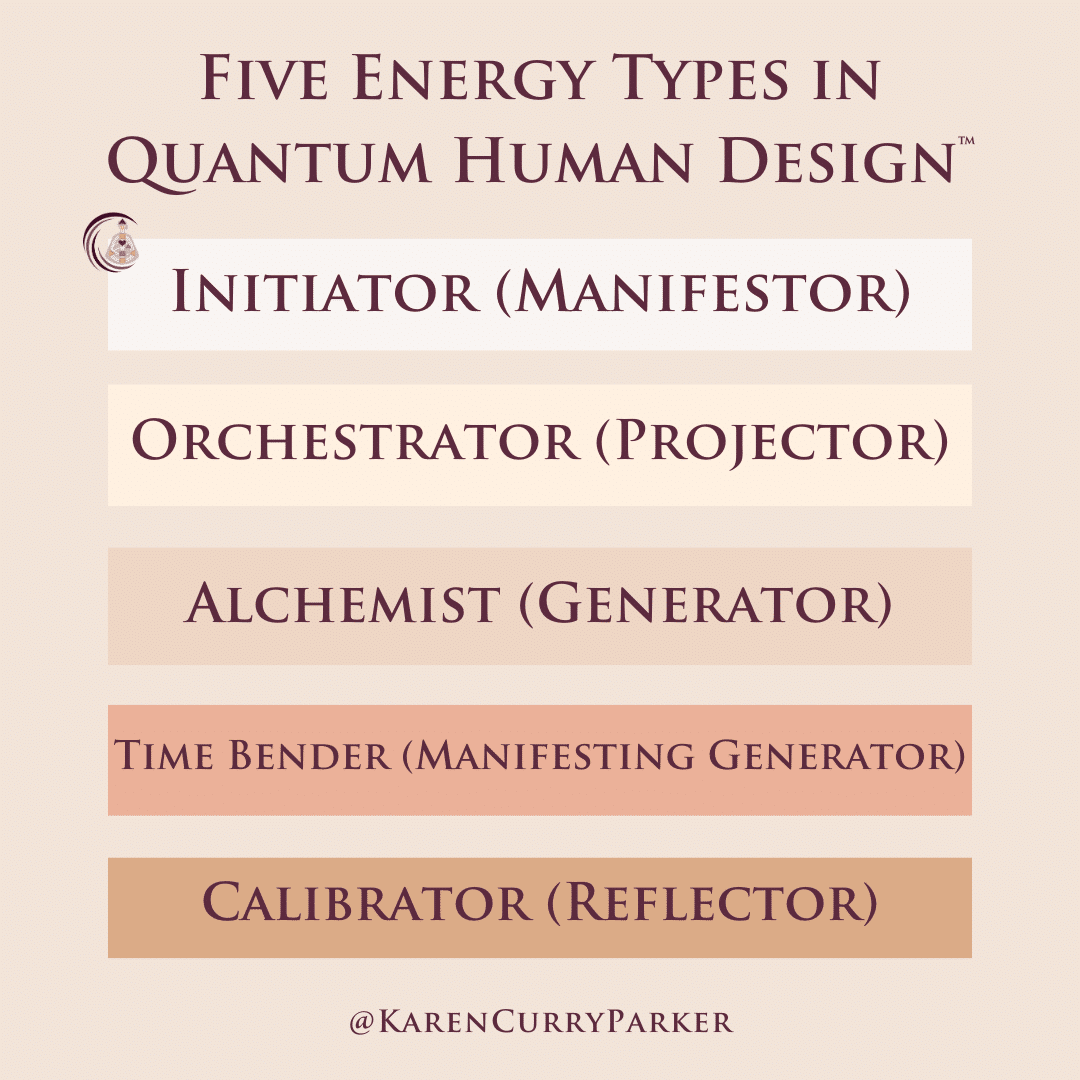
Human Design Type #1: Generators (Alchemists)
Generators are the largest percentage of the population. They have a sustainable and responsive life force. Generators are designed to wait for a sense of inner recognition or response before committing their energy to something. They thrive when they are doing work that they love and energizes them.
Human Design Type #2: Manifesting Generators (Time Benders)
Manifesting Generators combine aspects of both Manifestors and Generators. They have a fast-paced and multi-faceted energy. Like Generators, they need to wait for a response, but they often have a natural ability to manifest their desires quickly.
Human Design Type #3: Manifestors (Initiators)
Manifestors have a powerful, initiating energy. They are here to make things happen and bring their visions into reality. Manifestors are designed to inform others about their plans and actions before taking action themselves.
Human Design Type #4: Projectors (Orchestrators)
Projectors have a focused and penetrating energy. They are here to guide and manage others. Projectors excel at understanding people and systems. They need to wait for recognition and invitation from others before offering their guidance or insights.
Human Design Type #5: Reflectors (Calibrators)
Reflectors have a rare and unique energy. They are highly sensitive to the environment and act as mirrors to the world around them. Their role is to reflect the health and well-being of the community they are in. Reflectors are designed to wait a full lunar cycle before making important decisions.
A Brief History Lesson
Human Design has an intriguing history that began in the late 20th century. It was founded by Robert Allan Krakower, who later changed his name to Ra Uru Hu, in 1987. According to Ra, the foundation of Human Design came to him during a mystical experience he had on the Spanish island of Ibiza.
During this experience, Ra claimed that he received a download of information from an entity known as “The Voice.” This information encompassed various esoteric and scientific disciplines, including astrology, the I Ching, the Kabbalah, and quantum physics. Ra spent years studying, developing, and refining this knowledge to create the Human Design system.
Ra Uru Hu introduced Human Design to the public in the early 1990s, sharing it through workshops, lectures, and publications. He aimed to provide people with a practical tool for self-discovery and personal transformation through understanding Human Design. Over time, Human Design gained a dedicated following and began to spread globally.
Throughout the years, Human Design has continued to evolve and expand its reach. Ra Uru Hu trained a group of students known as “Human Design Analysts” who further disseminated the teachings and conducted readings for individuals. The system gained popularity, and today there are numerous certified Human Design practitioners and online resources available to explore and learn about this fascinating modality.
While the origins of Human Design can be traced back to Ra Uru Hu’s mystical experience, it draws from various ancient wisdom traditions and modern scientific concepts. It has become a unique synthesis of different disciplines, offering individuals insights into their energetic makeup and guidance for living in alignment with their true nature.
The 7 Human Design Authority Types
One of the essential elements in understanding Human Design is the concept of authority. But what exactly does authority mean in the context of Human Design? At its core, authority refers to the way we make decisions that align with our unique design.
Throughout our lives, we are often advised to follow our instincts or use rational thinking when faced with choices. We may be encouraged to simplify complex decisions by making lists of pros and cons. However, what if these approaches don’t suit our individual design? What if there is a distinct and personalized way for each of us to arrive at the best possible decisions?
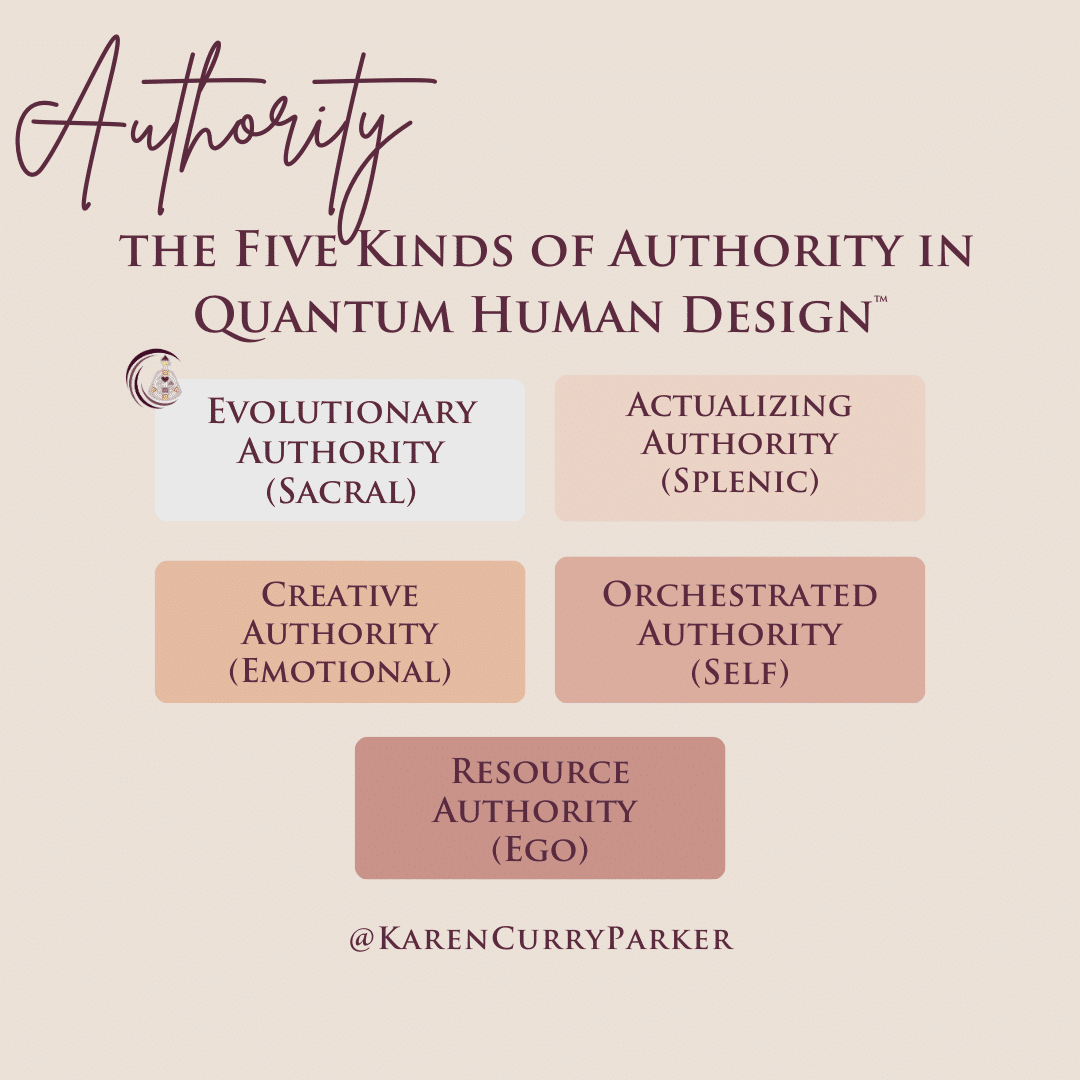
Authority #1: Solar Plexus – Emotional (Creative Authority)
If your Emotional Solar Plexus is defined in your Human Design chart, it plays a significant role in shaping your decision-making strategy. The defined Emotional Solar Plexus acts as a motor that generates energy in pulsating waves. As someone with emotional definition, you might be familiar with experiencing mood swings or fluctuations in your emotional energy on a regular basis.
It’s quite common for individuals with emotional definition to feel hesitant about making decisions. They may have a history of eagerly jumping into choices, only to wake up a few days later with their mood shifted, finding themselves obligated to continue with a project or a relationship that no longer aligns with their current emotional state.
Understanding your emotional authority can greatly assist you in making better choices and reducing the likelihood that your mood will negatively impact your commitments.
Authority #2: Sacral (Evolutionary Authority)
Sacral authority refers to having a defined Sacral Center without any additional energies influencing it. This type of authority applies specifically to Generators who do not have a defined Solar Plexus Center. Sacral authority is deeply rooted in the body and is often associated with the phrase “trust your gut.” The response from sacral authority is a clear yes or no. This is why Generators tend to respond well to questions that have a binary nature, as it allows their defined Sacral Centers to process information more easily.
Authority #3: Splenic (Actualizing Authority)
The spleen in Human Design serves as the center for survival, time, health, and intuition. As it encompasses the energy related to basic survival, the spleen operates in the present moment with a strong intuitive pulse. Individuals with spleenic authority rely on their gut instincts and act upon them.
Authority #4: Ego-Manifested (Resource Authority)
Ego authority is specific to Manifestors in Human Design. It occurs when the Will Center is connected to the Throat Center through a colored channel. With ego authority, Manifestors have the autonomy to take action without needing to wait for external factors.
However, there is an important consideration: ensuring that you are well-rested and prepared to tackle tasks. A defined ego is designed to operate in cycles of work and rest. It is crucial to be mindful of not pushing through to the point of burnout or compromising your health due to the strong willpower associated with the ego. If you possess ego authority, it is advisable to regularly check in with yourself and assess if you require downtime before embarking on the next commitment.
Authority #5: Self-Projected (Orchestrated Authority)
Self-projected authority is unique to Projectors in Human Design. It arises when the Identity Center is connected to the Throat Center through a channel, without any other dominant energies defined in the chart, such as the Solar Plexus or the Spleen. Having self-projected authority means that Projectors need to “see” their decisions reflected or projected through others in order to gain clarity.
To truly understand what is correct for them, Projectors require a circle of trusted friends with whom they can discuss their choices. By vocalizing their thoughts and observing the response of others, Projectors can determine whether something is aligned with their authentic path or not. It is through this external interaction that Projectors gain valuable insights and clarity regarding their decisions.
Authority #6: None (Projector) (Orchestrated Authority)
Mental projected authority is considered an outer authority and, is a unique form of authority that is specific to Projectors with a defined connection between the Ajna and the Throat Center, without any other dominant energies present. Similar to self-projected authority, mental projected authority entails the need for Projectors to engage in conversations with others in order to gain clarity regarding suitable invitations.
Authority #7: None (Reflector) (Orchestrated Authority)
Reflectors are the sole Human Design type that possesses Lunar authority due to the absence of defined centers in their charts. Lunar authority is also an outer authority. For Reflectors, it is crucial to give themselves the space and time of a complete lunar cycle, which spans approximately 28 days, before making any significant decisions. This extended period allows Reflectors to sample and experience a diverse range of energies from various authority types.
By observing these energy shifts throughout the lunar cycle, Reflectors can gather insights and perspective that lead them to the most appropriate decisions for themselves. Keeping track of the planetary transits during decision-making processes can be particularly beneficial for Reflectors, aiding them in navigating life-changing choices with greater awareness.
Your Human Design Profile
Your Profile is characterized by two numbers, representing distinct energies that collaborate to shape your experiential learning style. These numbers correspond to the gate lines present in both your conscious and unconscious sun centers. The first number reflects a conscious aspect of your life role, which you are likely aware of and can easily relate to. The second number signifies an unconscious aspect of your life role, which is still a significant part of your personality despite being less conscious to you. Understanding Human Design with regard to your Profiles, helps you to see the role that you play in the world.
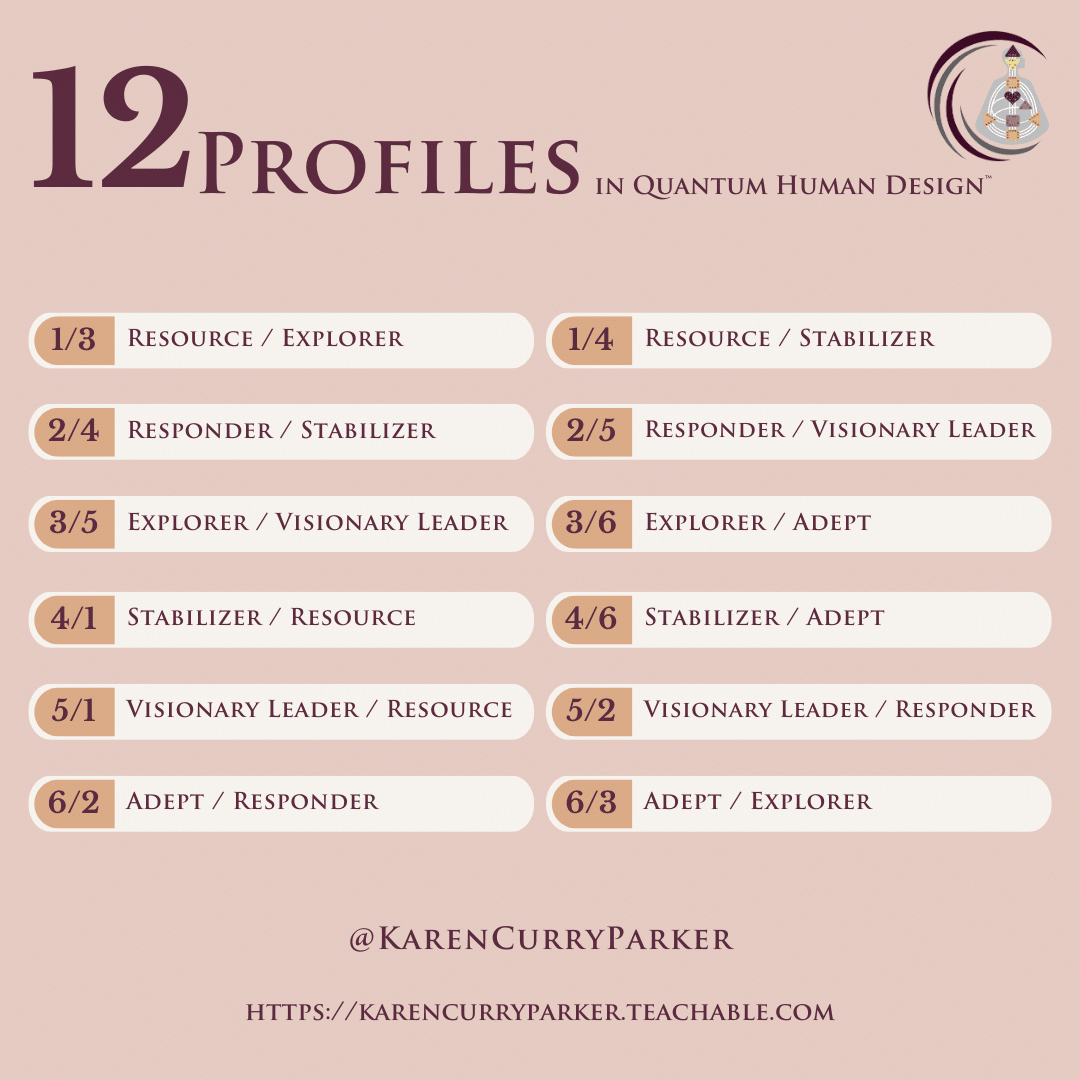
Line 1: The Investigator (The Resource)
Individuals with Line 1 in their Profile have a natural inclination to seek information and feel secure when they have gathered sufficient data. They thrive in the age of the internet, as it provides them with a wealth of knowledge to explore and analyze.
Line 2: The Hermit (The Responder)
Line 2 Profiles require alone time to integrate their experiences and recharge their energy. The Hermit archetype symbolizes their need for personal space to feel grounded and aligned. Interestingly, when Line 2 individuals take time for themselves, it seems as though others can energetically sense their readiness to rejoin social activities and actively seek their company.
Line 3: The Martyr (The Explorer)
For Line 3 Profiles, experimentation is crucial. They must be allowed to explore their ideas and make mistakes without judgment. There is no concept of getting it wrong for Line 3 individuals; rather, they focus on discovering what works based on their understanding of what doesn’t work.
Line 4: The Opportunist (The Stabilizer)
Line 4 Profiles thrive by building a foundation of friendships and engaging in networking opportunities. They require acceptance from others and a sense of what lies ahead to feel secure. Line 4 individuals find it challenging to cope with uncertainty or being in a state of limbo.
Line 5: The Heretic (The Visionary Leader)
The Heretic serves as a teacher who imparts wisdom gained through their own life experiences. They often act as karmic mirrors, reflecting the areas in others that require healing. Line 5 Profiles need to trust that others will truly see and understand their authentic selves in order to feel safe. Initially, they may conceal their truth, gradually revealing it as trust is established.
Line 6: The Role Model (The Adept)
Line 6 Profiles embody the Role Model archetype by actively demonstrating what they are here to contribute to the world. They must align their actions with their beliefs and values. Line 6 individuals go through distinct life phases: a youthful phase of experimentation and learning, a cycle of healing and growth in their middle years, and finally, a phase of living and embodying the wisdom they have gained. Line 6 Profiles find meaning and energy in life when they perceive their participation to be worthwhile and purposeful.
How To Get Your Free Human Design Chart
To discover your Human Design type, you can visit freehumandesignchart.com
To generate an accurate chart, you will need to provide your date of birth, time of birth, and place of birth. If you’re unsure about your birth time, we suggest scheduling a reading with our Quantum Human Design specialists who can assist you in obtaining the most precise chart.
The chart is based on your birth information, including the date, time, and place of your birth. It reveals your energy type (Manifestor, Generator, Manifesting Generator, Projector, or Reflector) and provides detailed information about your inner authority, decision-making strategy, and how you interact with others.
How To Learn More
Understanding Human Design and what it means to you is important because it provides valuable insights into your authentic self and helps you navigate life with greater clarity and alignment. Here are a few key reasons why understanding your Human Design is beneficial:
Self-Awareness:
Understanding Human Design reveals your innate strengths, talents, and challenges, allowing you to develop a deeper understanding of your unique qualities and tendencies. This self-awareness empowers you to make choices that are in alignment with your authentic nature, leading to a more fulfilling and purposeful life.
Decision-Making:
Understanding Human Design offers guidance on how to make decisions that are aligned with your true self. By understanding your specific decision-making authority, whether it’s based on intuition, gut feelings, or other factors, you can approach choices with greater clarity and confidence, avoiding unnecessary confusion or doubt.
Relationships:
Understanding Human Design provides insights into how you interact with others and how to navigate relationships more harmoniously. By understanding your energetic dynamics and compatibility with different types, you can cultivate healthier and more fulfilling connections with family, friends, romantic partners, and colleagues.
Life Purpose:
Understanding Human Design offers guidance on your life path and purpose. It helps you recognize and embrace your unique gifts and talents, allowing you to pursue endeavors that align with your authentic self. Understanding your Human Design can bring clarity and direction to your professional and personal pursuits.
Personal Growth:
By embracing and integrating your Human Design, you can embark on a journey of self-discovery and personal growth. It provides a framework for understanding and embracing your shadows, challenges, and areas for growth, helping you evolve into your highest potential.
Ultimately, understanding Human Design empowers you to live a more authentic, fulfilled, and purpose-driven life by honoring your unique energetic blueprint. It serves as a valuable tool for self-awareness, decision-making, relationships, and personal growth, guiding you toward a more aligned and meaningful existence.
If this has inspired you to want to know more about how to live your Quantum Human Design, click here
Want more content? Why not follow us on YouTube
Note: The names in brackets above are the Quantum Human Design (QHD) names for these Types. QHD helps us to reframe the ‘Not Self’ or conditioned self in Human Design to explore the potential of the deconditioned self and to live more in alignment with our inner truth.
Curious about the difference between Human Design and Quantum Human Design? Karen Curry Parker explains it in this video:
Want more content? Why not follow us on YouTube