The Human Design System is simple to understand overall, but it is much more powerful when you understand the precise definitions of terms associated with it. We decided to help you with that by creating this Human Design Glossary of Terms.
Sacral Center
The Sacral Center is one of the nine energy Centers in Human Design, located in the lower abdomen area of the Bodygraph. It’s the Center of life force energy and sexuality. When defined, it provides consistent access to generative energy for work and creativity. It’s the defining Center for Generator and Manifesting Generator Types. Practice saying “uh-uh” (no) and “uh-huh” (yes) to tune into your Sacral response.
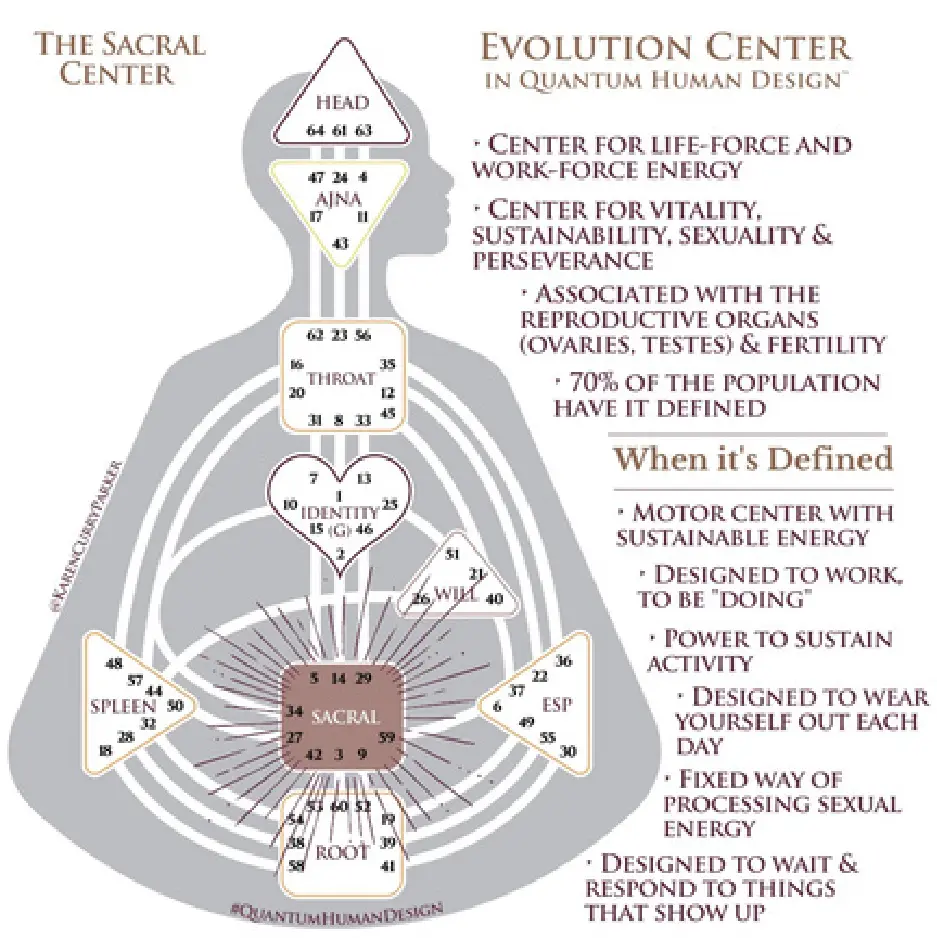
Example: Someone with a defined Sacral Center (a Generator or Manifesting Generator) has sustainable energy for work and responds to life with either an energetic “uh-uh” (no) or “uh-huh” (yes).
See also: Centers, Generator, Manifesting Generator
Satisfaction
In Human Design, Satisfaction is the signature emotion of the Generator and Manifesting Generator Types when they are living in alignment with their Strategy and Authority. It represents a state of fulfillment and contentment that these Types experience when they respond to life rather than initiate.
Example: A Generator who consistently waits to respond before taking action might experience a deep sense of satisfaction in their work and life choices.
See also: Generator, Manifesting Generator, Strategy, Signature
Saturn Return
In Human Design, Saturn Return refers to a significant astrological event that occurs approximately every 29.5 years when Saturn completes its orbit and returns to the position it was in at the time of an individual’s birth. This period is considered a time of maturation, transition, and potential transformation in a person’s life journey. Saturn Return in Human Design is viewed as an opportunity for individuals to align more deeply with their authentic nature and life purpose as defined by their unique Human Design chart.
Example: Maria, at age 29, experiences her first Saturn Return. During this time, she feels compelled to reassess her career choices and personal relationships. Through studying her Human Design chart, she gains insights into her true nature and decides to make significant changes that align more closely with her authentic self, such as leaving a corporate job to start her own creative business.
Science of Differentiation
The Science of Differentiation in Human Design refers to the systematic approach of understanding and embracing one’s unique energetic blueprint as defined by their Human Design chart.
It emphasizes the importance of recognizing and honoring individual differences rather than conforming to societal norms or expectations. This science promotes making decisions and living life in alignment with one’s specific design, leading to greater authenticity and fulfillment.
Example: Alex, upon learning about the Science of Differentiation, discovers he is a Projector type. Instead of trying to keep up with the constant activity of his Generator friends, he embraces his natural ability to guide and direct energy. He starts waiting for invitations before offering his insights, which leads to more meaningful interactions and less burnout in his personal and professional life.
Self-Awareness
In Human Design, Self-Awareness refers to the deep understanding and recognition of one’s unique energetic makeup, strengths, and potential challenges as revealed by their individual Human Design chart. It involves consciously acknowledging one’s type, strategy, authority, and other key aspects of their design, and using this knowledge to navigate life more effectively. Self-Awareness in Human Design is seen as a foundational step towards living in alignment with one’s true nature and making decisions that resonate with one’s authentic self.
Example: Lisa, a Manifestor, develops Self-Awareness by studying her Human Design chart. She realizes that her natural tendency to initiate and her need to inform others before taking action are integral parts of her design. By embracing these aspects, she improves her relationships and feels more comfortable in her role as a leader, experiencing less resistance in her personal and professional life.
Self-Projected Authority
Self-Projected Authority in Human Design is a decision-making mechanism associated with Projectors. This authority relies on the individual’s ability to speak their truth spontaneously and authentically, often through verbal processing or “talking it out.” People with Self-Projected Authority are guided by listening to their own voice as they express themselves, finding clarity and direction through the act of speaking their thoughts aloud.
Example: A Projector with Self-Projected Authority might find themselves unsure about a job offer until they start talking about it with a friend, and as they speak, they hear their own voice become more energized and clear when describing certain aspects of the opportunity, leading them to recognize their genuine excitement and ultimately decide to accept the position.
Signature
In Human Design, the Signature refers to the positive emotional state or experience that each Type feels when living in alignment with their Strategy and Authority. Each Type has a unique Signature: Peace for Manifestors, Satisfaction for Generators and Manifesting Generators, Success for Projectors, and Surprise for Reflectors.
Example: A Projector following their Strategy of waiting for recognition and invitation might experience a sense of Success in their endeavors.
See also: Type, Strategy, Authority
Signature/Not Self
In Human Design, Signature and Not-Self are contrasting states of being. The Signature is the positive emotional state each Type experiences when living in alignment with their design (e.g., Peace for Manifestors, Satisfaction for Generators). The Not-Self is the negative emotional state experienced when not living in alignment (e.g., Anger for Manifestors, Frustration for Generators).
Example: A Generator following their Strategy of responding might experience Satisfaction (Signature), while initiating without response might lead to Frustration (Not-Self).
See also: Type, Strategy, Authority
Single Definition
In Human Design, Single Definition refers to a Bodygraph where all defined Centers are connected through Channels, forming one continuous area of definition. This indicates a more focused and consistent energy flow within the individual’s design.
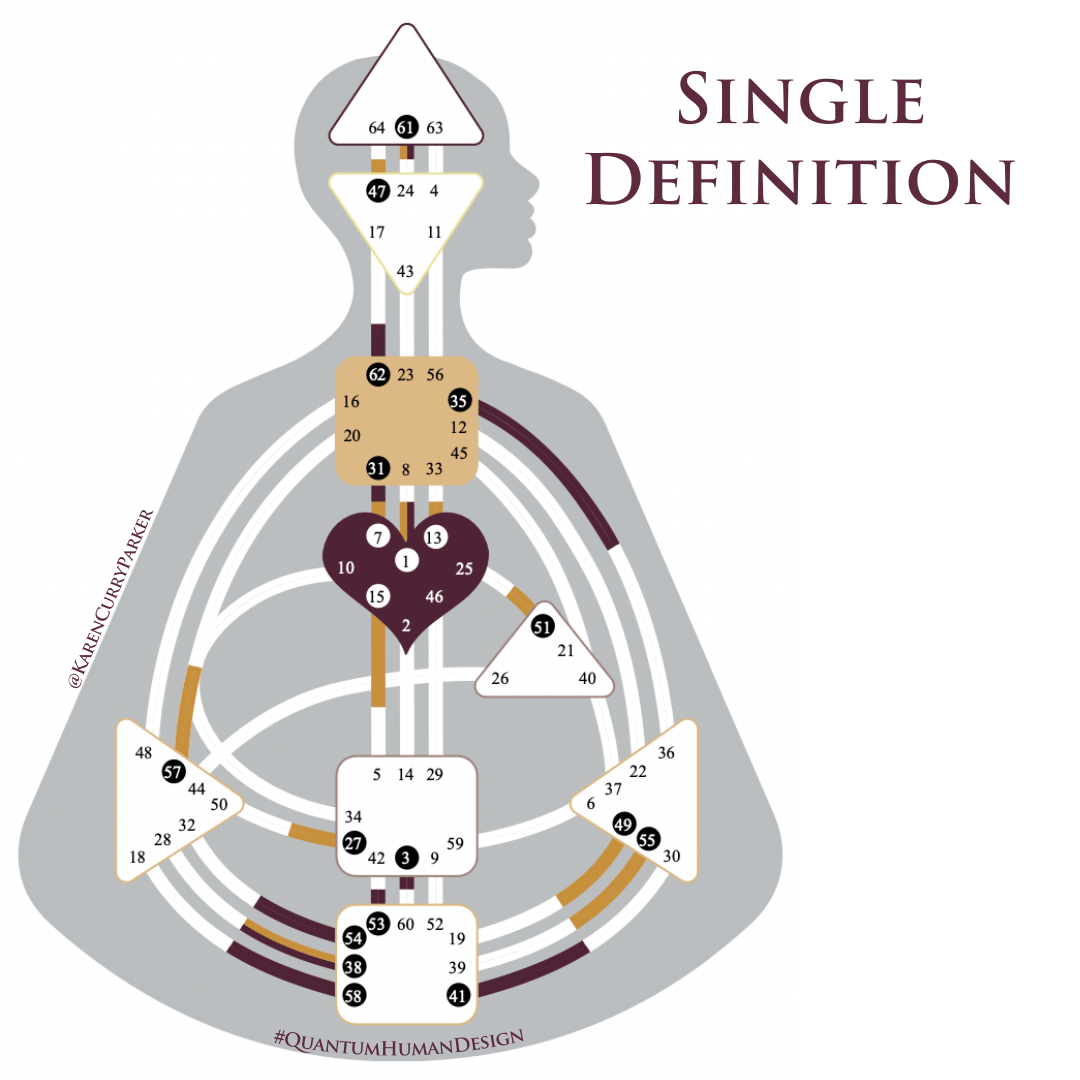
Example: Someone with Single Definition might have a clear sense of their energy and how it operates, with a more predictable internal experience.
See also: Definition, Split Definition
Solar Plexus Center (Emotional Solar Plexus)
The Solar Plexus Center is one of the nine energy Centers in Human Design, located in the middle of the Bodygraph. It’s associated with emotions and desires. When defined, it operates on an emotional wave, cycling through various emotional states. When undefined, it can be more open to others’ emotions but may also be more easily influenced by them.
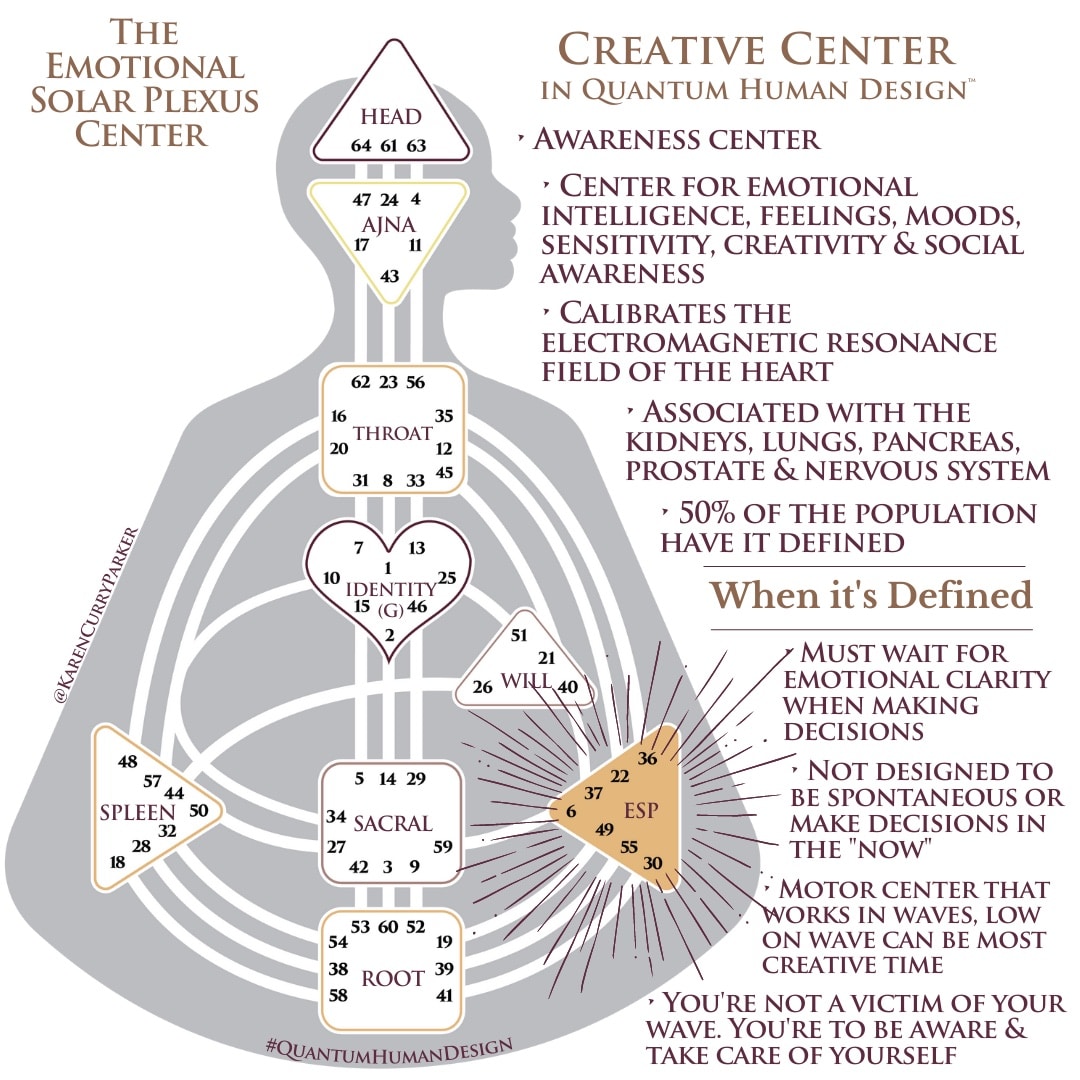
Example: Someone with a defined Solar Plexus Center might experience clear emotional cycles and benefit from waiting for emotional clarity before making decisions.
See also: Centers, Emotional Authority
Solar Return
In Human Design, the Solar Return refers to the annual return of the Sun to its exact position at the time of an individual’s birth, marking their birthday in the tropical zodiac. This event is considered a reset point for the year ahead, offering insights into the themes and potential experiences that may unfold in the coming year. The Solar Return chart in Human Design provides a unique energetic blueprint for the year, which can be used in conjunction with one’s original Human Design chart for deeper self-understanding and navigation.
Example: James celebrates his 35th birthday and decides to have a Human Design practitioner analyze his Solar Return chart. The analysis reveals that his G Center (identity and direction) is defined this year, indicating a time of potential self-discovery and shifts in his life direction. James uses this information to set intentions for the year, focusing on exploring new aspects of his identity and being open to changes in his career path.
Spleen/Splenic Center
The Splenic Center is one of the nine energy Centers in Human Design, located on the left side of the Bodygraph. It’s associated with intuition, well-being, and spontaneous decision-making. When defined, it provides consistent access to intuitive insights about health and safety. When undefined, it can be more open to various intuitive experiences but may also be more susceptible to fears.
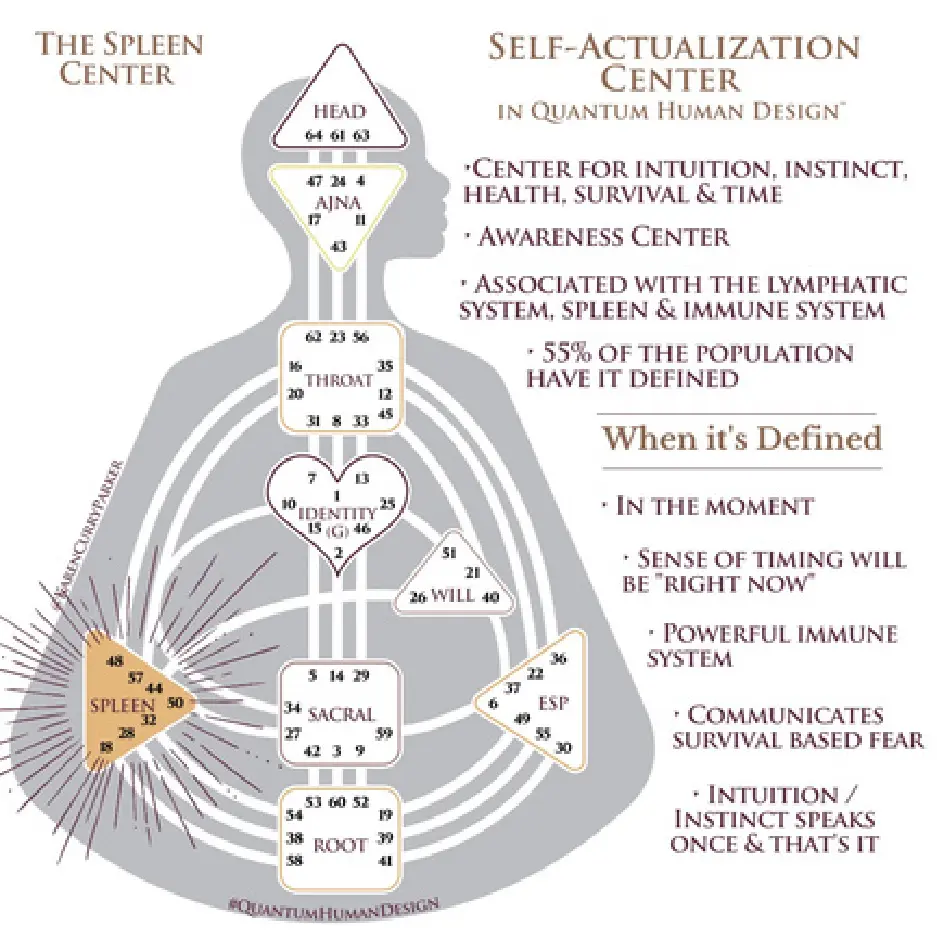
Example: Someone with a defined Splenic Center might have strong, spontaneous intuitions about whether a situation or person is safe or beneficial for them.
See also: Centers, Splenic Authority
Split Definition
In Human Design, Split Definition refers to a Bodygraph where there are two or more separate areas of definition, not connected by Channels. This indicates a more complex energy dynamic within the individual’s design, often resulting in a need to connect with others to “bridge” these separate areas.
Example: Someone with Split Definition might find they need to interact with others to fully access and integrate different aspects of their energy.
See also: Definition, Single Definition
Strategy
Strategy in Human Design refers to the specific approach each Type is designed to use for navigating life and making decisions. Following one’s Strategy helps align an individual with their true nature and leads to experiencing their Type’s Signature. The five Strategies are: Wait to Respond (Generator), Inform (Manifestor), Wait for Invitation (Projector), Wait a Lunar Cycle (Reflector), and Wait to Respond then Inform – (see articles for Generator and Manifestor as the Manifesting Generator has both strategies.
Example: A Projector’s Strategy of waiting for recognition and invitation helps them conserve energy and engage when their unique gifts are truly appreciated.
See also: Type, Authority, Signature
Strategy Alignment
Strategy Alignment in Human Design refers to the process of consistently living and making decisions in accordance with one’s specific Type Strategy. It involves consciously applying the recommended approach for one’s Human Design Type in daily life and decision-making processes. Strategy Alignment is believed to lead to reduced resistance, increased flow, and a more authentic expression of one’s true nature.
Example: Mark, a Manifesting Generator, practices Strategy Alignment by following his sacral response and informing others before taking action. When a new project opportunity arises at work, instead of immediately jumping in, he checks in with his gut feeling and then informs his team of his intention to participate. This alignment with his Strategy leads to smoother collaboration and a sense of energetic correctness in his decision.
Strategy by Type
Strategy by Type in Human Design refers to the specific approach each of the five Types (Manifestor, Generator, Manifesting Generator, Projector, and Reflector) should follow to align with their natural energy and make decisions in harmony with their design. It’s a fundamental concept that guides individuals on how to interact with the world and navigate life’s choices in a way that’s most authentic and effective for their unique configuration.
Each Type has a distinct Strategy that, when followed, is said to reduce resistance and increase flow in one’s life experiences. Following one’s Strategy is considered essential for living in alignment with one’s true nature in Human Design.
Example: Emily, a Projector, learns that her Strategy is to “wait for the invitation” before offering her guidance or taking on major life decisions. Instead of initiating projects or pushing her ideas onto others, she practices patience and focuses on developing her skills. When she receives a genuine invitation to join a leadership program at work, she feels recognized and valued, experiencing the ease and success that comes from following her Projector Strategy.
Success
In Human Design, Success is the signature emotion of the Projector Type when they are living in alignment with their Strategy and Authority. It represents a state of recognition and fulfillment that Projectors experience when they wait for and receive the right invitations before offering their insights or entering major life situations.
Example: A Projector who waits for recognition and invitation before taking on a leadership role might experience a deep sense of success and fulfillment in that position.
See also: Projector, Strategy, Signature
Surprise
In Human Design, Surprise is the signature emotion of the Reflector Type when they are living in alignment with their Strategy and Authority. It represents a state of wonder and delight that Reflectors experience when they allow themselves to fully reflect and amplify the energies around them, without getting stuck in any particular perspective.
Example: A Reflector who waits a full lunar cycle before making a major decision might be pleasantly surprised by the clarity and alignment they feel with their choice.
See also: Reflector, Strategy, Signature
Surrender
In Human Design, Surrender refers to the process of releasing resistance to one’s natural design and allowing oneself to flow with their authentic energy. It involves letting go of conditioned behaviors and societal expectations to fully embrace one’s unique Strategy and Authority. Surrender is seen as a key aspect of deconditioning and aligning with one’s true self.
Example: Lisa, a Reflector, practices Surrender by allowing herself the full 28-day lunar cycle to make important decisions, despite feeling pressured by others to decide quickly. She lets go of the need to conform to others’ timelines and trusts in her own process, resulting in clearer, more aligned choices and a deeper sense of self-trust.
Tantric Channels
Tantric Channels in Human Design refer to specific energy pathways in the bodygraph that are associated with spiritual or transformative experiences. These channels are believed to carry a unique frequency that can lead to profound personal growth, heightened awareness, and spiritual awakening when defined. Tantric Channels are often considered to have a mystical or transcendent quality, potentially facilitating experiences of unity or expanded consciousness.
The Tantric Channels are:
5/15 The Channel of Rhythm (Channel of Natural Order)
14/2 The Channel of the Beat (The Channel of Progress)
29/46 The Channel of Discovery (Channel of Dedication)
Example: John has the Channel of Rhythm (5-15) defined in his Human Design chart, which is considered a Tantric Channel. He finds that when he follows his strategy and authority, he often experiences moments of deep trust in life’s flow. These experiences lead to profound insights and a sense of spiritual connection, especially when he’s engaged in creative pursuits or intimate relationships.
Theme
Theme in Human Design refers to the dominant life focus or area of significance for an individual based on their specific energy type. It represents the primary way a person is designed to navigate and experience life, influencing their decision-making process and overall approach to situations. The Theme serves as a guiding principle that, when followed, is believed to lead to greater alignment and fulfillment in one’s life journey.
Example: For a Generator type in Human Design, the Theme is “To Respond.” This means that a Generator is designed to respond to life rather than initiate, waiting for things to come to them and then using their gut response to guide their decisions and actions.
Throat Center
The Throat Center is one of the nine energy Centers in Human Design, located in the neck area of the Bodygraph. It’s associated with communication, manifestation, and action. When defined, it provides consistent access to self-expression and the ability to manifest. When undefined, it can be more flexible in modes of expression but may also struggle with consistent self-expression.

Example: Someone with a defined Throat Center might have a natural ability to articulate their thoughts and manifest their ideas into reality.
See also: Centers, Manifestation
Trajectory
Trajectory in Human Design refers to the unique path or direction an individual is designed to follow in life based on their specific configuration. It represents the natural flow of energy and experiences that align with one’s innate characteristics and purpose. The Trajectory is believed to guide a person towards their most authentic and fulfilling life experiences when recognized and honored.
Example: A person with a 1/3 Profile in Human Design has a Trajectory of “The Investigator to the Martyr.” This suggests a life path that involves deep research and foundational work (1), coupled with experiential learning through trial and error (3), often leading to insights that can benefit others.
Transformation
Transformation in Human Design refers to the process of aligning oneself with one’s true nature and design, leading to significant personal growth and change. It involves shedding conditioned behaviors and thought patterns that don’t align with one’s authentic self, as revealed by their Human Design chart. The transformation process is often described as a journey of self-discovery and self-acceptance, resulting in a more fulfilling and aligned life experience.
Example: A Projector in Human Design might experience transformation by learning to wait for invitations rather than initiating, leading to less burnout and more recognition for their unique gifts. This shift in approach can dramatically change their interactions, energy levels, and overall life satisfaction.
Transit
In Human Design, Transits refer to the current positions of planets and how they activate Gates in an individual’s chart. Transits can influence day-to-day experiences and offer opportunities for growth and self-awareness. They are often used in Human Design to understand current energetic influences and potential areas of focus or challenge.
Example: A transit of the Sun through Gate 1 might bring a period of increased creativity and self-expression for everyone, but especially those with Gate 1 defined in their chart.
See also: Gates, Planets
Tribal Circuit
The Tribal Circuit is one of the main Circuits in Human Design, representing aspects of human consciousness related to support, loyalty, and resources. It includes Channels that connect the Spleen Center to the Sacral or Ego Center. People with strong Tribal Circuit definition often have a natural capacity for creating and maintaining supportive communities and managing resources.
Example: Someone with the 19-49 Channel (part of the Tribal Circuit) might have a talent for creating supportive environments and nurturing others.
See also: Circuits, Channels, Spleen Center
Trigram
Trigrams in Human Design are symbolic representations derived from the I Ching, consisting of three lines that can be either broken (yin) or solid (yang). They are fundamental components used to describe the energetic qualities and characteristics of various elements in a person’s Human Design chart. Trigrams are combined to form hexagrams, which provide deeper insights into an individual’s design and life experiences.
Example: The trigram for Heaven (☰) consists of three solid lines, representing pure yang energy, and is associated with creativity, strength, and leadership in Human Design. It might appear in a person’s Profile or in the gates of their chart, influencing how they express and experience these qualities in their life.
Triple Split
In Human Design, a Triple Split refers to a configuration in a person’s BodyGraph where the defined centers are separated into three distinct groups, with no channels connecting them. This split creates three separate areas of consistent energy, each isolated from the others. A Triple Split is considered a complex energy configuration that can present both unique challenges and opportunities for personal growth.
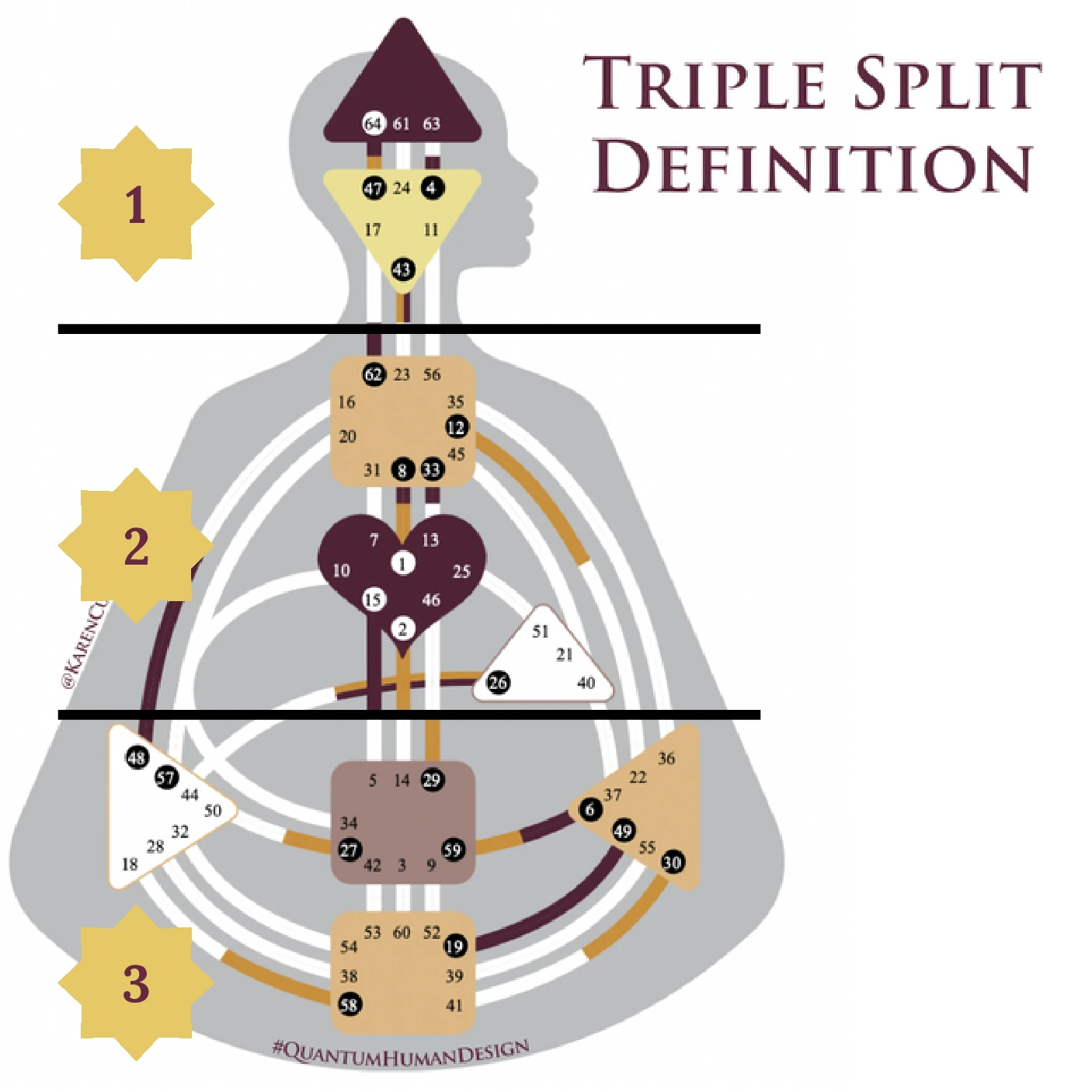
Example: Emily’s Human Design chart reveals a Triple Split, with defined centers clustered in three separate areas: Head/Ajna, Throat/Heart, and Sacral/Root. This configuration indicates that Emily may experience internal “dialogues” between these three aspects of her being, potentially leading to moments of indecision or feeling scattered. By recognizing this energy layout, Emily can develop strategies to bridge these separate aspects of herself, leading to more integrated decision-making and self-expression.
True Self
True Self in Human Design refers to an individual’s authentic nature and inherent characteristics as defined by their unique energetic blueprint. It represents the core essence of a person, free from societal conditioning, external pressures, and false beliefs about oneself. Embracing one’s True Self is considered a key aspect of living in alignment with one’s Human Design, leading to greater fulfillment and ease in life.
Example: A Manifestor in Human Design might discover their True Self by recognizing and honoring their natural ability to initiate and inform others, rather than trying to fit into societal expectations of waiting for permission or consensus before taking action.
Type (Aura Type)
Type in Human Design refers to one of the five fundamental energy Types: Generator, Manifestor, Projector, Reflector, and Manifesting Generator. Each Type has a specific Strategy for decision-making and navigating life. Understanding one’s Type is considered fundamental in Human Design for living in alignment with one’s true nature.
Example: A person identified as a Generator Type would be advised to wait to respond before making decisions or taking action.
See also: Strategy, Authority, Signature
Unconscious
In Human Design, the Unconscious refers to the aspects of one’s design determined by the position of the planets approximately 88 degrees before birth. This is also known as the Design Crystal. The Unconscious represents innate behaviors and traits that one may not be consciously aware of but that significantly influence how they interact with the world.
Example: Someone’s Unconscious might include a defined Spleen Center, giving them strong intuitive responses they may not always consciously recognize.
See also: Design Crystal, Personality
Undefined (Open)
In Human Design, Undefined refers to Centers in the Bodygraph that are not consistently energized (shown as white). Undefined Centers are more open and flexible, potentially amplifying and taking in energy from others. They represent areas where an individual can gain wisdom through experience but may also be more susceptible to conditioning.
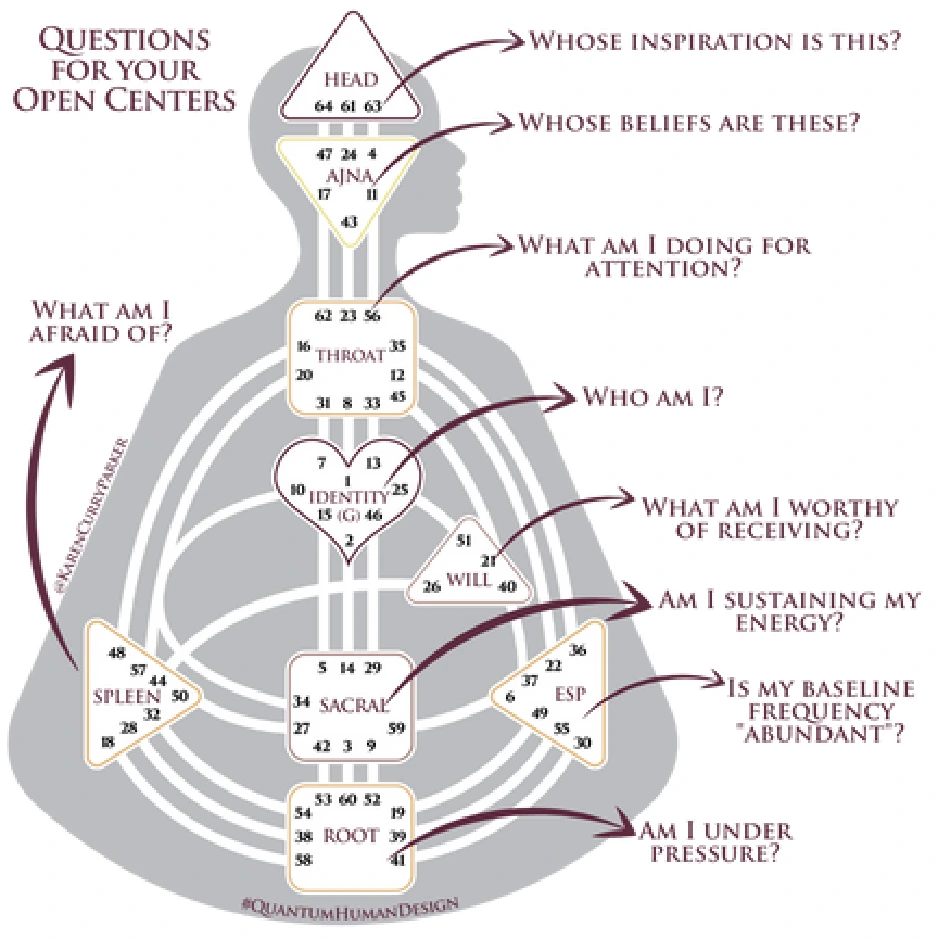
Example: Someone with an undefined Heart Center might be more flexible in their approach to willpower and material needs, but may also struggle with consistent self-worth.
See also: Centers, Open, Definition
Variables (Arrows)
Variables in Human Design are four specific aspects of a person’s design that add nuance and depth to their overall profile. These aspects are Environment, Perspective, Motivation, and Cognition, each with six possible variations that influence how an individual processes information and interacts with the world. Variables provide insight into a person’s optimal surroundings, decision-making process, driving forces, and learning style, further refining the understanding of their unique design beyond the basic elements like Type and Profile.
Example: A person with the Environment variable of “Caves” may find they work best and feel most at ease in small, enclosed spaces or intimate settings, rather than in open or crowded environments.
Voice
In Human Design, voice refers to the unique way an individual expresses themselves and communicates their truth to the world. It is determined by the Throat Center and its connections to other centers through defined channels in a person’s bodygraph. The Voice represents not just verbal communication, but also the overall energetic signature of how a person projects their essence and interacts with others.
Example: Someone with a defined channel connecting the Will Center to the Throat Center might have a Voice that naturally expresses personal truth and identity, often speaking from a place of “I am” statements and embodying a strong sense of self in their communication.
The Voice also refers to the medium of communication through which Ra Uru Hu received the information in 1987 that led to the creation of the Human Design System.
Yin/Yang
In Human Design, Yin/Yang refers to a specific Variable within the Cognition category, describing how an individual processes and applies information. The Yin aspect represents a more receptive, introspective, and detail-oriented approach to cognition, while the Yang aspect embodies a more active, expressive, and big-picture oriented cognitive style. An individual’s placement on the Yin/Yang spectrum influences their learning style, problem-solving approach, and how they interact with information in their environment.
Example: A person with a strong Yin cognition might excel at deep, focused research and analysis, preferring to thoroughly understand all details before taking action, while someone with a strong Yang cognition might be quick to grasp overall concepts and eager to implement ideas, even if all the details aren’t yet clear.
To research other terms:
Has the Human Design Glossary Inspired You to Explore Your Human Design More Deeply?
To find out what your Human Design is, why not download your FREE Human Design chart
Remember that we all have ALL of the chart. If the Gate is colored in or defined, it’s part of your Soul Curriculum. If it’s white or undefined, it means you learn about this Gate through relationships with others or through the Transits.
At its core, Human Design is a unique system that offers profound insights into your inner self and how you interact with the world around you. Your Human Design chart is a valuable tool that can help you understand your true nature, discover your strengths and weaknesses, and unlock your full potential.
By downloading and reviewing your unique Human Design Chart you are embarking on a journey of self-discovery that will empower you to make conscious choices in all aspects of your life. Your chart is an Energy Blueprint of your unique energy configuration and contains valuable information about your personality traits, your natural talents, and your life purpose. With this knowledge, you’ll navigate life’s challenges with greater ease and clarity.
Human Design is a deeply empowering system that encourages us to embrace our true selves, rewrite our personal narrative, and live in alignment with our inner wisdom. When we align with our authentic nature, we tap into a wellspring of creativity, joy, and fulfillment that flows effortlessly through us.
There’s More – How To Learn More About Human Design
If you are trying to learn and apply Human Design to your life circumstances, but traditional Human Design rings a little off-key, you don’t quite connect with it, or it feels heavy as you read it. We invite you to explore training options with Quantum Human Design, internationally respected and time-tested training courses.
These courses will empower you to create a life filled with more money, better relationships, health and vitality, a rewarding career, and experience profound personal transformation.
Explore the life-changing options in our Quantum Human Design School
Curious about the difference between Human Design and Quantum Human Design? Karen Curry Parker explains it in this video: