The Human Design System is simple to understand overall, but it is much more powerful when you understand the precise definitions of terms associated with it. We decided to help you with that by creating this Human Design Glossary of Terms.
88 Degrees of the Sun
The 88 Degrees of the Sun in Human Design creates what is known as the ‘unconscious design or life purpose’. As one degree of the sun is one day, your ‘unconscious design’ is calculated 88 days prior to your birth date and time. These parts of your personality are consistent but unconscious meaning that you don’t have much control over those parts of your personality.
Often as we age and mature, we become more aware of these unconscious elements and can exercise more control over them to benefit our lives.
Example: Sophie was not aware of her unconscious Gate 51 – The Gate of Shock. She would intuitively say things that sometimes resulted in disruption and unintended consequences. This made her not express her knowing for fear of what would happen.
When she recognized this she saw that she was able to navigate change and transformation more easily and to help others do the same. She remained connected to her intuition and Source in the process.
See also: Hexagrams, Gates
Alignment
Alignment in Human Design refers to the state of living in accordance with one’s unique design, following their Strategy and Authority. When aligned, an individual experiences less resistance in life, makes decisions that are correct for them, and feels a sense of ease and fulfillment. Alignment is considered a key aspect of living one’s Human Design authentically.
Example: A Generator who waits to respond before making decisions is living in alignment with their design.
See also: Strategy, Authority
Ajna Center (Divine Translator Center)
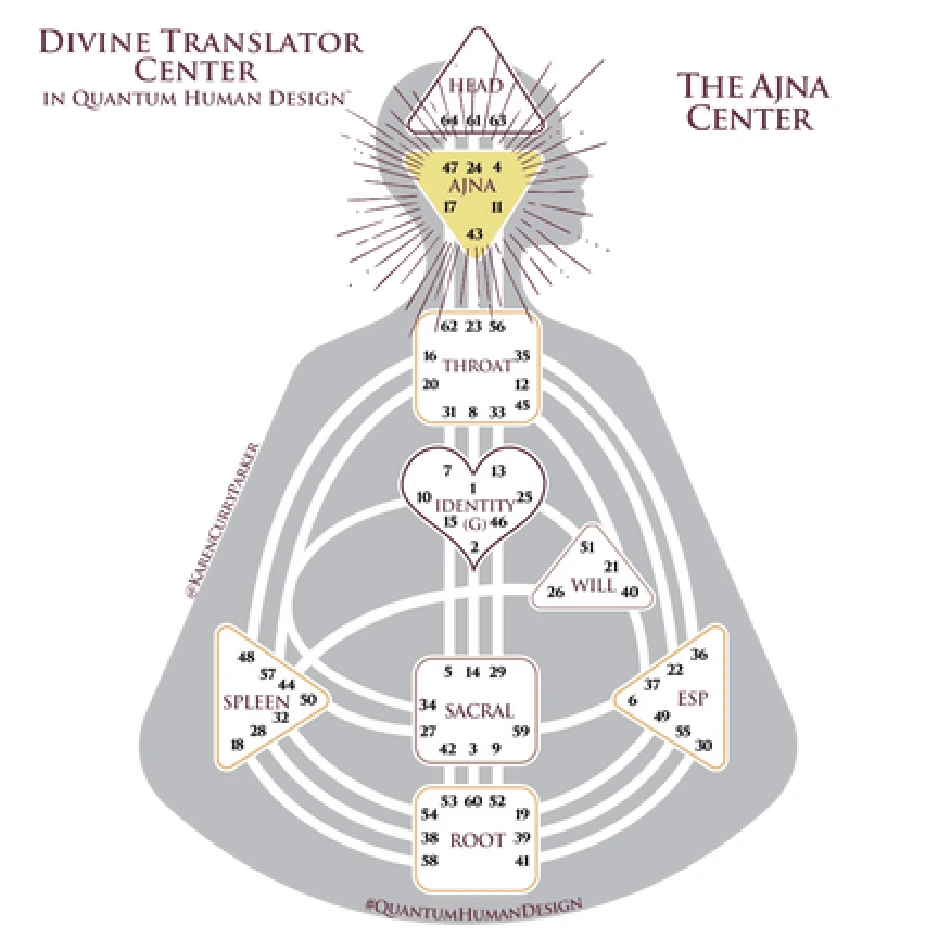
The Ajna Center is one of the nine energy centers in Human Design, located in the head area and represented by a triangle shape. It is associated with mental conceptualization, beliefs, and certainty. The Ajna Center processes information and formulates ideas, playing a crucial role in how we think and express our thoughts.
Example: Someone with a defined Ajna Center might have fixed ways of thinking and a strong sense of mental certainty about their ideas.
See also: Head Center, Mental Pressure
Astrology
In Human Design, astrology plays a crucial role but is used in a unique way compared to traditional astrology. It incorporates the positions of celestial bodies at the time of birth and 88 degrees prior to birth to create the Bodygraph.
Example: In a Human Design chart, the position of Mars at birth might activate certain Gates and Channels, influencing the individual’s energy dynamics.
See also: Bodygraph, Gates, Channels
Aura
The Aura in Human Design refers to the electromagnetic field surrounding each person, which is shaped by their unique energy configuration. It determines how an individual interacts with the world and others around them. The Aura is directly related to one’s Type and plays a crucial role in following one’s Strategy for decision-making and life navigation.
Example: A Projector’s Aura is absorbing and focused, designed to recognize and guide others when invited.
See also: Type, Strategy
Authentic Self
In Human Design, the Authentic Self refers to living and operating in alignment with one’s unique energetic design. It involves following one’s Strategy and Authority, honoring one’s Type, and making decisions that resonate with one’s true nature. Living as one’s Authentic Self is believed to lead to less resistance and more fulfillment in life.
Example: A Generator living as their Authentic Self would wait to respond before taking action, leading to a sense of satisfaction and alignment.
See also: Strategy, Authority, Type
Authority
Authority in Human Design refers to the internal decision-making system unique to each individual. It is the most reliable way for a person to make correct decisions according to their design. There are several types of Authority, including Emotional, Sacral, Splenic, Ego, and Self-Projected, each corresponding to different energy centers in the Bodygraph.
Example: Someone with Emotional Authority would benefit from waiting out their emotional wave before making important decisions.
See also: Strategy, Type, Centers
Bitterness
Bitterness in Human Design is often associated with the not-self theme of the Projector Type. It can arise when Projectors don’t honor their Strategy of waiting for the invitation or recognition before offering their insights and guidance. This emotion signals that a Projector may be out of alignment with their authentic nature.
Example: A Projector who consistently gives unsolicited advice and feels unappreciated might experience bitterness.
See also: Projector, Not-Self Theme, Strategy
Blueprint
In Human Design, the term Blueprint refers to the unique energetic design of an individual as represented in their Bodygraph. It encompasses all aspects of a person’s Human Design, including their Type, Strategy, Authority, Profile, and defined centers and channels. The Blueprint serves as a guide for understanding one’s innate characteristics and optimal way of navigating life.
Example: A person’s Blueprint might reveal they are a Manifestor with Emotional Authority and a 4/6 Profile, providing insights into their decision-making process and life trajectory.
See also: Bodygraph, Type, Strategy, Authority
Body Graph ( May also be referred to as blueprint, bodygraph chart, or chart)
A Bodygraph chart in Human Design is a visual representation of an individual’s unique energetic makeup, based on their birth time and location. It displays nine energy centers, 64 gates, and 36 channels, showing which areas are defined (consistently energized) or undefined (open to external influences). The bodygraph serves as a personal blueprint, revealing innate traits, decision-making strategies, and potential life themes.
Example: In a Bodygraph, a person might have the Heart Center colored in burgundy/red*, indicating it’s defined and consistently operates in a specific way for them.
(*depending on which software you use.)
See also: Centers, Gates, Channels, Definition
Center
Centers are the nine fundamental energy hubs in the Bodygraph, each representing different aspects of human nature and function. These Centers can be defined (colored in) or undefined (white), influencing how consistently and reliably one experiences and expresses that particular energy. The interaction between defined and undefined Centers forms the basis of an individual’s unique Human Design.
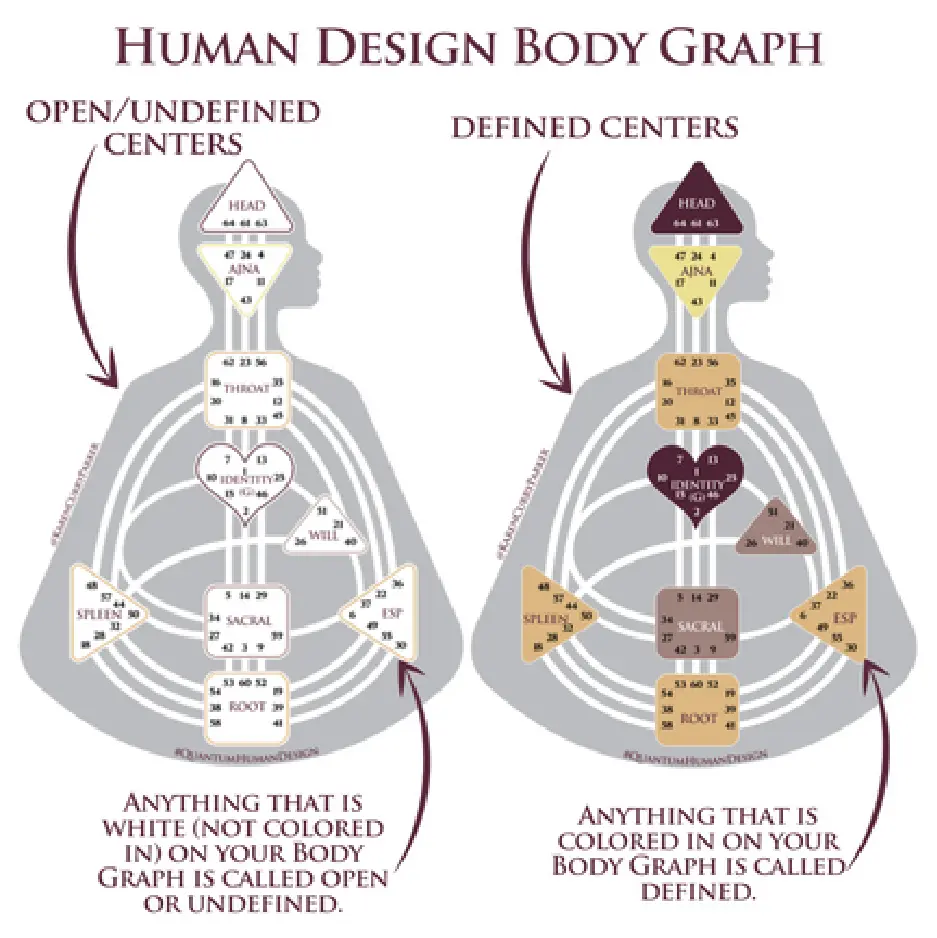
Example: The Root Center, when open or undefined, provides a consistent source of adrenaline and pressure to get things done.
See also: Bodygraph, Definition, Open Centers
Chakras
Chakras are integrated into the system as part of the nine energy Centers in the Bodygraph. While not exactly equivalent to the traditional seven chakras, the Human Design Centers incorporate aspects of chakra energy. The Centers represent different aspects of human consciousness and energy, similar to how chakras are understood in other spiritual systems.
Example: The Sacral Center in Human Design corresponds roughly to the Sacral Chakra in traditional systems, dealing with life force energy and creativity.
See also: Centers, Bodygraph
Channel
A Channel in Human Design is formed when two connected Gates are both defined, creating a consistent energy flow between two Centers. There are 36 Channels in total, each representing a specific life theme or way of operating. Defined Channels contribute to an individual’s fixed characteristics and reliable ways of functioning in the world.
Example: The Channel of Initiation (Gate 1 to Gate 8) connects the Indentity Center (Heart) and Throat Center. The 1-8 Channel asks us to learn that expressing our Authentic Self is the fulfillment of our life purpose.
See also: Gates, Centers, Definition
Circuits
There are three main Circuits: Individual, Tribal, and Collective. Each group represents a different aspect of human consciousness and how energy moves through society. Understanding Circuit Groups helps in comprehending the broader themes and purposes of specific Channels.
Example: The Knowing Circuit, part of the Individual Circuit Group, deals with intuition and empowerment.
See also: Channels, Individual Circuit, Tribal Circuit, Collective Circuit
Clarity
Clarity in Human Design often refers to the state of emotional clarity experienced by those with Emotional Authority. It’s the point in the emotional wave where one feels most clear and balanced, typically occurring after moving through various emotional states. Making decisions from a place of emotional clarity is considered optimal for those with Emotional Authority.
Example: Someone with Emotional Authority might wait for emotional clarity before deciding on a job offer, rather than making a choice when feeling extremely excited or doubtful.
See also: Emotional Authority, Solar Plexus Center
Collective Circuit
The Collective Circuit in Human Design is one of the main Circuits representing the aspect of human consciousness that deals with patterns, sharing, and community. It includes the Logic (Pattern) Circuit and the Sensing (Miracle) Circuit.
The Collective Circuit is about gathering and distributing information for the benefit of the collective, often manifesting as a desire to understand and improve societal structures.
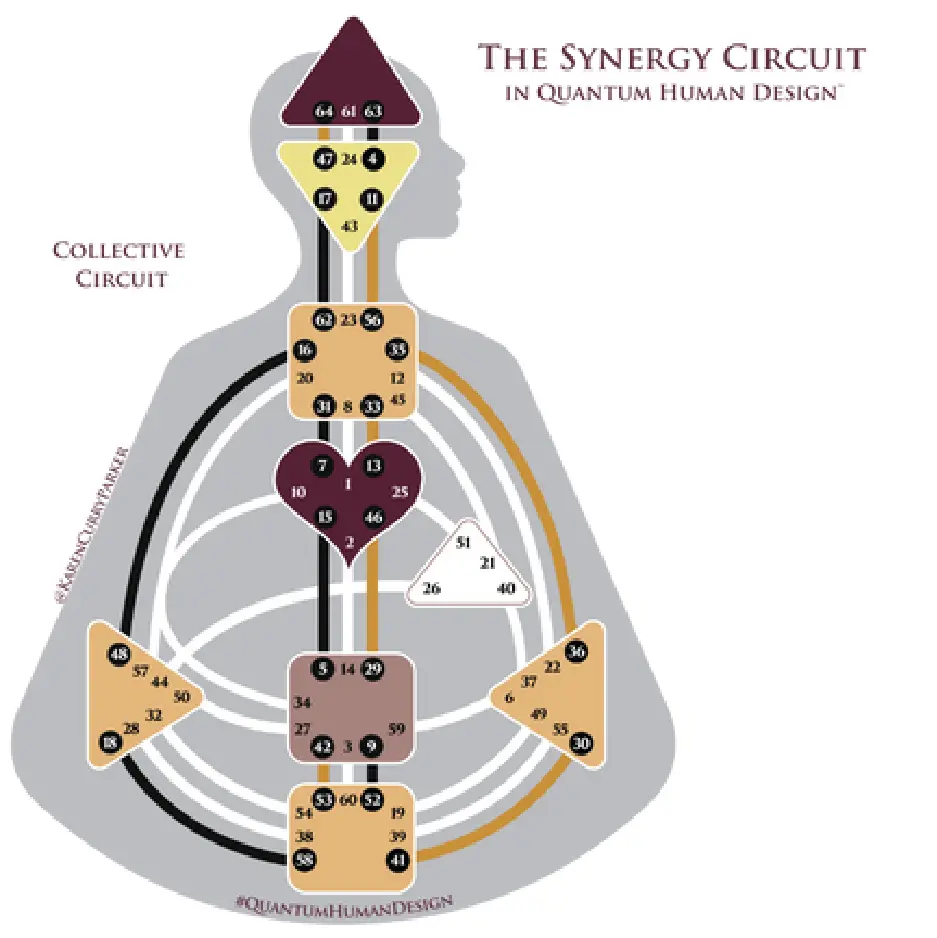
Example: Someone with many defined Channels in the Collective Circuit might feel a strong drive to share knowledge and work towards societal progress.
See also: Circuits
Composite Chart
A Composite Chart is created by combining the Bodygraphs of two individuals to analyze their collective energy dynamics. This chart reveals how the individuals interact energetically and can provide insights into relationship dynamics between two people. This can be used to look at friendships, family connections, or work colleagues. The Composite Chart shows which Centers, Gates, and Channels are defined when the individuals come together.
Example: A Composite Chart of two partners might show a newly defined Channel that neither has individually, indicating a unique energy they create together.
See also: Bodygraph, Channels, Gates
Conception
Conception refers to the moment of conception, calculated as approximately 88 degrees of the Sun’s movement (about 88 days) before birth. This point is significant because it determines the Personality Crystal, one of the two main components of an individual’s design. The conception point influences the conscious aspects of one’s personality and decision-making.
Example: If someone’s birth date is January 1st, their conception date in Human Design would be around October 5th of the previous year.
See also: Design Crystal, Personality Crystal
Conditioning (May also be called social conditioning or socialization)
Conditioning in Human Design refers to the influence of external energies on an individual, particularly through their open (white) Centers. Open Centers are vulnerable to taking in and amplifying the energy of others, which can lead to behaving in ways that are not authentic to one’s true self. Recognizing and working with conditioning is a key aspect of Human Design self-discovery.
Example: Someone with an open Emotional Solar Plexus Center might easily absorb and amplify the emotions of others, mistaking these feelings for their own.
See also: Open Centers, Not-Self Theme
Conscious
Conscious typically refers to the aspects of one’s design determined by the Personality Crystal, which is based on the birth time. These are the traits and energies that one is generally aware of and identifies with consciously. The conscious aspects are represented by the burgundy or black markings on the Bodygraph and contribute to how an individual perceives themselves and interact with the world.
Example: A consciously defined Throat Center might manifest as an awareness of one’s communication style and expression.
See also: Personality Crystal, Design Crystal, Bodygraph
Decision Making
Decision-making is intrinsically linked to one’s Inner Authority. It’s the process by which an individual makes choices aligned with their authentic self. Human Design posits that each person has a specific way of making correct decisions based on their Type, Strategy, and Authority. Following this inner guidance system is believed to lead to more fulfilling and aligned life experiences.
Example: Someone with Sacral Authority would make decisions by paying attention to their gut response of “uh-huh” (yes) or “uh-uh” (no) to opportunities.
See also: Authority, Strategy, Type
Deconditioning
Deconditioning refers to the process of releasing conditioned behaviors and thoughts that are not authentic to one’s true self. It involves becoming aware of how open Centers have been influenced by external energies and learning to use these Centers in a way that aligns with one’s unique design. Deconditioning is a crucial part of living according to one’s Human Design.
Example: A Projector with an open Root Center might decondition from the belief that they need to be constantly busy to be valuable.
See also: Conditioning, Open Centers
Definition/Defined
Definition refers to the consistent energy in a person’s chart, represented by colored-in Centers and the Channels connecting them. Defined areas indicate where an individual has reliable and consistent ways of operating. These defined aspects form the foundation of one’s unique energetic imprint and contribute to their Type and Authority.
Example: A defined Sacral Center indicates a consistent access to life force energy and the capacity for sustained work.
See also: Centers, Channels, Open
Design
Design (or Life Purpose – depending on what software you use) refers to the unconscious aspects of a person’s energetic makeup. Design represents innate behaviors and traits that one may not be consciously aware of but that significantly influence how they interact with the world.
Example: Someone’s Design might include a defined Spleen Center, giving them strong intuitive responses they may not always consciously recognize.
See also: Personality, Design Crystal
Design Crystal
The Design Crystal in Human Design represents your father’s Soul Energy that gets called forth around eight hours before conception. The Design Crystal is a crystalline code of information that resides within the Earth. This code engineers all the parts of the story that makes up your physical body, genetic programming, and your life purpose. The Design Crystal resides in the Ajna Center.
Example: The Design Crystal might activate certain Gates that create a Channel the person isn’t consciously aware of but that influences their natural behavior.
See also: Personality Crystal, Conception
Design Reading
A Design Reading is a session where a Quantum Human Design Specialist interprets an individual’s Bodygraph, explaining their Type, Strategy, Authority, Profile, and other key aspects of their energetic design. This reading provides insights into how one can live in alignment with their true nature and make decisions that are correct for them.
Example: During a Design Reading, a person might learn they are a Projector with Emotional Authority, helping them understand why waiting for invitations and emotional clarity leads to better outcomes in their life.
See also: Bodygraph, Type, Strategy, Authority
Disappointment
In Human Design, disappointment is often associated with the not-self theme of the Reflector Type. Disappointment can arise when Reflectors don’t honor their Strategy of waiting a full lunar cycle before taking action. Disappointment signals that the Reflector may be out of alignment with their authentic nature.
Example: A Reflector who consistently makes decisions without waiting for the lunar cycle might experience a sense of disappointment or feeling unfulfilled.
See also: Reflector, Authority, Not-Self Theme, Strategy
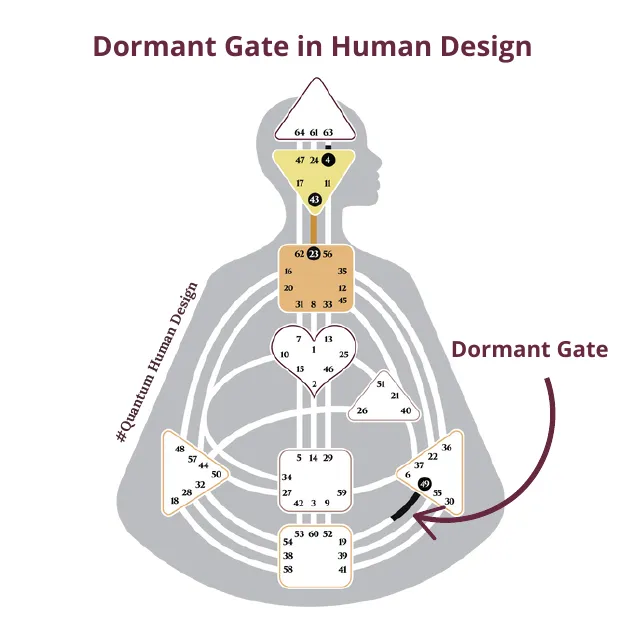
Dormant Gate
A dormant gate in Human Design refers to a defined gate that hangs off an undefined Center. It is the energetic potential within a person’s chart that is present but not consistently defined.
These gates represent latent abilities or traits that may become expressed under certain circumstances or through conscious development. Dormant gates can be thought of as untapped resources that, when defined, can contribute to a person’s growth and self-expression.
The dormant gates can be activated temporarily by being with someone whose Human Design defines that Center or a transit defines that Center for you. Then you’ll be aware of it until that energy goes away ie the person leaves or the transit ends.
Example: Someone with a dormant Gate 11 (Ideas) might have periods of exceptional clarity and innovative thinking when this gate is temporarily defined, even though it’s not a consistent part of their energetic makeup.
Has This Human Design Glossary Inspired You to Explore Your Human Design More Deeply?
To find out what your Human Design is, why not download your FREE Human Design chart
Remember that we all have ALL of the chart. If the Gate is colored in or defined, it’s part of your Soul Curriculum. If it’s white or undefined, it means you learn about this Gate through relationships with others or through the Transits.
At its core, Human Design is a unique system that offers profound insights into your inner self and how you interact with the world around you. Your Human Design chart is a valuable tool that can help you understand your true nature, discover your strengths and weaknesses, and unlock your full potential.
By downloading and reviewing your unique Human Design Chart you are embarking on a journey of self-discovery that will empower you to make conscious choices in all aspects of your life. Your chart is an Energy Blueprint of your unique energy configuration and contains valuable information about your personality traits, your natural talents, and your life purpose. With this knowledge, you’ll navigate life’s challenges with greater ease and clarity.
Human Design is a deeply empowering system that encourages us to embrace our true selves, rewrite our personal narrative, and live in alignment with our inner wisdom. When we align with our authentic nature, we tap into a wellspring of creativity, joy, and fulfillment that flows effortlessly through us.
There’s More – How To Learn More About Human Design
If you are trying to learn and apply Human Design to your life circumstances, but traditional Human Design rings a little off-key, you don’t quite connect with it, or it feels heavy as you read it. We invite you to explore training options with Quantum Human Design, internationally respected and time-tested training courses.
These courses will empower you to create a life filled with more money, better relationships, health and vitality, a rewarding career, and experience profound personal transformation.
Explore the life-changing options in our Quantum Human Design School
Curious about the difference between Human Design and Quantum Human Design? Karen Curry Parker explains it in this video: